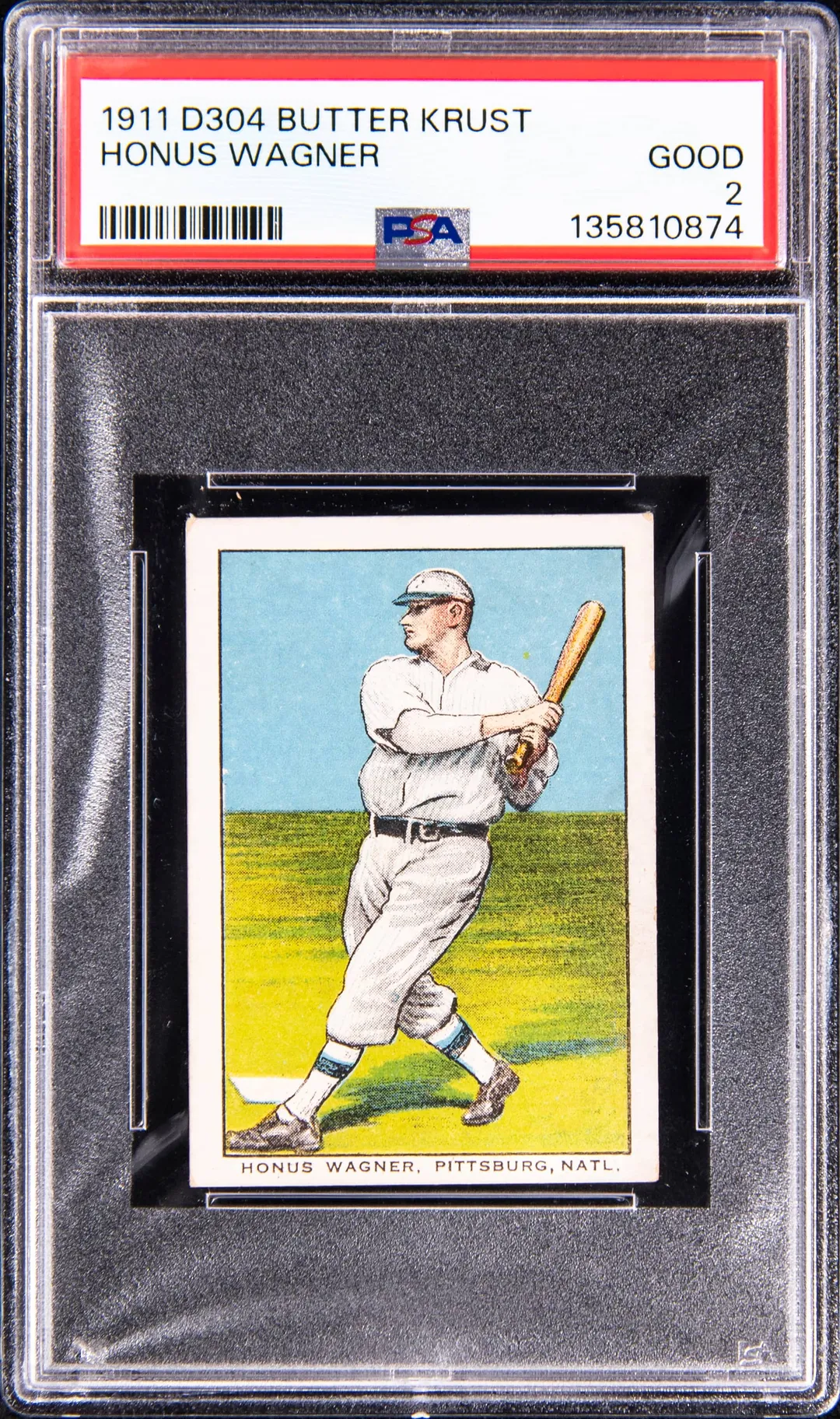
1911 D304 Butter Krust Honus Wagner PSA 2 Sale
Breakdown of the 1911 D304 Butter Krust Honus Wagner PSA 2 that sold for $80,520 at Goldin on 2/22/26, including rarity, pop data, and market context.
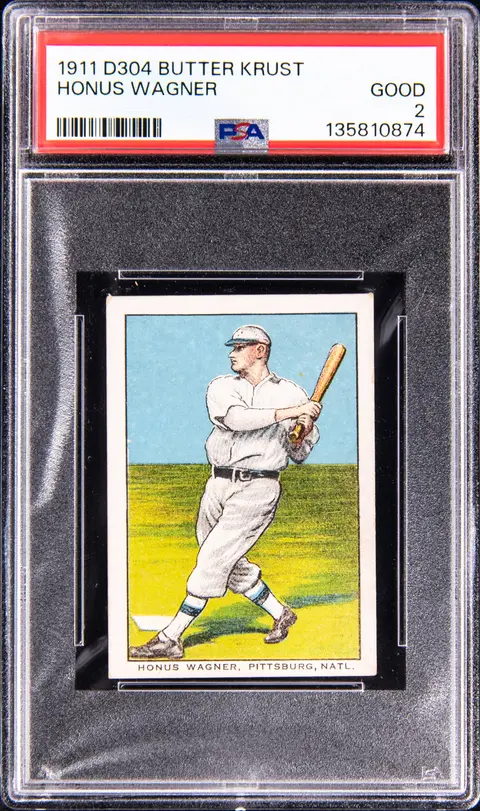
Sold Card
1911 D304 Butter Krust Honus Wagner - PSA GD 2 - Pop 1, with 1 Higher - The 2nd Rarest Back of Only 31 PSA-Graded D304 Wagners (Scarcer Than T206)
Sale Price
Platform
Goldin1911 D304 Butter Krust Honus Wagner PSA 2 Sells for $80,520: Why This Back Matters
On February 22, 2026, Goldin closed a sale that quietly mattered a lot to advanced prewar collectors: a 1911 D304 Butter Krust Honus Wagner graded PSA GD 2 sold for $80,520.
For most modern-focused collectors, D304 cards sit in the shadow of T206. But for hobby historians, this Wagner is one of the key bakery issues of the deadball era – and this specific Butter Krust back takes the card into truly rare air.
In this breakdown, we’ll look at what the card is, why the Butter Krust back is such a big deal, and how this $80,520 sale fits into the wider market for Honus Wagner and prewar type cards.
Card Snapshot
- Player: Honus Wagner (Pittsburgh Pirates)
- Team: Pittsburgh Pirates
- Year: 1911 (D304 issue window often cited as 1911–1914)
- Set: D304 Bakery Cards (Butter Krust advertising back)
- Designation: Honus Wagner (key Hall of Famer, not a rookie, but a cornerstone prewar card)
- Grading Company: PSA
- Grade: PSA GD 2 (Good)
- Population Notes:
- Pop 1 in PSA 2 with a Butter Krust back
- Only 1 higher in the PSA pop report for this back
- Only 31 total PSA-graded D304 Wagners across all backs
- Butter Krust identified as the second rarest back for the Wagner in this issue
- Auction House: Goldin
- Sale Date (UTC): 2/22/26
- Sale Price: $80,520
This is not a rookie card in the modern sense – Wagner’s first cards date to the late 1890s and early 1900s – but it is a prime-era Hall of Fame issue from an extremely scarce regional set.
What Is the 1911 D304 Set?
D304 cards are often called “bakery cards.” They were issued by multiple bread and bakery brands in the early 1910s. Each brand advertised on the card back, creating distinct “back varieties,” similar in concept to the different advertising backs on T206.
Common D304 backs include:
- Martens Bakery
- Brunners Bread
- Weber Bakery
Less common, and in some cases genuinely scarce, include:
- Butter Krust
- Other regional bakery marks that appear very infrequently
Compared with T206 – which was widely distributed in tobacco packs – D304 cards were regional food premiums. Surviving examples are fewer, and high-grade copies are even harder to find. Even at low grades, demand is anchored by low supply and strong interest from type collectors (collectors who target one example from each important early set).
Why the Butter Krust Back Matters
The headline detail on this card is not just the grade; it’s the back.
According to the PSA population report and hobby census work compiled by advanced collectors, this Butter Krust Wagner:
- Comes from the second rarest back among D304 Wagners.
- Is part of a very small group of known Butter Krust Wagners in any grade.
- Sits within a total of only 31 PSA-graded D304 Wagners (all backs combined).
The seller notes that the Butter Krust back is scarcer than the famous T206 Honus Wagner when you focus purely on confirmed graded examples.
For context:
- The T206 Wagner is iconic and more widely known, but it has been tracked and graded for decades; the total number of copies, while small, is relatively well mapped.
- The D304 Wagner with Butter Krust back has significantly fewer graded examples, and examples surface much less frequently at major public auction.
In other words, among prewar Honus Wagner issues, this card sits in an unusually thin supply channel.
Grading and Condition: PSA GD 2 (Pop 1, 1 Higher)
Most surviving bakery cards show handling wear, staining, and centering issues – they were food premiums, not items originally meant for long-term archival storage.
This example:
- Is graded PSA 2 (Good) – a typical grade band where many prewar food and candy issues cluster.
- Holds Pop 1 status at this grade for Butter Krust, with only one example in a higher grade according to PSA.
For prewar specialists, the grade-to-population relationship is as important as the number itself. A PSA 2 on a card that shows up dozens of times a year is one thing; a PSA 2 on a card with this kind of back scarcity, where there are only 31 total D304 Wagners graded across all backs, is something else entirely.
Market Context and Recent Sales
Because D304 Butter Krust Wagners appear so infrequently, “comps” – shorthand for recent comparable sales used to gauge market value – are limited. That lack of data is itself part of the story.
Based on recent public auction history across major houses for D304 Wagner cards more broadly (not restricted to Butter Krust), we can make a few grounded observations:
Any D304 Wagner is significant. Even the more common bakery backs often command strong prices at low to mid grades due to scarcity and demand from both Wagner and prewar type collectors.
Back rarity drives large price spreads. Just as rare T206 backs (e.g., Drum, Uzit, Lenox) sell at a premium over Piedmont or Sweet Caporal, rare D304 backs command significant premiums.
This $80,520 result is toward the strong end of the spectrum. When we set it against recent sales for comparable-grade, non-Butter-Krust D304 Wagners, the premium makes sense once you factor in:
- Butter Krust’s position as the second rarest back.
- Pop 1 status with only one higher.
- Very limited auction history when filtered to this exact back.
In other words, the sale is not a random spike with no context; it lines up with how the market has been treating rare-back prewar Wagners.
Because there are so few public Butter Krust Wagner sales to chart, it’s hard to define a linear “price trend.” Instead, each appearance becomes a reference point. This Goldin sale on 2/22/26 now stands as a key modern benchmark.
How This Compares to T206 Wagner and Other Wagner Issues
The T206 Honus Wagner is often called “the Mona Lisa of cards.” But serious Wagner collectors know that the T206 is only part of the story.
T206 vs. D304 Butter Krust Wagner:
- Awareness: T206 Wagner is vastly more famous.
- Population: T206 Wagner has more known, graded copies than the D304 Butter Krust back.
- Distribution history: T206 was a national tobacco set; D304 Butter Krust was a regional bakery issue.
Measured by public visibility and cultural impact, the T206 will likely always dominate. Measured by raw back scarcity and how infrequently it appears at auction, this D304 Butter Krust Wagner can be considered more elusive.
For prewar specialists, that difference matters. The Goldin result reflects pricing behavior seen with other ultra-scarce Wagner issues: when a confirmed, graded example surfaces, especially with strong eye appeal for the grade, bidders treat it as a rare opportunity rather than a routine comp.
Why Collectors Care About D304 and This Wagner Specifically
A few key reasons this card resonates in the hobby:
Honus Wagner as a cornerstone Hall of Famer
Wagner is one of the defining stars of the deadball era. Collectors often build entire prewar collections around key Wagner issues.Prewar regional issue with real scarcity
D304s are not mass-distribution tobacco cards. They fit into a smaller ecosystem of early 20th-century food and bakery releases, which tend to survive in much lower numbers.Back-variation collecting
Many advanced collectors chase one example of each back within a set. In D304, the Butter Krust back sits close to the top of the difficulty ladder. For set-builders, this is a major obstacle piece.Population profile
Only 31 PSA-graded D304 Wagners in total is a small universe. With this specific Butter Krust copy being Pop 1 with just one higher, it checks a lot of boxes for collectors seeking “best available” examples in a realistic grade range.Era preference
In vintage and prewar, scarcity and historical context often matter more than surface-level condition alone. A PSA 2 on a 1911 regional issue can still be a centerpiece card.
Reading the $80,520 Price in Context
It’s important not to treat any one sale as a prediction. Instead, think of this Goldin auction as a data point in a thin but meaningful series.
Here’s a grounded way to interpret the result:
Strength relative to more common backs: The Butter Krust premium appears intact. For an advanced buyer, the combination of back scarcity, pop data, and brand recognition justified a significant bid level.
Confirmation of demand for prewar type and back rarities: Across several recent auction cycles, we’ve seen consistent interest in truly rare backs and regional issues, even while some modern segments have cooled or stabilized.
Useful reference, not a universal benchmark: Because each D304 Wagner can vary in back type, eye appeal, and provenance, this $80,520 sale should be used as a reference point for Butter Krust examples, not a blanket valuation for every D304 Wagner.
Takeaways for Collectors and Small Sellers
For collectors newer to prewar:
- Know the set: Understanding what D304 is – a bakery issue with multiple backs – is crucial before you compare it to T206 or to modern flagship sets.
- Learn the backs: Just as in T206, the advertising back can change the entire price picture. A casual glance at the front isn’t enough.
- Look at population, not just grade: A PSA 2 on a card with 200 graded copies is very different from a PSA 2 on a card where the entire population is under 40.
For small sellers:
- Backs can be leverage: If you’re listing prewar cards, photograph and describe backs carefully. Back variety can be the main driver of interest.
- Use public sales as anchors, not promises: Sales like this Goldin result on 2/22/26 are helpful for pricing expectations, but they’re not guarantees. Condition, timing, and audience all matter.
Final Thoughts
The 1911 D304 Butter Krust Honus Wagner PSA 2 that sold for $80,520 at Goldin on 2/22/26 is more than just another high-end Wagner.
It’s a reminder that within the prewar landscape, some of the most historically interesting and truly scarce pieces are still the regional, food, and bakery issues – and that a rare back can transform a Hall of Fame card into a centerpiece of advanced collections.
As more collectors move beyond the best-known names like T206 and explore sets like D304 in detail, sales like this provide a clearer, data-backed picture of how the hobby values genuine scarcity, even in lower technical grades.