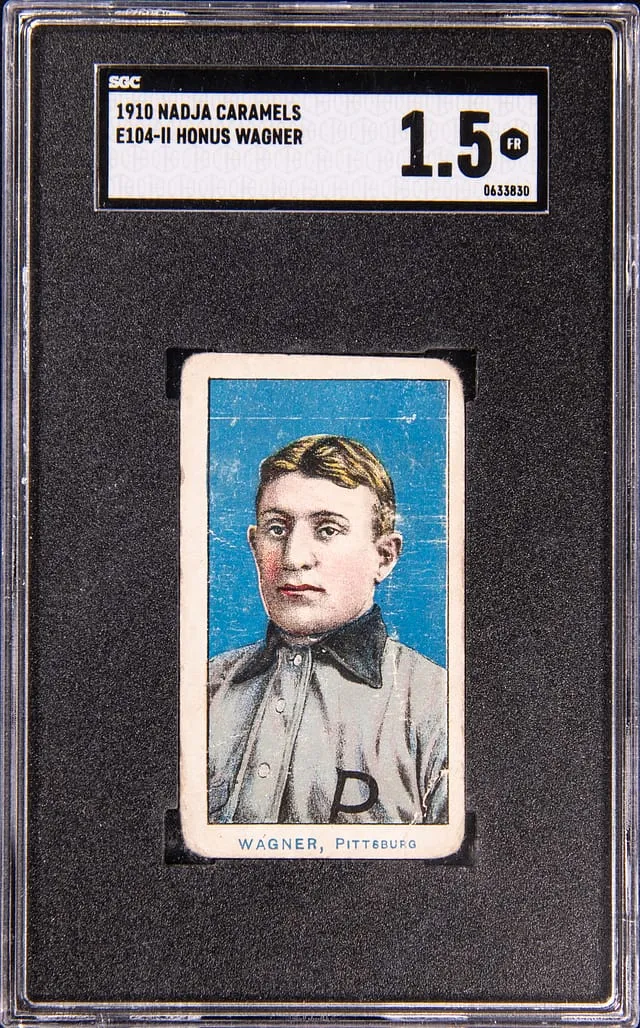
1910 Nadja Caramel Honus Wagner SGC 1.5 Sells for $81K
A 1910 E104-2 Nadja Caramel Honus Wagner SGC 1.5 sold for $81,130 at Goldin. Here’s what this scarce prewar Wagner means for collectors.
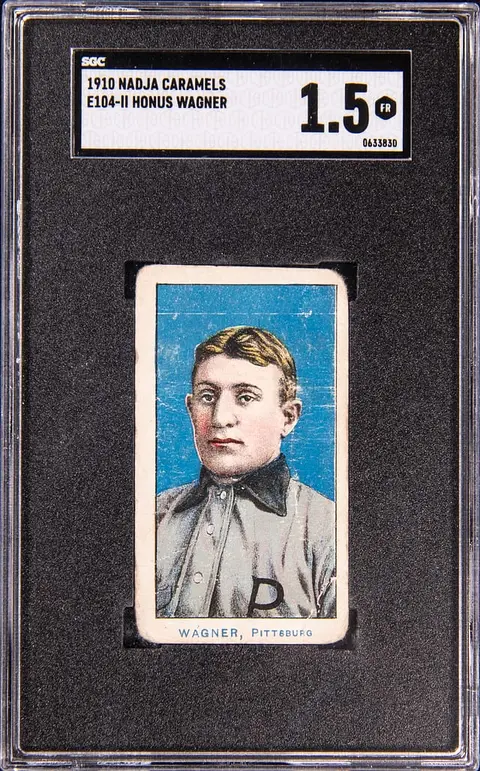
Sold Card
1910 E104-2 Nadja Caramel Honus Wagner - SGC FR 1.5 – One of Only 8 Known Copies on the Combined SGC & PSA Census Reports
Sale Price
Platform
GoldinA 1910 E104-2 Nadja Caramel Honus Wagner SGC FR 1.5 sold at Goldin on February 22, 2026 for $81,130, underscoring how deep demand runs for prewar Wagner issues beyond the famous T206.
For context, this card is part of the E104-2 Nadja Caramel set, a caramel candy issue released around 1910 that features players from the Pittsburgh Pirates. Honus Wagner appears here in a portrait pose, and the card is widely considered one of his key prewar issues. It is not his earliest card, but it is a highly significant, regionally distributed caramel card that sits firmly in the “advanced vintage” lane.
Key details collectors will care about
- Player: Honus Wagner, Pittsburgh Pirates
- Year / Set: 1910 E104-2 Nadja Caramel (Pirates team issue)
- Card type: Wagner portrait, often treated as a key Wagner caramel issue
- Era: Prewar (early 1900s)
- Grading company: SGC
- Grade: FR 1.5 (Fair)
- Census note: One of only 8 known copies on the combined SGC & PSA population reports
When we talk about “pop reports” or “census,” we mean the total number of copies a grading company has recorded for a card. In this case, combining SGC and PSA data shows just eight total graded examples of this Wagner, across all grades. For a Hall of Fame inner-circle player like Wagner, that level of supply is extremely low.
Why the E104-2 Nadja Wagner matters
Honus Wagner’s name is usually attached to the 1909–11 T206 "holy grail" card, but advanced collectors know his caramel and regional issues are just as historically important.
A few reasons this E104-2 stands out:
Scarce caramel issue The E104-2 Nadja set is a caramel (candy) issue, produced in much smaller quantities than tobacco sets of the same era. Surviving examples are often heavily worn due to how they were originally handled by children.
Extremely low supply With only eight graded copies between PSA and SGC, simple availability becomes a defining factor. Many iconic cards have populations in the dozens or even hundreds; this Wagner is in single digits.
Hall of Fame inner-circle player Wagner is widely regarded as one of the greatest shortstops of all time. Prewar cards of tier-one legends tend to have the deepest, most stable collector base, which often translates to strong competition when a rare example surfaces.
Prewar focus The prewar era (roughly pre-World War II) is known for thin supply and fragile cardboard. Collectors in this segment often prioritize eye appeal and survival over numeric grade. A Fair 1.5 grade on a 1910 caramel card can still be a major prize if the card presents decently for the issue.
Understanding the SGC FR 1.5 grade
The SGC FR 1.5 (Fair) grade signals significant wear: creases, rounded corners, staining, or paper loss, but enough integrity to remain fully identifiable and intact. For a 1910 caramel card, that isn’t surprising. The bar for condition was different in that era, and the market often prices these more on rarity and eye appeal than on strict technical grade.
In practical terms:
- Condition-sensitive issue: Thin, fragile stock and candy distribution mean high-grade examples are nearly nonexistent.
- Collector mindset: Many prewar specialists would rather own a low-grade copy of a truly scarce card than a high-grade copy of a more common issue. This card lives squarely in that world.
Price context: the $81,130 sale
This copy closed at Goldin for $81,130 on February 22, 2026.
When looking at price context, collectors often talk about “comps” – recent comparable sales of the same card or a very close variant. For ultra-rare prewar issues like the E104-2 Wagner, comps can be sparse or years apart. Instead of a tight price range, the hobby usually sees big jumps whenever a fresh copy surfaces.
Recent market observations for this card and related Wagners:
- Exact-card comps: Public auction records for this specific E104-2 Wagner are limited, especially in SGC 1.5. When a card has fewer than ten graded examples, it may not appear at major auction more than once every few years.
- Adjacent comps: Other prewar Wagner issues from the 1900s and 1910s, especially regional and caramel cards, have tracked upward over the past decade, largely driven by renewed interest in early Hall of Famers and the relative scarcity versus more commonly traded T206 cards.
- T206 vs caramel context: Premium T206 Wagners can sell in the millions, even in low grade, while rarer but somewhat less iconic Wagner issues (like this Nadja) tend to sit in the mid- to high-five-figure or six-figure range, depending on condition and eye appeal.
Given the tiny population and the lack of frequent recent sales, the $81,130 price fits a pattern where each new public sale effectively helps “reset” expectations for the card. Instead of being clearly high or low versus a long line of comps, it becomes one of the main datapoints.
How collectors might think about this sale
For newer or returning collectors, it’s easy to view the T206 Wagner as the entire story. But this result at Goldin highlights several broader themes in the vintage market:
Depth of demand for prewar legends When a rare Wagner appears, it draws attention even if it isn’t the famous T206. Inner-circle Hall of Famers with strong historical narratives tend to have multi-layered markets that extend across sets and formats.
Rarity vs condition In modern cards, people often chase high grades and low serial-numbered parallels. In prewar, raw scarcity and survival can matter more than the number on the label. A Fair 1.5 in an issue like E104-2 can be treated as a trophy-level piece because collectors know there may not be another chance for years.
Regional and caramel sets gaining respect Over the last decade, more hobby attention has flowed into early caramel and regional issues. These sets tell a complementary story to the major tobacco runs and often have much smaller surviving populations.
Auction houses as price discovery engines With so few copies available, auction results from houses like Goldin, REA, Heritage, and others become the key benchmarks. Each sale is not just another comp; it becomes a reference point collectors may rely on for years.
What this means for different types of collectors
- Newcomers: Treat this sale as a window into how the prewar segment works. Instead of chasing this specific card, you can learn from it – how scarcity, history, and condition interplay.
- Returning collectors: If you remember a time when non-T206 Wagners were relatively under the radar, this result is a reminder that niche prewar issues have matured into well-established targets.
- Small sellers and hobbyists: You may never handle a Nadja Wagner, but understanding why serious buyers compete for cards like this can help you evaluate other prewar or regional pieces you encounter.
Key takeaways from the Goldin sale
- Card: 1910 E104-2 Nadja Caramel Honus Wagner portrait
- Grade: SGC FR 1.5 (Fair)
- Census: One of only 8 graded examples between PSA and SGC
- Sale venue: Goldin
- Sale date: February 22, 2026 (UTC)
- Price: $81,130
This result reinforces the idea that truly scarce prewar issues of all-time great players occupy their own lane in the hobby. Even in modest technical grade, their combination of history, rarity, and collector demand can support strong, sometimes defining sale prices.
For figoca readers, the main lesson isn’t to chase this exact card, but to recognize the patterns it represents: thin populations, significant players, and historically important sets tend to anchor the high end of the vintage market, with each auction playing a visible role in price discovery.