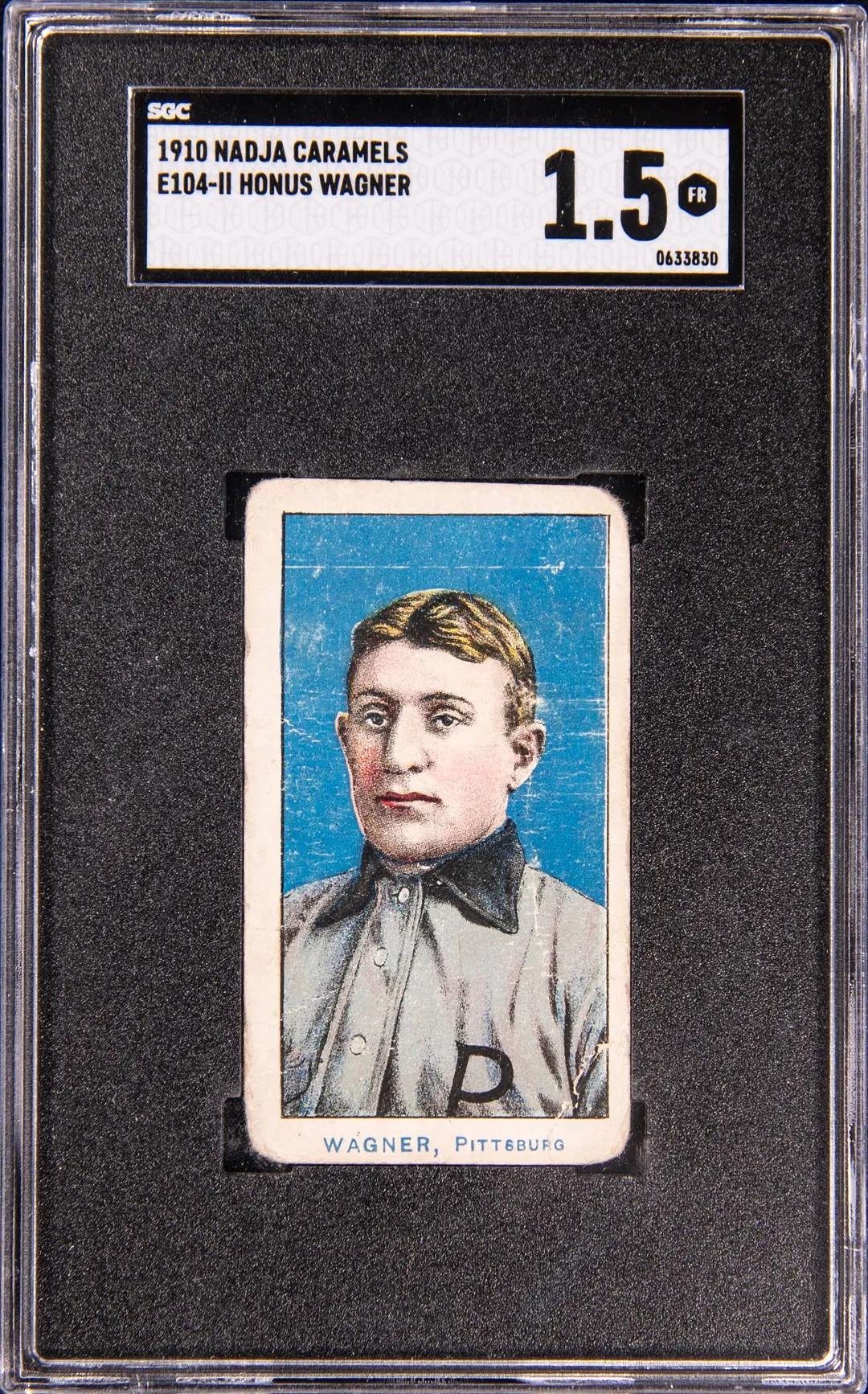
1910 E104-2 Nadja Caramel Honus Wagner SGC 1.5 Sale
Goldin sold a scarce 1910 E104-2 Nadja Caramel Honus Wagner SGC 1.5 for $81,130. One of only 8 graded copies across PSA and SGC.
Sold Card
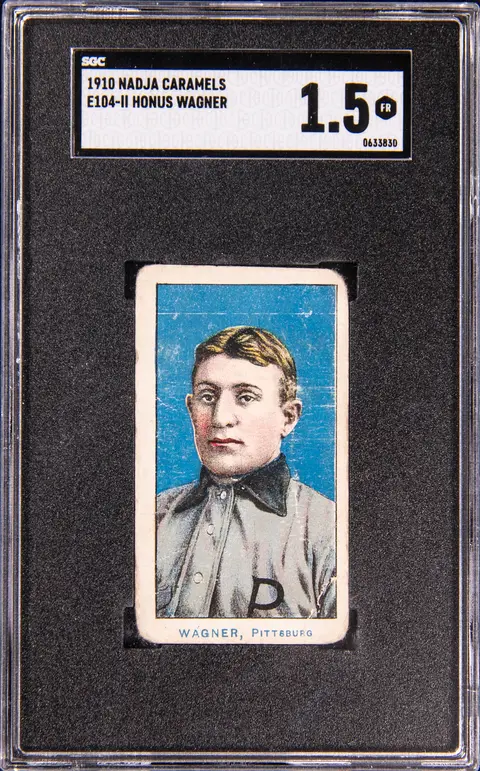
1910 E104-2 Nadja Caramel Honus Wagner - SGC FR 1.5 – One of Only 8 Known Copies on the Combined SGC & PSA Census Reports
Sale Price
Platform
GoldinFor many prewar baseball collectors, Honus Wagner is more than a name on a legendary tobacco card. He’s a benchmark for scarcity, condition sensitivity, and long-term demand across multiple early-1900s issues. A recent result at Goldin underscores that point in a big way.
On February 22, 2026, Goldin sold a 1910 E104-2 Nadja Caramel Honus Wagner graded SGC FR 1.5 for $81,130. This particular card is one of only eight total copies listed on the combined population reports (or “pop reports”) of SGC and PSA. In other words, across the two major grading companies, fewer than ten examples are confirmed in holders.
The card: 1910 E104-2 Nadja Caramel Honus Wagner, SGC FR 1.5
Here’s how this card breaks down:
- Player: Honus Wagner, Pittsburgh Pirates
- Year: 1910
- Set: E104-2 Nadja Caramel
- Manufacturer: Nadja Caramel (caramel candy issue)
- Team: Pittsburgh Pirates
- Grader: SGC
- Grade: FR 1.5 (Fair)
- Attributes: Prewar caramel issue, no autograph or relic, valued primarily for rarity and historical importance
The E104-2 Nadja Caramel cards are often grouped among the tougher early caramel issues. They’re scarcer than many better-known tobacco sets from the same era and were originally distributed with candy rather than cigarettes. That candy origin means these cards were handled heavily by kids, leading to creasing, staining, rounded corners, and paper loss—conditions that are typical even for graded examples.
This Honus Wagner is not his rookie card; Wagner’s playing career and cardboard presence start earlier in the 1900s. Instead, it’s a key issue from a very scarce regional caramel set, sitting in the same broader prewar conversation as T206, E90-1, and other early releases, but with much lower overall supply.
Population: one of only eight known in PSA and SGC slabs
When collectors talk about “pop report,” they’re referring to the official counts from grading companies that show how many copies of a specific card have been graded, and at what grades.
For this 1910 E104-2 Nadja Caramel Honus Wagner, the pop report is tiny:
- Combined SGC + PSA population: just 8 copies
- Within that small group, the condition curve is very bottom-heavy; most known examples sit in the lowest grades due to the fragile cardstock and the way caramel cards were stored and handled.
It’s worth keeping in mind that pop reports only track cards that have been submitted for grading. There may be raw (ungraded) examples in private collections, but the graded population gives us a reasonable sense of how thin supply is for this specific Wagner.
In practical terms, eight graded copies means:
- A typical auction cycle might only see this card appear once every few years.
- Many long-time prewar collectors have never had a chance to bid on, let alone own, an E104-2 Wagner.
Market context: how does $81,130 fit in?
The Goldin sale price was $81,130 for an SGC FR 1.5. That puts this example firmly in the high-end vintage market, even among prewar stars.
Because this is such a low-population card, “comps” (short for “comparables,” or recent sales of the same or similar card) are naturally limited. Compared with modern or postwar iconic issues, you don’t see a regular flow of recorded sales to build a granular price chart.
What we can say reliably from the available data and auction records:
- Sales frequency is extremely low. Some Wagner caramel issues can go several years without a public sale in any grade.
- Even low-grade examples command strong prices due to the intersection of three factors: Wagner’s status, the scarcity of the E104-2 set, and overall demand for prewar Hall of Famer issues.
This $81,130 result:
- Lines up with the broader trend of significant money flowing into scarce prewar type cards and Hall of Fame subjects.
- Illustrates that, in certain lanes of the vintage market, grade is only one piece of the puzzle; sheer scarcity and player significance can matter more than technical condition.
Because so few E104-2 Wagners have sold publicly, it’s hard to call this result definitively high, low, or typical. Instead, it feels like a data point in an extremely thin market, where each sale helps set the reference point for the next one.
Why collectors care about E104-2 Nadja Caramel
The E104-2 Nadja Caramel series sits in a niche of the hobby that blends:
- Prewar history – printed during a period when baseball cards were tied to everyday consumer goods.
- Regional distribution – caramel issues were often produced in smaller runs than national tobacco brands.
- Condition challenges – thinner stock, caramel staining, and kid-level handling make high grades rare.
Honus Wagner, in particular, is central to the story of early baseball cards. While the T206 Wagner has become a cultural icon, his lesser-known caramel issues appeal to:
- Collectors building type sets (one example from each important prewar issue).
- Advanced Wagner collectors seeking breadth across different brands and print runs.
- Investors and historians interested in documenting Wagner’s full cardboard footprint, not just his most famous card.
Within that niche, the E104-2 Wagner checks several key boxes:
- Era: firmly in the prewar, dead-ball era.
- Set rarity: significantly less common than many tobacco sets.
- Player: one of the defining Hall of Famers of his generation.
- Low supply in any condition: only eight graded across SGC and PSA.
That combination makes an SGC FR 1.5 copy highly relevant, even to collectors who usually focus on higher-grade cards.
Condition: understanding SGC FR 1.5 on a caramel issue
An SGC grade of FR 1.5 (Fair) usually indicates:
- Heavy wear throughout the card.
- Potential creases, wrinkles, edge wear, or small areas of paper loss.
- Eye appeal that is clearly below average, but still intact enough to present the subject and key design elements.
For a 1910 caramel card, that kind of wear is almost expected. Many prewar collectors actively adjust their expectations downward for condition on obscure or brittle issues; they focus instead on:
- Image clarity (can you see the player clearly?).
- Major defects (large missing chunks, heavy writing, etc.).
- The overall “look” of the card within its grade.
This is one reason why price gaps between 1, 1.5, and 2 can be smaller for ultra-rare prewar cards than for more common, later-era issues. When there are only a handful of examples, simply securing an authentic, graded copy can be the priority.
What this sale might signal for the prewar market
Because each E104-2 Wagner sale is rare, it’s too strong to call this one auction a full market signal. Still, for collectors and small sellers, there are a few takeaways worth noting:
True scarcity is still being rewarded. In a hobby where many modern cards have large print runs and complex parallel rainbow checklists, genuinely low-pop, prewar issues continue to attract serious bids.
Player quality remains central. Wagner’s name consistently carries weight across multiple sets. When you combine an all-time Hall of Famer with a tough regional issue, the result tends to be durable interest over time.
Condition context matters. In ultra-scarce prewar sets, a Fair 1.5 can compete for attention with mid-grade examples of more common cards, both in terms of conversation and price.
Auction houses matter for visibility. A sale at Goldin gets the card in front of a wide audience, including both long-time vintage specialists and newer collectors exploring prewar for the first time.
None of this guarantees what the next copy will sell for, or how the prewar market will move. It simply adds another reference point to a very thin sales history.
How collectors might use this data point
If you collect or sell vintage baseball cards, this Goldin result can be useful in a few ways:
- Benchmark for similar caramel stars: While direct comps for E104-2 Wagner are limited, this sale helps frame expectations for other rare caramel Hall of Famers in low grade.
- Context for Wagner across sets: If you track Wagner prices in T206, E90-1, and other early issues, adding the E104-2 result gives a more complete picture of how different segments of the Wagner market behave.
- Reference for type collectors: For collectors working on prewar type runs, this gives a baseline for just how far into five figures some of the tougher types can go, even in heavily worn condition.
As always, it’s helpful to view this sale alongside other recent results, not in isolation. Tracking auction catalogs and pop reports over time can give you a clearer sense of where rarity and demand intersect.
Closing thoughts
The 1910 E104-2 Nadja Caramel Honus Wagner isn’t a card most collectors will ever own. With only eight graded copies between SGC and PSA, it’s more of a reference point than a realistic target. Still, the February 22, 2026 Goldin sale at $81,130 tells us a lot about where the hobby currently sits:
- Prewar scarcity continues to command attention.
- Hall of Fame anchors like Wagner remain central to the market.
- Condition is important, but not absolute, when supply is this thin.
For collectors who enjoy the history of the hobby as much as the cards themselves, tracking cards like the E104-2 Wagner is a way to see how the earliest days of baseball cardboard continue to shape today’s market.