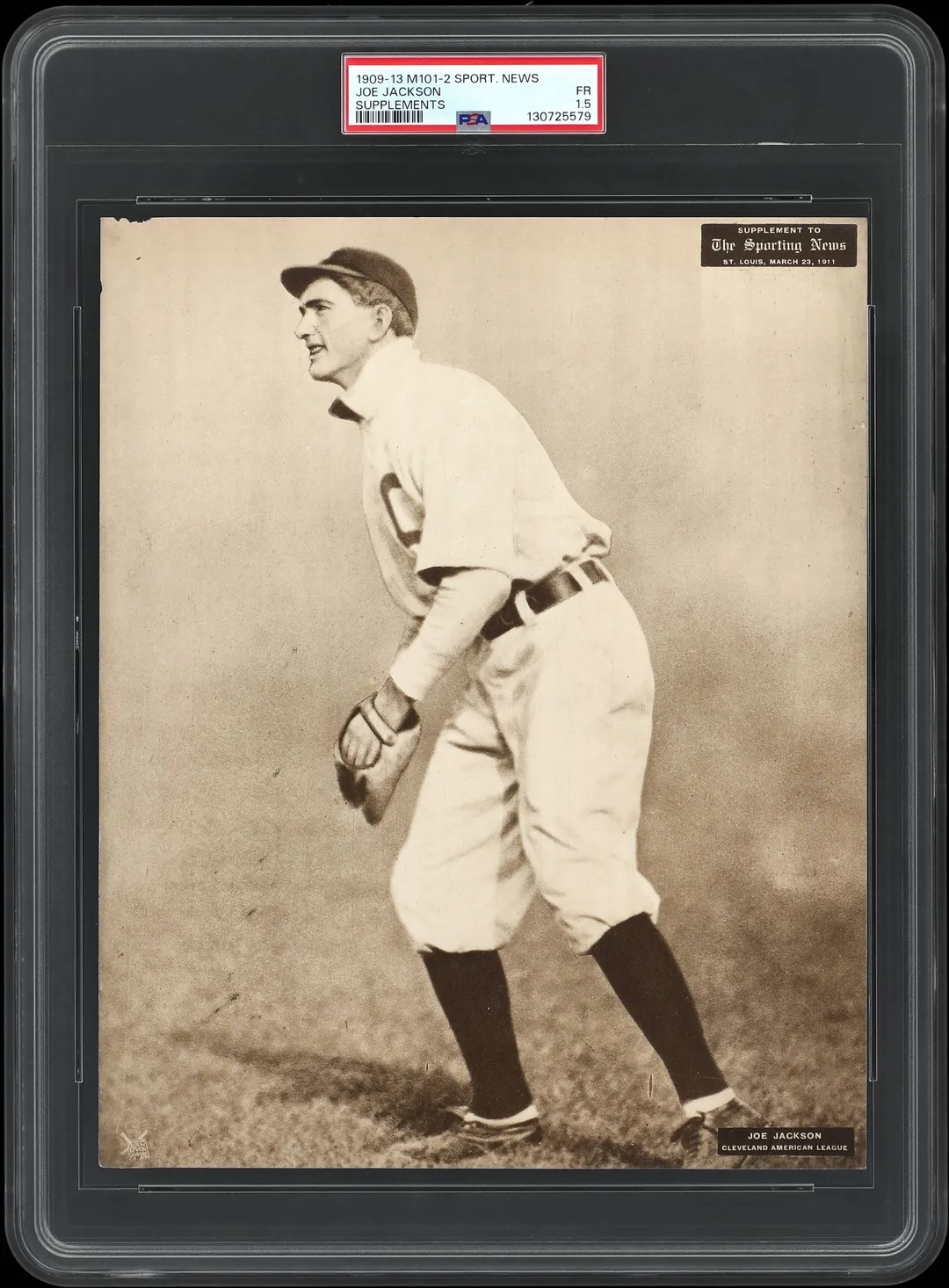
1909-13 M101-2 Joe Jackson PSA 1.5 sells for $16K
Goldin sold a 1909-13 M101-2 Sporting News Joe Jackson PSA FR 1.5 for $16,477. See population, context, and what it means for vintage collectors.
Sold Card
1909-13 M101-2 Sporting News Supplements Joe Jackson - PSA FR 1.5 - POP 3; Only 2 Higher PSA Copies
Sale Price
Platform
Goldin1909-13 M101-2 Sporting News Supplements Joe Jackson – PSA FR 1.5 Market Breakdown
On February 22, 2026, Goldin sold a 1909-13 M101-2 Sporting News Supplements Joe Jackson, graded PSA FR 1.5, for $16,477. According to PSA’s population report, this example is part of a tiny graded census: only three copies sit at PSA 1.5, with just two higher-graded PSA examples known.
For a pre-war Joe Jackson issue, that combination of age, scarcity, and name recognition makes this a meaningful sale for vintage collectors.
Card ID: What Exactly Sold?
Let’s start by clearly identifying the piece:
- Player: Joe Jackson (“Shoeless Joe”)
- Team: Cleveland Naps (period team, pre–Chicago White Sox)
- Years: 1909–1913 issue window
- Set: M101-2 Sporting News Supplements
- Format: Large paper supplement (not a standard-size card)
- Manufacturer/Issuer: The Sporting News (insert / newspaper premium)
- Grading company: PSA (Professional Sports Authenticator)
- Grade: FR 1.5 (Fair)
- Population: PSA pop 3 in FR 1.5; only 2 higher PSA copies
- Attributes: Oversized, pre-war, Type Card/Type Issue; key early Joe Jackson appearance (often treated as a major early-career piece, though not his standard “rookie card” in the strict modern sense)
M101-2 Sporting News Supplements are large-format photographic premiums issued in the early 1910s. Because they were printed on thin stock and often pinned or tacked to walls, surviving examples typically show creasing, tears, pinholes, and edge wear. That’s why even low-grade, fully presentable specimens are taken seriously in the hobby.
Why the M101-2 Joe Jackson Matters
Pre-war and early Joe Jackson
For many collectors, anything pre–Black Sox era tied to Joe Jackson is historically significant. Jackson’s combination of on-field production, banned-from-baseball story, and cultural mystique (from books to movies) keeps demand steady, especially for authentic pre-war issues.
This M101-2 is an early-career Jackson supplement, issued during his time with the Cleveland Naps. While some collectors reserve the word “rookie” for standard-size card issues, this is undeniably one of his key early appearances and a core type card for dedicated Jackson collectors.
Set significance: M101-2 Sporting News Supplements
The M101-2 run is a respected pre-war issue because:
- It features many stars and Hall of Famers in large, photographic format.
- Surviving examples are fewer than their contemporary tobacco cards, largely due to their size and fragile paper.
- They occupy a cross-collecting space between cards, cabinets, and photos, which appeals to advanced type collectors.
Many hobbyists consider M101-2 a foundational early-1910s baseball supplement issue, especially for star players.
Rarity and grading reality
Paper supplements from 1909–13 simply do not survive in high grade. Pinholes, tape, folds, and trimming are common. As a result, the PSA pop numbers here are extremely low:
- FR 1.5 population: 3 copies
- Only 2 higher PSA copies known
For practical purposes, that makes this a top-five PSA-graded example and a very tough card to upgrade.
Market Context and Price Overview
The Goldin result came in at $16,477. To understand where that sits, it helps to look at a few context points:
- Format and era: Pre-war supplements and cabinets often trail iconic tobacco issues (like T206) in headline prices, but they command strong interest among advanced vintage and type collectors.
- Player tier: Joe Jackson sits in that small group of pre-war names—Ruth, Cobb, Wagner, Jackson—whose early items consistently attract competition.
- Grade reality vs. eye appeal: With this kind of issue, the number on the slab (1.5) doesn’t tell the full story. Centering, print quality, and completeness matter more than in many modern cards. A presentable 1.5 in a tiny pop can trade like a much “stronger” card within its category.
Public auction data for this exact card in this exact grade is limited, largely because so few graded examples exist and they don’t surface often. When sales are infrequent, price discovery is choppy: a single strong or weak result can move the perceived range.
Within that context, $16,477 for a PSA FR 1.5, pop 3 with only two higher, looks consistent with how the market usually treats scarce, early Jackson issues: values that are firm, but still noticeably below his most iconic tobacco cards and premium photo pieces.
Because transaction history is sparse, it’s difficult to call this result definitively high, low, or average. What we can say with confidence is that:
- The card traded at a level that reflects both Jackson’s stature and the scarcity of M101-2.
- The small PSA pop and limited public comps mean each sale can influence how collectors think about fair value the next time one surfaces.
Scarcity: Pop Report and Real-World Supply
Pop report (short for population report) refers to the grading company’s census: how many copies of a card they’ve graded at each grade. As of this sale:
- Only three copies are graded PSA FR 1.5.
- Only two copies sit higher in the PSA registry.
Those numbers don’t include:
- Raw (ungraded) examples tucked away in older collections.
- Copies graded by other companies like SGC or Beckett.
Even accounting for that, M101-2 supplements are clearly not a high-supply item, particularly for a star of Jackson’s caliber. For collectors who want a graded, cataloged example, PSA’s tiny pop underscores how infrequently a copy is likely to appear in a major auction.
How This Fits the Broader Joe Jackson Market
Joe Jackson material has held a stable place in the vintage hobby for years. While price levels can move up or down with broader market cycles, a few themes tend to stay constant:
- Story-driven demand: Jackson’s ban from baseball and his portrayal in popular culture keep him relevant to new collectors discovering pre-war.
- Limited card catalog: Compared to modern stars, he simply doesn’t have many contemporary issues. That scarcity concentrates attention on each key piece.
- Pre-war premium: Early 1900s items tend to be thinly traded; a single sale can set expectations until the next example appears.
Within that ecosystem, the M101-2 supplement sits alongside his other important early issues as a type card that serious Jackson or pre-war specialists watch whenever it hits the block.
Takeaways for Collectors
For collectors, this Goldin sale on February 22, 2026 offers a few practical lessons:
Condition standards differ by era. A PSA FR 1.5 on a 1909–13 paper supplement can be a very respectable example, especially when the pop is tiny.
Format matters. Large-format supplements don’t behave like standard-size cards. They’re harder to store, more fragile, and often rarer, which can make them attractive to type collectors and advanced vintage-focused hobbyists.
Low pop changes the conversation. When only a handful of graded copies exist and few sales are public, each auction result carries outsized weight in shaping price expectations.
Context beats headlines. Rather than reading this $16,477 sale as a “spike” or a “dip,” it’s more useful to view it as one data point in the slow, thinly traded market for pre-war Joe Jackson issues.
Where This Leaves the M101-2 Jackson
The 1909-13 M101-2 Sporting News Supplements Joe Jackson in PSA FR 1.5 is now clearly pegged in the mid–five-figure range, at least based on this February 22, 2026 sale at Goldin. Given the combination of:
- Early Joe Jackson subject matter
- Tough pre-war supplement format
- Extremely small graded population
…it remains a card that most collectors will encounter only through auction catalogs and hobby write-ups rather than in person.
For newer collectors, it’s a reminder that the vintage market extends well beyond standard-size cards and that some of the most historically interesting pieces took the form of fragile newspaper premiums like M101-2.
For long-time hobbyists tracking Jackson’s market, this sale is another data point confirming that demand for his significant early issues remains intact, even as overall market conditions evolve.
As always, this information is meant as context, not advice. Each collector’s situation, goals, and risk tolerance are different. If you’re exploring pre-war baseball, spending time with population reports, past auction catalogs, and set checklists can be just as valuable as watching the latest headline sale.