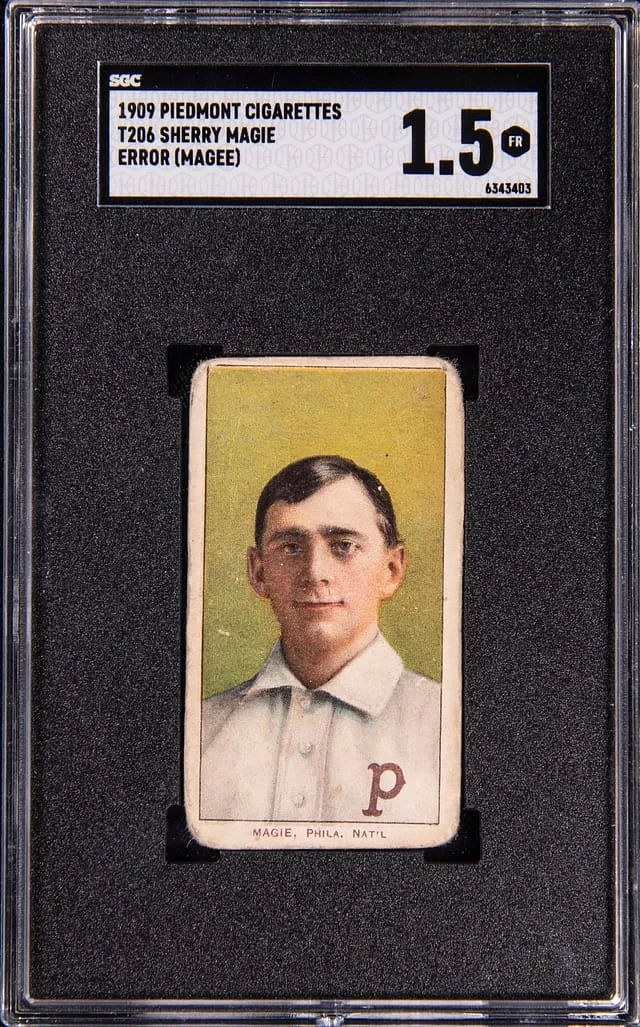
1909-11 T206 Sherry Magie Error SGC 1.5 Sale
Goldin sold a 1909-11 T206 Sherry Magie Error SGC 1.5 for $15,860. See why this iconic T206 variation still commands strong vintage demand.
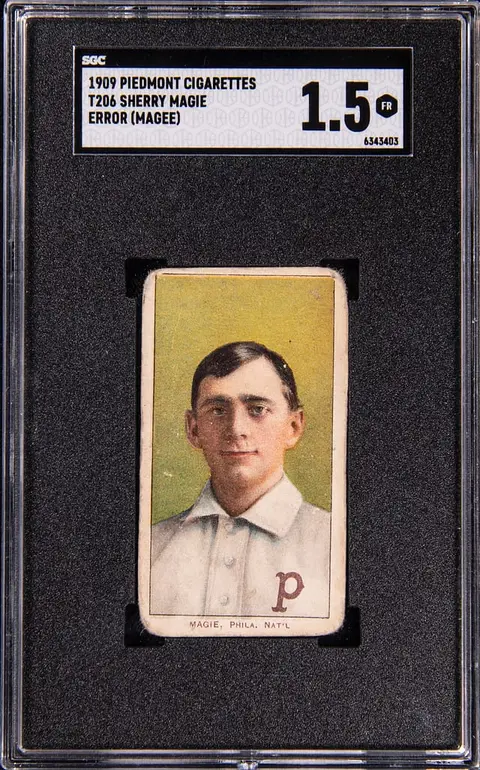
Sold Card
1909-11 T206 White Border Sherry Magie Error (Magee) - Piedmont - SGC FR 1.5
Sale Price
Platform
Goldin1909-11 T206 Sherry Magie Error (Magee) SGC 1.5 Sells for $15,860 at Goldin
The T206 White Border set is one of the foundation stones of pre-war baseball collecting, and within that set, a handful of cards have taken on near-mythic status. The Sherry Magie error card is one of them.
On February 22, 2026, Goldin sold a 1909-11 T206 White Border Sherry Magie Error (Magee) with a Piedmont back, graded SGC FR 1.5, for $15,860. For a low-grade pre-war card, that number carries a lot of information about where this hobby niche sits today.
What exactly is this card?
- Player: Sherry Magee (spelled "Magie" on the error card)
- Team: Philadelphia Phillies
- Set: 1909-11 T206 White Border
- Card type: Error version – name misspelled “Magie” instead of “Magee”
- Back: Piedmont
- Era: Pre-war tobacco era
- Grade: SGC FR 1.5 (Fair)
This is not a modern “short print” in the contemporary sense, but it functions very similarly in the T206 ecosystem. The original printing used the wrong spelling (Magie). The error was corrected relatively quickly to the standard "Magee" version, leaving a smaller (but not one-of-a-kind) population of error cards.
Among T206 collectors, Sherry Magie’s error is widely considered one of the core key cards in the set, often discussed in the same breath as cards like the Honus Wagner, Eddie Plank, and the Doyle N.Y. Nat’l variation, even though it sits on a different price tier.
Why the Sherry Magie error matters to collectors
A cornerstone T206 variation
Within T206, there are a few main categories of chase cards:
- Portrait and Hall of Fame stars (Cobb, Johnson, Mathewson, etc.)
- True rarities and legendary cards (Wagner, Plank, ultra-scarce variations)
- High-demand errors and variations – this is where the Magie error fits.
The Magie error has been a checklist staple for decades for:
- Master set builders trying to complete as close to a full T206 run as possible
- Variation collectors who focus on print errors and name/pose differences
- Type collectors who want one representation of every major T206 key
Because the corrected “Magee” version is common, Sherry Magee himself is not the driver here. The appeal is almost entirely about the printing history and how this card fits into the T206 story.
Pre-war scarcity and survivorship
The T206 set was printed in large numbers, but over more than a century, survival rates—especially for variations like the Magie error—have created practical scarcity. Many surviving copies show heavy wear, trimming, or damage.
That’s why even low-grade examples, like this SGC 1.5, still command solid prices. In pre-war collecting, experienced hobbyists often say: “Buy the card, not the grade.” For key issues like the Magie error, collectors are often willing to accept creases, rounded corners, and soiling if the card is authentic and relatively presentable.
About this specific copy: SGC FR 1.5, Piedmont back
The card sold at Goldin is:
- Graded by SGC: One of the major grading companies, particularly respected in vintage and pre-war.
- Assigned FR 1.5 (Fair): This typically indicates:
- Multiple creases or wrinkles
- Rounded or damaged corners
- Possible surface wear, staining, or small paper loss
- Still intact and clearly identifiable with no major piece missing
- Piedmont back: One of the more common T206 advertising backs, which helps anchor pricing versus rarer backs (like Drum, Uzit, or Lenox) that usually bring premiums.
For a T206 Magie error, the combination of “error + authenticity + any numeric grade” usually matters more than fine distinctions within the lower grades, unless the card is severely damaged.
Price context: what does $15,860 tell us?
The hammer price here was $15,860 (converted from 1,586,000 cents). To understand that number, collectors often look at “comps”–short for comparables–which are recent sales of the same card in similar condition.
While exact figures move over time and can vary by auction and eye appeal, the general pattern on the Magie error over the last couple of years has looked something like this:
- Low-grade (PSA/SGC 1, 1.5, 2): Typically five-figure cards, with ranges that can stretch depending on:
- Eye appeal (centering, color, how heavy the creasing is)
- Whether the card is in a major auction or a smaller marketplace
- Overall market sentiment for vintage at the time
- Mid-grade (3–4 and up): Steady step-ups from low-grade, often significantly more due to the sharp drop-off in population as condition improves.
Within that framework, $15,860 for an SGC 1.5 sits in a realistic band for this card in today’s environment. It is not an outlier that redefines the category, but it reaffirms that:
- The Magie error remains a firmly five-figure card, even in Fair condition.
- Demand for key T206 variations is still healthy, despite broader ups and downs in the hobby.
For collectors watching trends, this sale is a useful data point rather than a shock headline.
Market context: T206, pre-war, and where this fits
T206’s enduring place in the hobby
The 1909-11 T206 set is often described as:
- The iconic tobacco baseball set, produced by the American Tobacco Company
- Featuring hundreds of players and multiple poses
- Linked to many famous backs (Piedmont, Sweet Caporal, and numerous scarcer brands)
Because of this, T206 acts almost like a benchmark for pre-war baseball. Watching where major T206 keys sell gives collectors a feel for how the vintage sector is holding up.
Recent years have seen:
- Strong interest in blue-chip vintage as a stabilizing segment during modern card volatility
- Continued attention to rare variations and error cards as alternatives to the most expensive icons
- Ongoing respect for SGC-graded T206s, especially among long-time pre-war collectors
Within that environment, the Magie error is one of the more accessible “famous” T206 chase cards still within reach of dedicated collectors, particularly in lower grades.
Why low grades still matter
Modern collectors who are used to chasing PSA 10s sometimes underestimate just how acceptable low grades are in pre-war. For T206 keys, many hobbyists actively prefer:
- A well-centered, honest 1.5–2 over a technically higher grade with poor eye appeal
- Authentic, slabbed copies with visible wear over raw copies of uncertain origin
The fact that this SGC 1.5 sold at a strong, market-consistent number suggests that collectors continue to value authenticated key issues, even when condition is firmly in the “collector grade” range.
What this sale means for different types of collectors
For newcomers and returning collectors
- This sale shows that error cards and variations can carry long-term interest, not just modern parallels.
- T206 is a deep rabbit hole; the Magie error is advanced territory, but studying it is a good way to learn how print history shapes value.
- Even if this card is outside your budget, the principles—scarcity, historical importance, and demand for key set cards—apply across eras.
For active hobbyists
- The $15,860 result reinforces the idea that iconic pre-war keys have a relatively stable collector base.
- If you track vintage, this is another comp to log when building your own reference ranges for the Magie error in low grade.
- It’s also a reminder that SGC-graded vintage continues to perform competitively at major auction houses.
For small sellers
- This is a good example of how story and set context matter as much as player stardom.
- When listing vintage cards, especially pre-war, clearly explaining:
- The set’s significance
- Any variation or error status
- Grading details and eye appeal can help buyers understand why a card sits in a particular price band.
Takeaways from the Goldin sale
The February 22, 2026 sale of the 1909-11 T206 White Border Sherry Magie Error (Magee) – Piedmont – SGC FR 1.5 at Goldin for $15,860 underscores a few key themes:
- The T206 Magie error remains a core, respected key in one of the hobby’s most important sets.
- Even in Fair condition, authenticated examples continue to achieve solid five-figure results.
- Vintage and pre-war collectors still show strong, steady interest in historically important variations.
For collectors across experience levels, this sale is another reminder that understanding the story behind a card—its set, its print quirks, and its place in hobby history—can be just as important as the number on the slab.
If you’re tracking the T206 market, the Magie error’s performance at auction remains a useful reference point for how deeply collectors value cornerstone pre-war pieces.