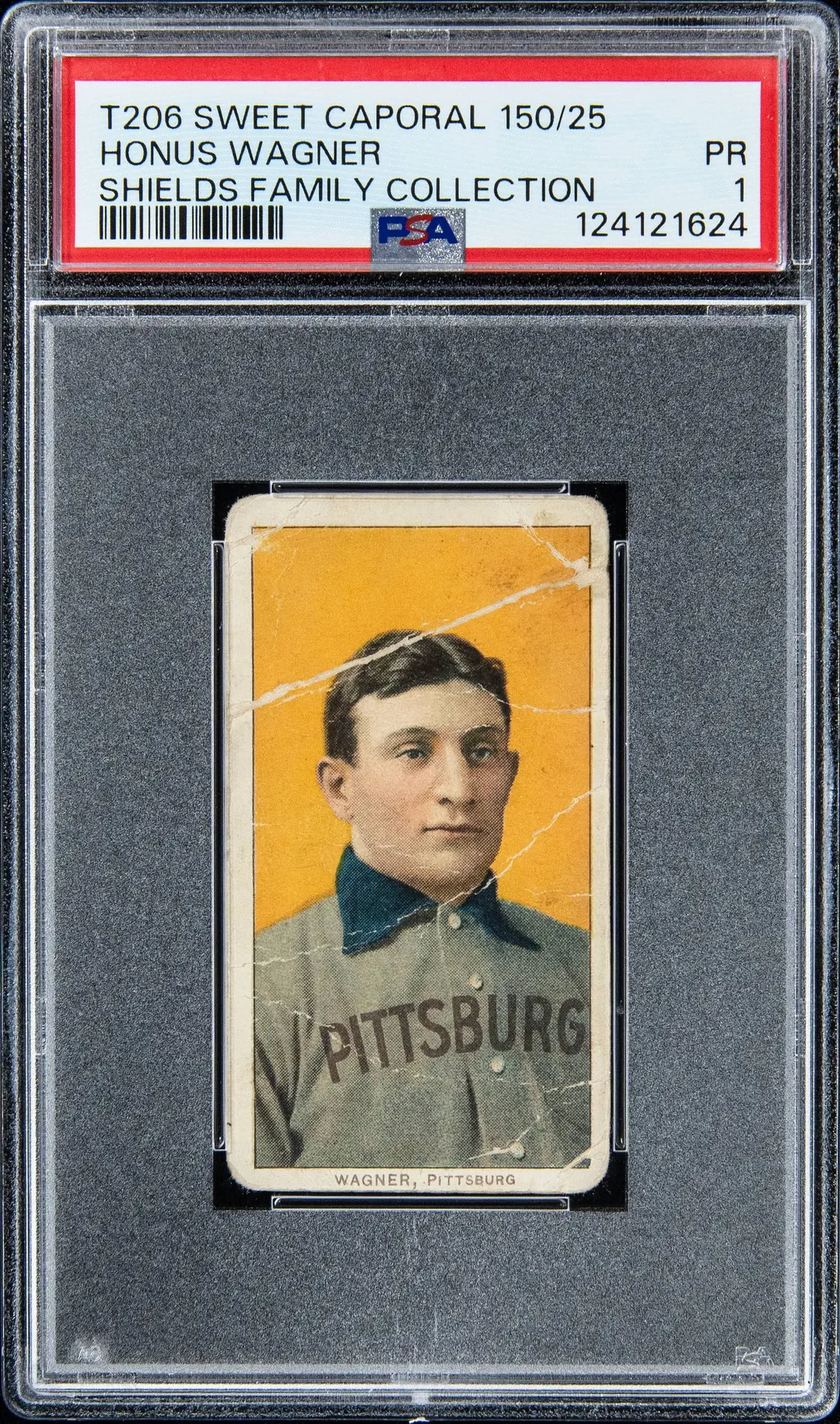
1909-11 T206 Honus Wagner PSA 1 Sells for $5.1M
Figoca breaks down the $5,124,000 Goldin sale of a 1909-11 T206 Honus Wagner Sweet Caporal 150/25 PSA 1 from the Shields Family Collection.
Sold Card
1909-11 T206 White Border Honus Wagner - Sweet Caporal 150/25 - Shields Family Collection - PSA PR-FR 1
Sale Price
Platform
GoldinA T206 Honus Wagner always stops the hobby in its tracks, and the latest sale from the Shields Family Collection is no exception.
On February 22, 2026, Goldin sold a 1909–11 T206 White Border Honus Wagner – Sweet Caporal 150/25 – PSA PR-FR 1 for $5,124,000. For a card graded Poor–Fair, that is a remarkable but historically consistent result for one of the most important pieces of cardboard ever printed.
In this article, we’ll unpack what this specific Wagner is, why the Sweet Caporal back and Shields provenance matter, and how this sale fits into the larger market for the T206 Wagner.
Card overview: what exactly sold?
Card: 1909–11 T206 White Border Honus Wagner
Set: T206 (often called the “White Border” tobacco set)
Brand/back: Sweet Caporal 150 Subjects, Factory 25 (usually written 150/25)
Player: Honus Wagner, Pittsburgh Pirates
Type: Key issue, widely considered the hobby’s most iconic card
Era: Pre-war vintage (tobacco era)
Grading company: PSA (Professional Sports Authenticator)
Grade: PSA 1 (PR-FR – Poor to Fair)
Collection/provenance: Shields Family Collection
The T206 Honus Wagner is not a rookie card in the modern sense—Wagner appears on earlier issues—but it is widely regarded as the iconic baseball card. For many collectors, it is the hobby’s “Mona Lisa.”
The back of this copy is a Sweet Caporal 150/25. T206 cards were inserted into various cigarette brands, and the brand design on the back creates what collectors call a "back variety." Sweet Caporal is one of the classic T206 backs, and the 150/25 designation refers to the 150-subject print series and Factory 25, New York.
PSA’s PR-FR 1 grade reflects heavy wear: creases, rounded corners, surface issues, and sometimes paper loss. With the T206 Wagner, however, the mere fact that the card exists, is authenticated, and is complete often matters more than technical condition.
Why the T206 Honus Wagner matters
A short-printed legend
The T206 set was produced from 1909 to 1911 and includes over 500 different player poses. The Honus Wagner is by far the most famous card in the set because it was withdrawn from production early, leading to a very short print run.
There are several stories about why Wagner was pulled—ranging from his dislike of cigarette advertising to contract and compensation disputes. Whatever the precise reason, the outcome is clear: very few Wagners made it into packs, and even fewer survived.
This scarcity, combined with Wagner’s status as one of the greatest players of the dead-ball era, made the card an early collectible icon. Well before the modern boom in graded cards, the T206 Wagner was featured in newspapers, books, and later documentaries, often as the face of baseball card collecting itself.
Pre-war vintage and true scarcity
Pre-war (pre–World War II) issues like the T206 are fundamentally different from modern and ultra-modern cards in terms of how they were produced, distributed, and stored. They were:
- Pack inserts in tobacco products, not sold as dedicated collectibles.
- Handled heavily, often pasted into scrapbooks or exposed to decades of wear.
- Printed with early 20th-century methods that naturally introduced variation.
Because of this, high-grade examples are extremely rare, and even low-grade survivors are fiercely collected.
Grading context: PSA 1 and why it still commands millions
A PSA 1 (PR-FR) grade means:
- Noticeable creases, folds, or wrinkles.
- Rounded or heavily worn corners.
- Possible surface wear, stains, or small areas of paper loss.
- The card is authentic and complete, but far from pristine.
With the T206 Wagner, collectors often treat the PSA label as an authentication and census tool rather than purely a condition score. The PSA population report (often shortened to “pop report,” meaning how many copies exist in each grade) for the Wagner is extremely small across the board.
In modern cards, a PSA 1 is usually considered a budget entry. For the T206 Wagner, a PSA 1 is still a museum-level piece simply because there are so few authentic examples in any condition.
Provenance: the Shields Family Collection
Named collections add an extra layer of interest and traceability. When a card is known to have been held in the same family or prominent collection for many years, that provenance—the documented history of ownership—can make it more appealing.
The reference to the Shields Family Collection signals that this Wagner has a trackable story behind it, not just a grading label. For historically important cards, that narrative often matters to advanced collectors and institutions.
Market context: how $5,124,000 fits into Wagner history
The card sold at Goldin on February 22, 2026, for $5,124,000. To understand that number, it helps to place it against recent and historically notable Wagner sales.
Historic benchmarks (high-level context)
Over the past two decades, several T206 Wagners across different grades have set headlines and records, including:
- High-grade examples that have crossed the multi-million-dollar mark and, in some instances, pushed beyond previous “most expensive card” titles.
- Mid-grade copies (for example, in the VG to EX range) that have consistently risen over long periods as major collectors and investors compete for very limited supply.
- Lower-grade and even altered or restored Wagners that still reach seven figures due to the combination of scarcity and brand recognition.
Collectible price history is always dynamic, and exact comps (short for “comparables,” meaning recent similar sales used to estimate value) depend on grade, eye appeal, back type, provenance, and market timing. But on a relative basis, a PSA 1 selling above $5 million is in line with the idea that all authentic Wagners, even at the low end of the grading scale, occupy a unique tier in the hobby.
How this sale fits
Based on publicly reported auction results and the typical hierarchy of T206 Wagner prices by grade, this Goldin result suggests:
- Continued institutional and high-net-worth interest in true hobby grails.
- Ongoing separation between the very top tier of vintage icons and even strong modern cards.
- A market that still recognizes provenance (Shields Family Collection), the Sweet Caporal back, and the Wagner name as premium factors.
For context-oriented collectors, this sale reinforces a pattern: when truly iconic, historically scarce pieces surface—especially with a story attached—they tend to draw deep bidding regardless of short-term swings in the broader card market.
Why collectors care so much about this card
1. Hobby symbolism
The T206 Wagner is more than a player card; it’s a symbol for the entire hobby. When mainstream media covers trading cards, this is often the image they use. Many longtime collectors can trace their interest in vintage back to seeing a photo of this exact card in a book or article.
2. True scarcity vs. manufactured scarcity
Modern products often rely on serial numbering (for example, /10 or /99), parallels, and short prints to create rarity. T206 Wagners are rare because very few were ever distributed in the first place and fewer still survived over a century.
That difference matters to collectors who prefer organic, historical scarcity to modern, planned scarcity.
3. Cross-appeal
The card appeals to:
- Pre-war specialists building type sets or chasing key T206s.
- High-end collectors and institutions viewing it as a cultural artifact.
- Baseball historians interested in dead-ball era stars and early advertising.
- General hobbyists, for whom the Wagner is often the first “grail” they learn about.
What this means for different types of collectors
This sale does not set a roadmap or guarantee for other cards, but it does offer some useful signals.
For newcomers
- The numbers here are extreme, but the underlying principles apply at all price levels: history, scarcity, and story matter.
- Learning about pre-war sets like T206 can help you understand why certain cards command long-term respect.
For returning collectors
- If you collected in the past and are re-entering the hobby, this sale is a reminder that vintage and pre-war remain foundational areas of the market, even amid attention to modern stars and prospecting.
- You don’t need to chase a Wagner; exploring T206 commons, Hall of Famers, or other tobacco issues can be a meaningful way to connect with this era at more accessible price points.
For active hobbyists and small sellers
- The Wagner sale underscores ongoing demand for authenticated, historically important pieces, even in low grade.
- It’s a good prompt to review your own vintage: are there cards where authentication and grading could significantly clarify value or buyer confidence?
- While few items reach this level, understanding the T206 Wagner story can help you explain the appeal of vintage cards to your own buyers or audience.
Goldin, the sale date, and auction dynamics
This Wagner closed at Goldin on February 22, 2026, a date that will now sit alongside other major Wagner milestones.
High-end auctions like this typically:
- Draw international attention and deep bidder pools.
- Establish a new reference point for future private and public sales.
- Prompt renewed discussion about the relative standing of other hobby grails.
For researchers and market watchers, sales like this create fresh data in a segment where transactions are infrequent and each new result carries substantial weight.
Key takeaways
- The 1909–11 T206 White Border Honus Wagner Sweet Caporal 150/25, PSA PR-FR 1, Shields Family Collection sold at Goldin on February 22, 2026, for $5,124,000.
- Even in a PSA 1 grade, the T206 Wagner stands as one of the hobby’s most important and recognizable cards.
- The combination of true scarcity, historical importance, and named provenance keeps it in a category of its own within the trading card market.
- For collectors at any budget level, studying this card offers a window into how the hobby views history, rarity, and storytelling.
At figoca, we track sales like this not to suggest that every card can follow the same path, but to better understand how the hobby values its most significant artifacts. The T206 Honus Wagner remains the ultimate reference point—and this Goldin sale adds another important chapter to its ongoing story.