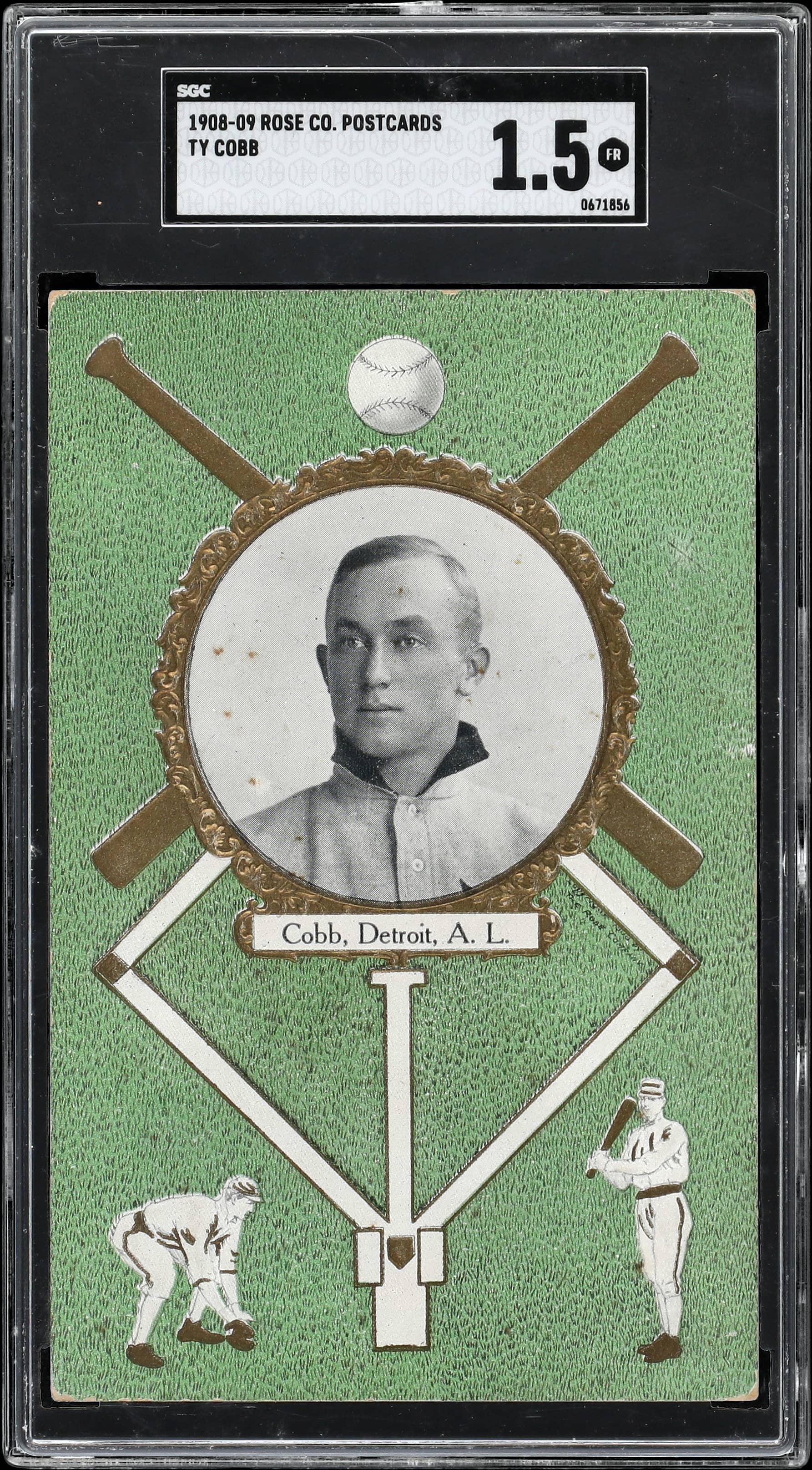
1908-09 Rose Ty Cobb Postcard Sells for $62,220
Goldin sold a scarce 1908-09 Rose Company Postcard Ty Cobb SGC 1.5 for $62,220. See why this low-pop pre-war Cobb matters for today’s vintage market.
Sold Card
Extremely Rare 1908-09 Rose Company Postcard Ty Cobb – SGC FR 1.5 – One of Only Five Professionally Graded Copies
Sale Price
Platform
GoldinExtremely Rare 1908-09 Rose Company Postcard Ty Cobb – SGC FR 1.5 – One of Only Five Professionally Graded Copies
On February 22, 2026, Goldin sold an extremely scarce pre-war Ty Cobb issue: a 1908-09 Rose Company Postcard graded SGC FR 1.5 for $62,220. For a card that rarely surfaces in any condition, this sale offers a useful data point for serious Cobb, pre-war, and type collectors.
In this article, we’ll walk through what this card is, why it matters, and how this sale fits into the current market picture.
What exactly is this Ty Cobb card?
Card ID
- Player: Ty Cobb
- Team: Detroit Tigers
- Year: 1908-09
- Set: Rose Company Postcards
- Type: Real photo postcard (premium early-issue Cobb)
- Card number: The Rose postcards are generally uncatalogued by number; Cobb is considered one of the key subjects
- Issue tier: Not a true “rookie card” in the modern sense, but a major early-career Ty Cobb issue and a hobby “key”
Grading details
- Grading company: SGC (Sportscard Guaranty Corporation)
- Grade: FR 1.5 (Fair)
- Format: Standard postcard size, photo-front with postcard back
- Special attributes: Extremely low census; one of only five copies graded by any major third‑party grader at the time of sale
For pre-war cards (roughly pre-World War II), collector demand often focuses less on numerical grade and more on authenticity, eye appeal, and scarcity. A Fair 1.5 grade on a 1900s postcard can still represent a very desirable example when the total graded population is this low.
About the 1908-09 Rose Company Postcards
The Rose Company Postcards are an early 1900s baseball postcard issue, produced by the A.C. Rose Company. They feature real photographic images and were sold or distributed as mailable picture postcards.
Key points about the set:
- Era: Deadball era (early 1900s), overlapping with Cobb’s rise to stardom.
- Production: Believed to have been printed in relatively low quantities compared to later mass-produced tobacco or gum cards.
- Distribution: Regional and hobbyist-oriented, which often leads to low modern survival rates.
- Survivorship: Many surviving postcards show writing, creases, or postal use – all of which impact grade but not necessarily collector desirability.
Ty Cobb issues from the 1900s are foundational pieces for advanced vintage collections. Alongside better-known cards like the T206 portraits, these Rose postcards offer a more photographic, real-life look at Cobb during his playing days.
Population and rarity
Population reports (often called “pop reports”) show how many copies of a given card each grading company has authenticated and graded. For this Cobb postcard, the listing notes that there are only five professionally graded copies between the major grading companies.
In practice, that means:
- Even heavily played or written-on examples are scarce.
- A collector who simply wants any graded Cobb from this issue will have very few opportunities in a typical year.
- Condition scarcity is layered on top of card scarcity – higher-grade copies, when they exist, tend to be locked away in long-term collections.
This combination of low pop and historical significance is a main driver of the realized price.
The Goldin sale: $62,220 on February 22, 2026
- Auction house: Goldin
- Sale date (UTC): February 22, 2026
- Final price: $62,220
- Grade: SGC FR 1.5
Goldin and other major auction houses tend to attract the kinds of collectors who chase obscure, early-issue Cobb pieces. When an item with this level of scarcity surfaces there, it often becomes a reference point for future pricing.
Market context and recent sales
When collectors talk about “comps”, they mean comparable sales – previous auction or marketplace results for the same card, or as close as possible (same set, same player, similar grade).
For this card, true 1:1 comps are limited because:
- Only five graded copies exist across major graders.
- Owners of early Ty Cobb issues often hold long term.
- Condition and image clarity can vary meaningfully card-to-card.
Instead of perfect comps, collectors usually look at a mix of:
- Other Ty Cobb Rose Company postcards (if any have sold recently).
- Comparable Cobb pre-war premiums (T206 portraits in lower grade, E-series cards, and other 1900s postcards).
- The overall trend in high-end Cobb material at major auctions.
Based on those broader markets:
- Early Cobb issues with strong provenance and confirmed authenticity have generally held value better than many modern segments.
- Significant Cobb cards in low grade routinely realize strong prices when they combine rarity and eye appeal.
The $62,220 realized price for an SGC 1.5 fits with the pattern we’ve seen: the market is willing to pay a meaningful premium for very low-pop, pre-war Cobb pieces, even when the numerical grade is modest.
Why collectors care about this card
Several factors make this Ty Cobb Rose Company postcard important:
1. Early-career Cobb
The 1908-09 timeframe captures Cobb in the heart of the Deadball era. He would win the Triple Crown in 1909 and was already recognized as one of the game’s most dominant hitters.
While there is ongoing debate about exactly which card should be called Cobb’s “true rookie,” there is broad agreement that any authenticated Cobb from the first decade of the 1900s is a cornerstone piece.
2. Pre-war postcard niche
Vintage postcards are a specialized subset of the hobby:
- They offer historically rich photography and printing styles.
- Many are one step removed from mainstream sets, which can keep public awareness relatively low even as serious collectors quietly compete for them.
Within that niche, a Ty Cobb from 1908-09 is about as significant as it gets.
3. Extreme scarcity
With only a handful of graded copies known, each appearance helps reset expectations. Scarcity in this context isn’t created by short-prints or serial numbers; it’s the natural outcome of:
- Small original print runs.
- Mailable format that encouraged real postal use.
- Over a century of handling, storage, and loss.
4. Condition vs. desirability
An SGC FR 1.5 grade generally indicates clear flaws: creasing, corner wear, writing, or other issues. For modern cards, that often caps value. For 1900s postcards, collectors tend to be more forgiving.
For many advanced vintage buyers, the hierarchy is:
- Authenticity.
- Rarity and subject (Ty Cobb, pre-war, scarce issue).
- Overall eye appeal (how the card looks in hand).
- Numerical grade.
This order of priorities helps explain how a Fair 1.5 postcard can still command $62,220.
How this sale fits into the broader Ty Cobb market
Ty Cobb remains one of the central figures in pre-war collecting, alongside Honus Wagner, Babe Ruth, and a small group of other legendary names. Over the last several years, we’ve seen:
- Strong demand for Cobb’s flagship tobacco issues (especially T206 portraits) across grades.
- Steadily rising interest in more obscure Cobb issues – postcards, regional releases, and early photo-based pieces.
This Goldin sale reinforces a few ongoing themes:
- Depth of demand: Even highly specialized Cobb items can attract enough bidders to clear mid-five-figures.
- Emphasis on rarity: Collectors are consistently willing to pay up for genuinely low-pop, early-issue Cobb cards.
- Grade flexibility: Pre-war buyers continue to accept lower numerical grades when the historical and scarcity boxes are checked.
Takeaways for collectors and small sellers
For newer or returning collectors, seeing a Fair 1.5 postcard sell for $62,220 can be surprising. A few practical lessons:
Era matters
Pre-war (especially 1900s) material behaves differently from modern or ultra-modern cards. Survival rates, printing methods, and collecting patterns are all unique.Rarity matters more than the number on the slab
In this lane of the hobby, a rare card in low grade can be much more valuable than a common card in gem-mint condition.Comps can be thin
With only five graded copies, it’s normal not to find recent direct comparables. When comps are thin, most collectors will:- Look at related issues.
- Consider long-term demand for the player.
- Factor in eye appeal and provenance.
Auction houses as price discovery
For specialty items like this, major auction houses such as Goldin act as primary price-discovery venues. Each sale becomes a new reference point rather than just another data entry.
Where this card sits in today’s hobby
The 1908-09 Rose Company Postcard Ty Cobb SGC FR 1.5 that sold at Goldin on February 22, 2026 sits at the intersection of:
- Pre-war baseball history.
- Ultra-low population scarcity.
- Long-term collector demand for early Cobb issues.
While most collectors will never own this exact card, understanding why it sold for $62,220 helps put the broader vintage market into context. It highlights how age, subject, scarcity, and format can matter just as much as – and sometimes more than – the numerical grade printed on the label.
For collectors building a Cobb, Deadball-era, or pre-war type collection, keeping an eye on sales like this offers useful insight into how the market continues to value the earliest surviving pieces of baseball’s history.