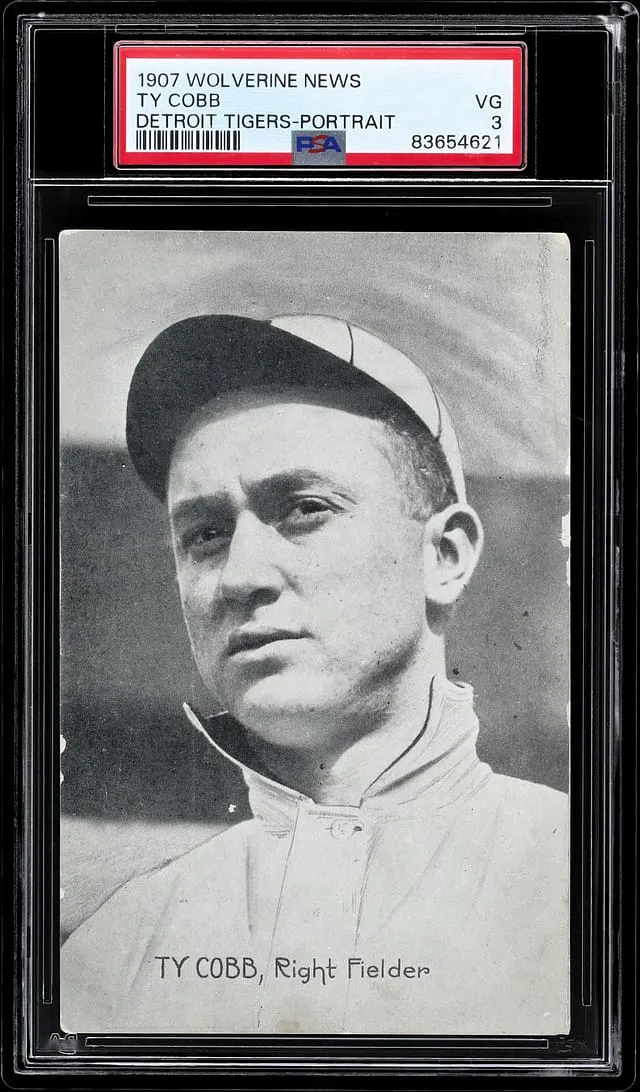
1907 Wolverine News Ty Cobb Rookie Postcard Sale
Goldin sold a PSA VG 3 1907 Wolverine News Ty Cobb rookie postcard for $40,260 on Feb 22, 2026, setting a key benchmark for this scarce portrait.
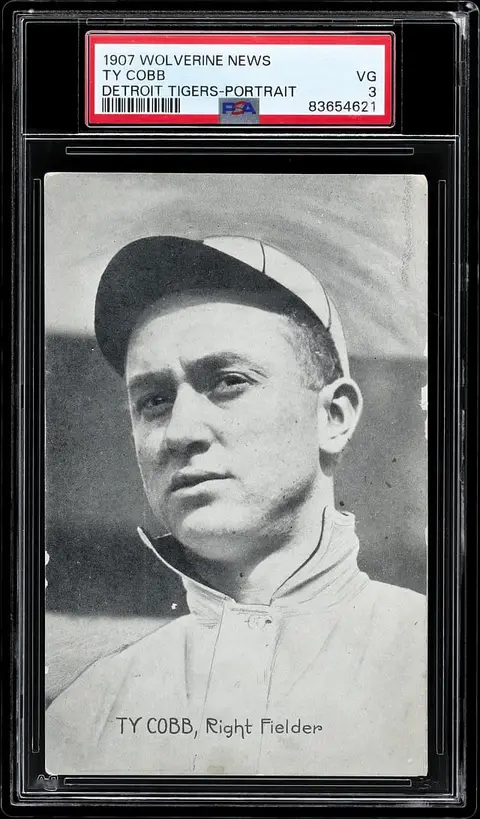
Sold Card
1907 Wolverine News Co. Ty Cobb Rookie Postcard; Scarce Portrait Variation – PSA VG 3 – POP 3; Highest PSA Copy
Sale Price
Platform
GoldinA $40,260 sale for a pre-war Ty Cobb rookie is always going to turn heads, but this one deserves a closer look.
On February 22, 2026, Goldin sold a 1907 Wolverine News Co. Ty Cobb Rookie Postcard, Scarce Portrait Variation, graded PSA VG 3 for $40,260. According to PSA’s population report, this is a POP 3 card in that grade and sits as the highest graded PSA example of this specific portrait variation.
For vintage baseball collectors and pre-war specialists, this checks nearly every box: early Cobb, regional issue, postcard format, and genuine scarcity in any presentable grade.
What exactly is this Ty Cobb card?
Let’s pin down the basics:
- Player: Ty Cobb (Detroit Tigers)
- Team: Detroit Americans (Tigers) – American League
- Year: 1907
- Issue: Wolverine News Co. Ty Cobb Postcard
- Variation: Scarce Portrait variation (distinct portrait image vs. more common batting/fielding poses)
- Format: Oversized postcard, pre-standard trading card era
- Rookie status: Widely regarded as a rookie-era postcard, and one of Cobb’s earliest mainstream hobby-recognized issues
- Grading company: PSA (Professional Sports Authenticator)
- Grade: VG 3 (Very Good)
- Population: POP 3 in PSA 3, none higher for this portrait variation at PSA
Unlike later mass-produced tobacco issues, this is a regional postcard distributed by Wolverine News Co., making it more of a hybrid between postcard and trading card. In the pre-war space, serious collectors treat these early postcards as core Cobb rookies or rookie-type issues.
There is no on-card autograph, patch, or serial numbering here—this is a straight vintage, condition-sensitive postcard where survival and eye appeal are the premium features.
Why collectors care about the 1907 Wolverine News Ty Cobb
1. One of Cobb’s true rookie-era issues
Ty Cobb debuted in MLB in 1905. By 1907, he was still in the early part of his career, and mainstream baseball cards were not yet standardized. That’s why early issues like:
- 1907-09 postcards
- 1907 Wolverine News
- 1908-09 W600s and early tobacco issues
are heavily targeted by collectors who want pre-T206, rookie-period Cobb pieces.
While you’ll see debate over which Cobb card is the “true” rookie, this 1907 Wolverine News postcard is firmly in the rookie-era conversation and is considered a key early Cobb by advanced vintage collectors.
2. Regional postcard with low natural survival
This is not a mass-produced national tobacco release. Wolverine News Co. operated regionally, and postcards from this era were often:
- Mailed and postmarked
- Pinned to walls or stored in albums
- Handled as stationary, not collectibles
That means fewer survivors, and many that do remain are creased, stained, trimmed, or heavily rounded at the corners. A straight, problem-free PSA VG 3 with decent eye appeal can feel more like a mid-grade card in a more durable, later issue.
3. Scarce Portrait variation
Within early Cobb postcards, the image variation matters a lot. Batting and action shots may have slightly larger surviving populations, but portrait images:
- Show Cobb’s facial details and early uniform
- Tend to be favored by collectors who like “iconic” player images
Here, the auction description highlights this as a “Scarce Portrait Variation”, which is a meaningful distinction. It signals that this is not just a Wolverine News Cobb postcard, but a tougher portrait pose that is considerably thinner in the population.
Population and grade scarcity
When collectors talk about a “pop report”, they mean the grading company’s population report – essentially a headcount of how many copies exist at each grade.
For this card:
- PSA Grade: VG 3
- Population in this grade: POP 3
- Higher PSA grades: None listed as higher for this specific portrait variation
In practical terms, this means:
- Every collector who wants a PSA-graded example of this exact portrait is fighting over a very short list.
- Even if more raw copies exist, they may not grade as high or may never enter the grading ecosystem.
In vintage postcards, the difference between a 1, 2, and 3 can be dramatic in both appearance and price, because surface creases, writing, and paper breaks are so common.
Market context and recent sales
Public data on this exact 1907 Wolverine News Co. Ty Cobb Portrait, PSA 3, POP 3 is thin compared to more common Ty Cobb issues such as T206 or T205 cards. That said, you can still place this $40,260 result within a broader Cobb pre-war market.
Comparable categories
When direct “same card, same grade” sales are sparse, collectors look to comps (short for comparables, or similar recent sales) by considering:
- Era and player: Pre-war Ty Cobb
- Issue type: Postcard or regional premium vs. standard tobacco
- Grade level: Lower-to-mid technical grade but presentable
- Image: Portrait vs. action poses
Over the past few years, several patterns have emerged:
- Pre-T206 Cobb material has been steadily repriced upward. As the hobby has focused on true early issues, postcards and regional sets from 1907–1908 have moved from niche oddities into mainstream advanced-collector targets.
- Rare Cobb pre-war portraits often realize strong prices even in low grade. A visually respectable 1, 1.5, or 2 can sell well if the card is genuinely scarce and historically important.
- PSA tops of the pop in rare issues typically draw a premium. “Top of the pop” means the highest grade PSA has recorded for that card/variation.
Against that backdrop, a $40,260 hammer for a POP 3, none-higher Cobb portrait postcard is in line with the broader shift that rewards early, scarce, and visually strong Cobb pieces rather than just highest-graded mainstream sets.
Because public records for this exact card and grade are limited and sometimes fragmented across smaller auction houses or private deals, you’ll often see:
- Wider price ranges for similar Cobb postcards, depending on pose and condition
- Occasional outlier sales when two or more advanced Cobb or type-card collectors go head-to-head
In other words, this Goldin result looks more like current market recognition of a legitimately scarce, important piece than a random spike detached from context.
How this sale fits the broader Ty Cobb market
The Ty Cobb market has a few consistent pillars:
- T206 remains the entry and anchor point, especially with the Green Background or Red Background portraits.
- Early, pre-T206 issues have been selectively revalued, especially regional postcards and cabinet photos.
- Condition and authenticity are critical, given the age and fragility of these pieces.
This Wolverine News portrait checks all three boxes collectors look for in a “serious” Cobb card:
- It predates or sits right alongside the earliest mainstream Cobb issues.
- It comes from a documented, cataloged set that advanced collectors recognize.
- It is population-limited and condition-sensitive, with a clear PSA record supporting its scarcity.
The $40,260 Goldin sale on February 22, 2026 doesn’t reset the entire Cobb market, but it reinforces a few trends:
- Scarce early-regionals are not lagging behind flagship sets anymore. They’re now priced as core pieces in a player’s run.
- Top-of-the-pop examples in rare sets command a real premium, even when the technical grade is only VG.
- Collectors are increasingly comfortable paying for story, history, and scarcity, not just for a familiar set name.
What this means for different types of collectors
For newcomers
If you’re just getting into Ty Cobb or pre-war baseball, this card illustrates why early vintage can look expensive even at low grades:
- You are paying for age + scarcity + player + condition, not just one variable.
- Many early Cobb pieces live in the $1,000+ range even when heavily worn, because demand far outstrips supply.
You don’t need to chase a 1907 postcard to enjoy Cobb collecting. But understanding why a card like this sells for over $40,000 helps you:
- Recognize why PSA 1 and PSA 2 Cobbs still have real markets
- Appreciate that not all “old” Cobbs are equal; issue and variation matter a lot
For active hobbyists and small sellers
For experienced collectors who buy and sell:
- This result supports the idea that well-documented early-regionals with clear provenance and grading can punch above their visual grade.
- It may also nudge more owners of raw pre-war postcards to consider grading, especially if they hold early stars or portrait poses.
At the same time, this is not a guarantee of future prices. The buyer pool for rare pre-war Cobb postcards is narrower than for, say, a T206 Cobb, and individual results can depend heavily on:
- Auction timing
- Consignment quality
- Cross-competition with other big vintage lots
Key takeaways from the Goldin sale
To recap the essentials:
- Card: 1907 Wolverine News Co. Ty Cobb Rookie Postcard, Scarce Portrait Variation
- Grade: PSA VG 3 (Very Good), POP 3, highest PSA-graded example
- Sale: $40,260 at Goldin on February 22, 2026 (UTC)
- Significance: Early, rookie-era Cobb issue from a scarce regional postcard set, with a tough portrait image and extremely limited graded population
For figoca users tracking vintage baseball and pre-war trends, this sale is a useful reference point the next time you’re evaluating:
- A pre-war star postcard with thin population data
- Whether a low-to-mid grade vintage piece may still carry major historical weight
- How much collectors value “firsts” and early portraits for icons like Ty Cobb
The 1907 Wolverine News Cobb portrait won’t be a weekly auction item. That’s precisely why this Goldin result is worth bookmarking: it helps set expectations for what the market is currently willing to pay for true early Cobb scarcity, even when the label reads only “VG 3.”