1906–07 Ty Cobb W601 Sporting Life Rookie Sells
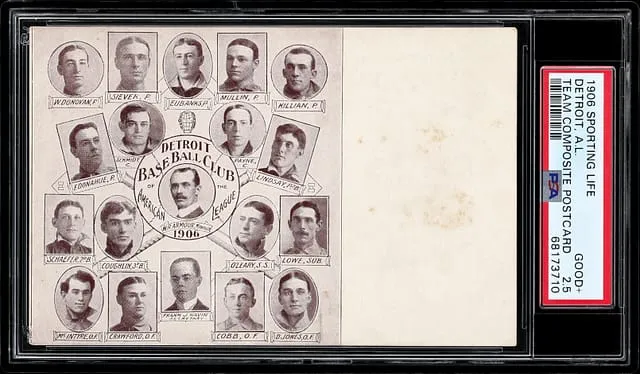
Goldin sells a rare 1906–07 W601 Sporting Life Detroit Ty Cobb rookie postcard for $15,860. Pop 1 in PSA 2.5, with only one higher graded copy known.
Sold Card
Extremely Rare 1906-07 W601 Sporting Life Team Composite Postcard Detroit – Ty Cobb “True” Rookie & His Inaugural Appearance on any Sports Card - PSA GD+ 2.5 – POP 1; Only One Higher PSA Copy
Sale Price
Platform
GoldinExtremely Rare 1906–07 W601 Sporting Life Detroit Ty Cobb Rookie Sells for $15,860
When a pre-war rarity surfaces, the hobby tends to pause and take notice. That’s exactly what happened on February 22, 2026, when Goldin sold an extraordinarily scarce 1906–07 W601 Sporting Life Detroit Tigers team composite postcard featuring a young Ty Cobb for $15,860.
This piece is more than just a vintage oddball. Many historians and advanced collectors view it as Cobb’s “true” rookie appearance and his inaugural presence on any sports card.
In this post, we’ll unpack why this card matters, how rare it really is, and what this sale might mean for collectors who track early baseball issues.
Card overview: what exactly sold?
• Issue: 1906–07 W601 Sporting Life Team Composite Postcard
• Team: Detroit Tigers
• Key player: Ty Cobb (appearing in the team composite as a young outfielder)
• Type: Team composite premium / postcard, issued by Sporting Life
• Era: Pre-war (deadball era)
• Grading company: PSA (Professional Sports Authenticator)
• Grade: PSA GD+ 2.5
• Population: PSA Pop 1 in this grade; only one higher PSA-graded example known at the time of the sale
• Player status: Widely regarded among advanced hobbyists as Cobb’s earliest carded appearance – often called his “true” rookie card
The W601 Sporting Life team composites are large-format premiums originally distributed by the Sporting Life publication in the early 1900s. They feature sepia-toned photographic montages of entire teams, with individual player portraits arranged around a central image.
In the case of this Detroit Tigers issue, Ty Cobb appears early in his playing career, several years before his more familiar tobacco-era cards (like the T206 portraits). That combination of era, subject, and format is what puts this piece in a different category from standard cards.
Why collectors care about W601 Sporting Life issues
The W601 Sporting Life series occupies a niche but important place in pre-war baseball collecting:
Early photographic appearances
These composites often capture players before they appear in mainstream sets. For a cornerstone figure like Ty Cobb, any confirmed earliest appearance carries extra weight.Low surviving population
These were not pack-issued cards. They were premiums and display pieces, more likely to be pinned, folded, written on, or simply discarded. As a result, few high-grade examples survived.Cross-collecting appeal
• Pre-war specialists pursue them as a core part of early 20th century baseball ephemera.
• Ty Cobb player collectors see this as a pinnacle piece.
• Rookie-focused collectors treat it as a foundational issue in Cobb’s card timeline.Historical context
Sporting Life was one of the major baseball publications of the era, competing with The Sporting News. Its premiums document the sport at a time when professional baseball was still formalizing its national identity.
Rookie status and “true” rookie discussion
In the vintage market, the concept of a “rookie card” can be different from modern definitions. For ultra-early players, especially from the deadball era, collectors often talk in terms of:
• Earliest known carded appearance (any format)
• First mainstream or widely distributed issue
• First appearance in a widely collected set (for Cobb, many casual collectors think of T206)
This W601 Sporting Life Detroit team composite is often cited in hobby research as Cobb’s inaugural appearance on any sports card. That’s why you’ll see it described as a “true” rookie, even though it doesn’t look like a standard small-format trading card.
For serious Cobb collectors, that early photographic debut, paired with documented Sporting Life provenance, gives the issue outsized importance relative to its modest numerical grade.
Grading, condition, and population
This example received a PSA GD+ 2.5. In pre-war collecting, especially for large-format pieces and premiums, lower numerical grades are common and often entirely acceptable.
Key grading context:
• PSA Grade: GD+ 2.5
A 2.5 indicates obvious handling and wear—creases, corner wear, light soiling, or small edge issues—but still retains visual integrity.
• Pop Report (Population Report):
A “pop report” is a grading company’s public tally of how many copies of a specific card they have graded at each grade level.
– This Cobb W601 Detroit is Pop 1 in PSA 2.5.
– There is reportedly only one higher PSA-graded copy at the time of sale.
– That means this piece sits near the very top of the PSA census for this exact issue.
With premium issues like W601, the absolute number of graded copies tends to be small. Many surviving examples sit in lower grades due to the fragile, larger-format nature of the originals.
Market context: how does $15,860 fit in?
The Goldin sale on February 22, 2026, closed at $15,860. To understand where that lands, collectors often look at “comps” (short for comparables)—recent, confirmed sales of the same card or closely related versions.
Because this exact card is extremely scarce and rarely comes to market, there are limited direct comps in public auction records. What we can say with some grounding:
• W601 Cobb appearances generally trade infrequently, with multi-year gaps sometimes occurring between public offerings.
• When they do appear, even well-worn examples tend to command meaningful premiums relative to more common Cobb issues from later tobacco-era sets.
• The combination of PSA encapsulation, confirmed Cobb image, and the Pop 1/only-one-higher status helps support a five-figure result in today’s pre-war market.
Compared with Cobb’s more widely known cards (for example, T206 portraits), the absolute dollar figure here may look modest. But in the context of ultra-early, specialty-format issues with little supply and very thin sales history, $15,860 is consistent with how the hobby often values rare, historically important but non-flagship pieces.
Because public comps remain sparse and infrequent, it’s more accurate to treat this sale as a data point in a thin market rather than a firm “going rate.”
How this fits into Ty Cobb’s broader card market
Ty Cobb’s card market has remained comparatively steady over time, supported by:
• Inner-circle all-time status
• Continued interest in pre-war baseball history
• Strong demand from player collectors and set builders
Within that ecosystem, there’s a clear hierarchy:
- Early, rare issues (like W601 Sporting Life, early postcards, and specialty premiums)
- Iconic tobacco cards (such as T206 Cobb portraits and the green background version)
- Later career and regional issues
The W601 Detroit composite sits in the first category—early and rare—making it more of a specialist’s target than a casual collector’s entry point. Its value is driven as much by historical placement and scarcity as by visual familiarity.
Takeaways for collectors and small sellers
For collectors:
• Pre-war premiums matter:
Items like W601 team composites are a reminder that the early card landscape included newspapers, postcards, and premiums—not just standard-size cards.
• Condition expectations differ:
A PSA 2.5 for a fragile, large-format issue from 1906–07 can be considered respectable, especially when population is extremely thin.
• Market data is thin:
When comps are limited, focus less on precise price predictions and more on your own collecting goals: player focus, era interest, or historical significance.
For small sellers:
• Research beyond the label:
If you encounter Sporting Life premiums or similar early ephemera, it’s worth checking hobby references, auction archives, and population reports before estimating value.
• Grading can unlock context:
Submitting rare, early pieces to a major grader like PSA can help clarify authenticity, condition, and relative scarcity via the pop report.
Final thoughts
The February 22, 2026 Goldin sale of the 1906–07 W601 Sporting Life Detroit team composite featuring Ty Cobb for $15,860 provides a useful snapshot of how the hobby values historically important, thinly traded pre-war issues.
While it may not grab headlines like a record-breaking T206 Cobb, this postcard sits at the very beginning of Cobb’s carded story. For collectors who care about origins, documentation, and scarcity, it’s precisely the kind of piece that quietly shapes how we understand the early baseball card market.
As more early premiums are graded and documented, sales like this help refine our picture of what “rookie” really means in the pre-war era, and how the market weighs history alongside condition and eye appeal.