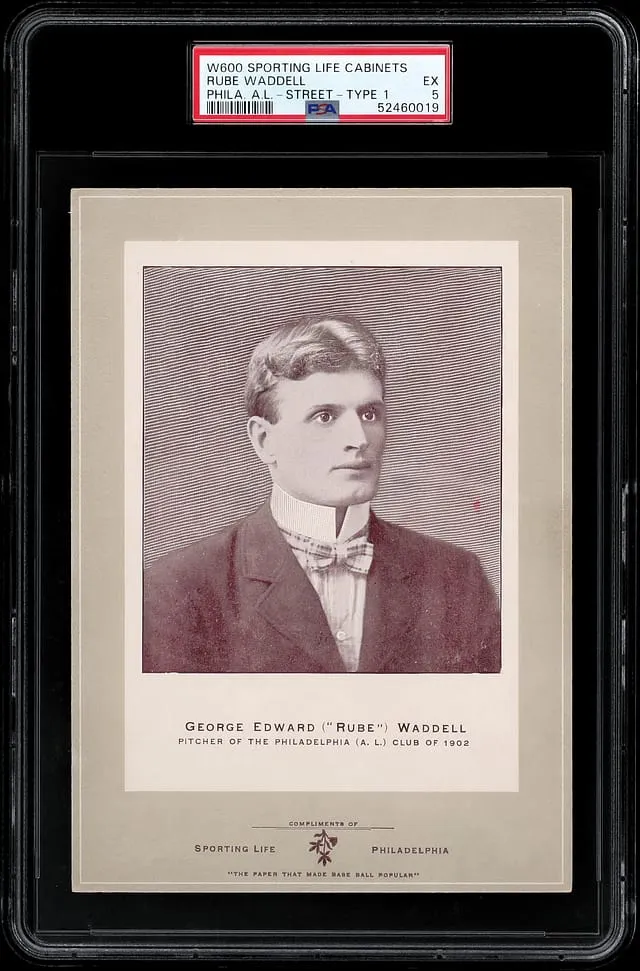
1902 W600 Rube Waddell Rookie PSA 5 Sells at Goldin
Figoca breaks down Goldin’s $31,720 sale of the 1902 W600 Rube Waddell rookie (PSA EX 5, POP 1) and what it means for prewar baseball collectors.
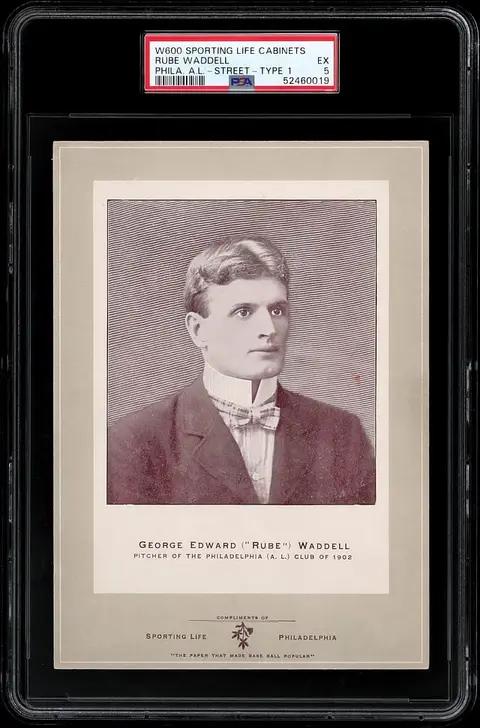
Sold Card
Extremely Rare 1902 W600 Sporting Life Cabinet Type 1 Mount Rube Waddell Street Clothes Rookie Card – PSA EX 5 - Waddell’s True Inaugural Baseball Card; POP 1; Only One Higher PSA Copy
Sale Price
Platform
GoldinExtremely Rare 1902 W600 Sporting Life Cabinet Type 1 Mount Rube Waddell Street Clothes Rookie Card – PSA EX 5 - Waddell’s True Inaugural Baseball Card; POP 1; Only One Higher PSA Copy Sells for $31,720 at Goldin
Goldin reported the sale of an important early baseball card on 2026-02-22: a 1902 W600 Sporting Life Cabinet Type 1 Mount Rube Waddell “Street Clothes” rookie, graded PSA EX 5, closing at $31,720.
For prewar collectors and anyone curious about how deep vintage goes, this card checks almost every box: true rookie status, a scarce regional issue, eye appeal at a strong grade level, and extremely low population.
Below is a breakdown of what this card is, why it matters, and how this sale fits into the broader market.
Card identification and key details
- Player: Rube Waddell (Hall of Fame pitcher)
- Team: Philadelphia Athletics (American League)
- Year: 1902 (early career period and widely treated as his true inaugural card)
- Set: W600 Sporting Life Cabinet
- Variant: Type 1 mount, “Street Clothes” portrait
- Card type: Oversized cabinet premium issued by Sporting Life newspaper
- Status: Widely considered Waddell’s true rookie card / inaugural hobby card
- Grading company: PSA (Professional Sports Authenticator)
- Grade: EX 5
- Population note: PSA population 1 in EX 5, with only one copy graded higher at the time of sale
- Attributes: Large cabinet format on a Type 1 mount; non-action, studio-style portrait in everyday dress, not a uniform pose
The W600 Sporting Life cabinets were issued between 1902–1911 and were never mass-distributed like tobacco or gum cards. They were ordered by mail as a premium from Sporting Life magazine, which dramatically limited how many survived at all, let alone in collectible condition.
Why the W600 Rube Waddell matters
Rube Waddell’s place in baseball history
George Edward “Rube” Waddell (Hall of Fame class of 1946) was one of the most dominant and eccentric pitchers of the deadball era. Known for enormous strikeout totals and a mercurial personality, he led the American League in strikeouts six times. Modern analytics often highlight just how far ahead of his contemporaries he was in missing bats.
For vintage collectors, Waddell sits in that important tier of early 1900s stars: not as universally recognized as Cobb or Wagner, but firmly in the core deadball Hall of Fame group. His earliest issues have long been chased by focused prewar and Hall of Fame rookie collectors.
Why collectors care about W600 Sporting Life
The W600 Sporting Life series is a premium, oversized cabinet set produced by the Sporting Life newspaper, starting in 1902. Collectors value the set for several reasons:
- Scarcity by design: These were mail-order premiums, not pack-issued cards. Fewer were produced, and fewer still survived.
- Cabinet format: The larger size and photographic-style portraits offer a very different look from tobacco and caramel issues of the same era.
- Key early appearances: The set includes some of the earliest or first-card appearances for a number of stars, which matters to “rookie card” and “Hall of Fame run” collectors.
- Type and mount differences: The Type 1 mount is particularly desirable among specialists because it ties to the earliest period of production, which aligns with Waddell’s early Athletics years.
In hobby terms, this Waddell is a key issue: a card that anchors both Waddell-specific player collections and broader Hall of Fame rookie or prewar type collections.
Grading, condition, and population
In the context of more modern cards, a PSA 5 might sound ordinary. For a 1902 oversized cabinet that was likely tacked to walls, stored in albums, or simply thrown away, EX-level condition is meaningfully high.
Key condition points for this card type:
- Oversized format risk: Corners and edges are prone to dings, creases, and chipping. Many surviving W600s show heavy wear.
- Mount surface: Staining, album removal damage, and paper loss are frequent.
- Image clarity: Photo contrast and surface gloss can fade or scratch over time.
The PSA population report at the time of sale lists this Rube Waddell W600 “Street Clothes” Type 1 as:
- PSA EX 5: Population 1 (this card)
- Higher than EX 5: Only one example graded above it
For a set like W600, where the total graded population is tiny, each example in mid-to-high grade is closer to a unique object than a routinely traded commodity. The term “POP 1” simply means this is the only known example graded at that exact level by PSA.
Market context and price comparison
This Goldin result at $31,720 sits in a small but instructive pocket of comps (comparative recent sales used by collectors to gauge fair value) for Waddell’s earliest cards and W600 Hall of Famers more broadly.
Because W600s are so scarce, direct apples-to-apples comparisons are limited. Most market context comes from:
- Other W600 Hall of Fame players in similar grades
- Waddell’s other early issues, especially tobacco and caramel cards
- Occasional past W600 Waddell sales across different mounts or conditions
How this price fits historically
From publicly available auction records and prior hobby reporting, several patterns show up:
- W600 Hall of Famers in solid mid-grade (when they surface at all) typically command strong five-figure results, with inner-tier stars and especially key rookies sometimes pushing higher.
- Prewar Hall of Fame “true rookie” pieces continue to hold a meaningful premium over later issues, reflecting their place in player-run collections.
- Waddell specifically has seen gradual, not explosive, price shifts over the last decade. Interest grows as more collectors move into focused Hall of Fame and prewar projects.
Relative to that context, $31,720 for a POP 1 EX 5 example of Waddell’s W600 rookie sits comfortably in the strong-but-not-unhinged range for a major prewar key. In other words, it reads less like a speculative spike and more like a serious collector stepping up for a piece that rarely appears, especially at this grade level.
Because true 1:1 comps (same card, same grade) are scarce or absent in recent years, it’s more accurate to see this sale as a benchmark: a data point that future W600 Waddell offerings—if they appear—will likely be measured against.
Why the “Street Clothes” Type 1 mount matters
Within W600, collectors sometimes differentiate by pose, attire, and mount style. This card features Waddell in street clothes on a Type 1 mount, which matters in several ways:
- Era-correct styling: The Type 1 mount aligns with the earliest runs of W600s and matches Waddell’s 1902 Athletics period.
- Distinct look: Collectors of prewar photography often appreciate off-field or studio portraits; they have a different aesthetic than in-uniform action shots.
- Niche demand: While uniformed poses are often more immediately recognizable as “baseball cards,” the street clothes portraits are valued by hobbyists who focus on early baseball imagery and cabinet photography traditions.
In practice, the Type 1 mount plus street clothes image underline this card’s status as a true early-period artifact rather than just another catalog entry.
What this means for collectors
For prewar specialists
This sale underlines a few ongoing truths about the pre-World War I segment:
- Real scarcity still matters. When population counts are in the single digits, each new auction can reset expectations.
- Hall of Fame rookies continue to draw focused demand. Even without major news around Waddell himself, his earliest card issues remain sought after.
- Condition tiers are magnified. The step from heavily worn to presentable mid-grade can be more important for cabinets than the same numerical jump would be for modern cards.
For newer or returning collectors
If you’re more familiar with 1950s Topps or modern chrome issues, the W600 sale offers a different lens:
- Not all vintage is equally available. A 1902 cabinet set like this can be more comparable to art prints than to mass-produced cards.
- “Comps” can be thin. In ultra-scarce segments, you won’t always find a perfect recent comparison. Instead, collectors triangulate from nearby sets, players, and grades.
- Grading numbers mean different things in different eras. A PSA 5 from 1902 can be dramatically tougher than a PSA 8 from 1980.
This is a reminder that when you move into prewar, you’re not just collecting “old cards” — you’re dealing with objects that may have fewer than a handful of surviving graded examples.
No news-driven spike, just steady demand
Unlike modern or ultra-modern players whose cards react quickly to awards, streaks, or hype cycles, Rube Waddell’s market is relatively stable. There has been no recent performance news to move his cards; instead, demand tends to come from:
- Hall of Fame set builders (collectors chasing a rookie or first-card for each Cooperstown inductee)
- Prewar specialists focused on early 1900s issues
- Type collectors seeking one representative example from important sets like W600
The $31,720 Goldin result appears aligned with those long-term collecting priorities rather than any short-term catalyst.
Takeaways for hobbyists and small sellers
For collectors and small sellers evaluating their own vintage holdings, this sale illustrates a few practical points:
- Documentation matters. Knowing the exact type (here, “Type 1 mount, street clothes”) can meaningfully affect how the card is perceived.
- Population reports are context, not destiny. A POP 1 tag adds scarcity, but real demand still comes from how important the card is to active collecting goals.
- Auction houses can surface specialized buyers. For niche prewar material, major houses like Goldin often connect items with the small set of collectors ready for five-figure purchases.
While a 1902 W600 Waddell is a niche item, the principles—understanding set history, grading context, and collector demand—apply across the hobby.
Summary
The 1902 W600 Sporting Life Cabinet Type 1 Mount Rube Waddell Street Clothes rookie, graded PSA EX 5 (POP 1, one higher), realized $31,720 at Goldin on 2026-02-22.
This result reinforces the card’s status as Waddell’s true inaugural appearance in the hobby, highlights ongoing strength in prewar Hall of Fame material, and sets a fresh benchmark for one of the most elusive early-1900s rookie cards. For collectors looking beyond the usual tobacco and gum issues, it’s another reminder that the deepest corners of vintage still have room for important, data-backed discoveries.