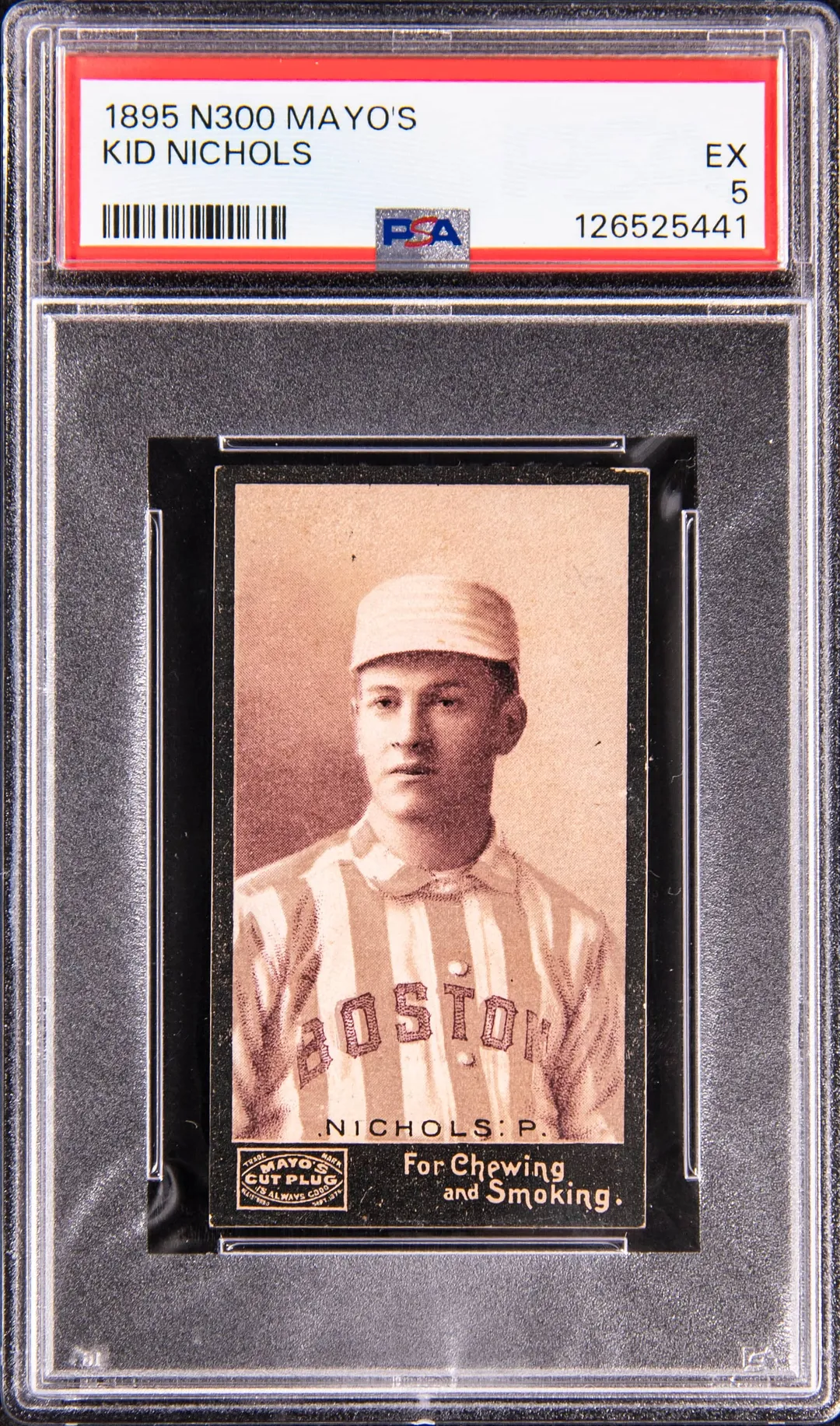
1895 N300 Kid Nichols PSA 5 Sells for $14,769
Goldin sold an 1895 N300 Mayo’s Cut Plug Kid Nichols PSA EX 5 for $14,769 on Feb 22, 2026. A key 19th-century Hall of Famer in mid-grade.
Sold Card
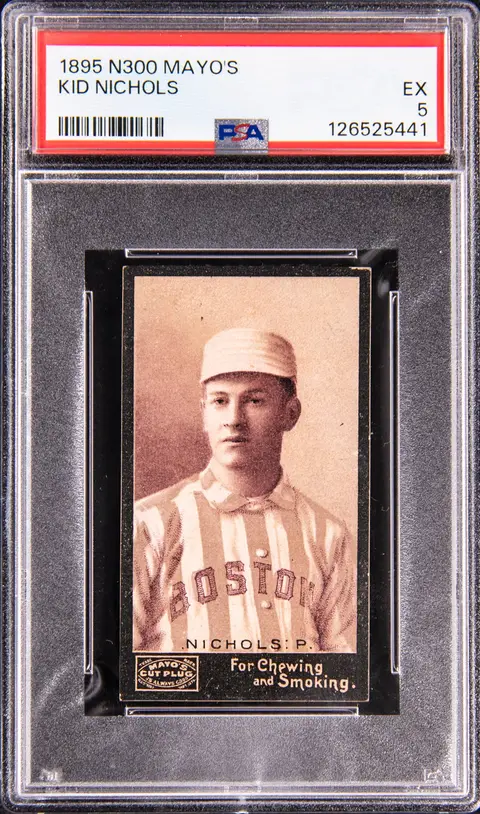
1895 N300 Mayo's Cut Plug Kid Nichols - PSA EX 5
Sale Price
Platform
GoldinA fresh result from the vintage side of the hobby puts an important 19th‑century Hall of Famer back in the spotlight. On February 22, 2026, Goldin sold an 1895 N300 Mayo’s Cut Plug Kid Nichols graded PSA EX 5 for $14,769.
For a card that predates the T206 era by more than a decade, this is the kind of comp (a recent, comparable sale) collectors pay attention to.
The card: 1895 N300 Mayo’s Cut Plug Kid Nichols – PSA EX 5
Set and issue
- Year: 1895
- Set: N300 Mayo’s Cut Plug (tobacco issue)
- Subject: Kid Nichols (Charles Augustus “Kid” Nichols)
- Team: Boston Beaneaters (National League)
- Card type: Base card from the set, not a parallel or modern insert
- Era: 19th‑century pre‑war tobacco card (pre‑World War I)
Grading details
- Grading company: PSA (Professional Sports Authenticator)
- Grade: EX 5 (Excellent)
- Attributes: No autograph or patch — this is a period lithographed tobacco card
For pre‑1900 cardboard, PSA 5 is firmly in the “collector grade” sweet spot: sharp enough to display well, but not so high that only a few elite registry chasers can pursue it.
Why the N300 Kid Nichols matters
A Hall of Famer from the 19th century
Kid Nichols is a foundational name in baseball history:
- 361 career wins, putting him near the top of the all‑time wins list
- Eight 20‑win seasons by age 30
- Elected to the Hall of Fame in 1949
In the vintage hobby, 19th‑century Hall of Famers sit in their own tier of scarcity and importance. There are simply fewer surviving examples, and the print runs were tiny compared to 20th‑century gum cards.
Importance of the N300 Mayo’s Cut Plug set
The N300 Mayo’s Cut Plug set is one of the key 1890s baseball issues. Produced as a tobacco premium, the cards are large and black‑bordered, which makes condition a challenge. Chipping, corner wear, and surface issues are common.
Because of that design, mid‑grade examples like PSA 4 and PSA 5 often see a steep value step up from lower grades.
Not a rookie in the modern sense, but still a key card
“Rookie card” is mostly a post‑war concept. For pre‑war and especially 19th‑century players, collectors generally talk about “earliest known cards” and “key issues” instead.
The 1895 N300 Kid Nichols is one of his important playing‑days tobacco cards, and for many Hall of Fame player collectors it functions as a core target alongside his other 19th‑century appearances.
Market context and price range
The Goldin sale closed at $14,769 on February 22, 2026.
Because this is a low‑population, pre‑1900 card, public sales in the exact same grade don’t surface very often. A typical research pass for a card like this involves:
- Checking major auction archives (Goldin, Heritage, REA, Memory Lane, etc.) for past N300 Nichols results
- Looking at PSA’s population report ("pop report" = how many copies exist in each grade) to understand how scarce PSA 5 and higher really are
- Comparing adjacent grades (PSA 4 and PSA 6) when exact‑grade comps are thin
Across the pre‑war market, you tend to see the following patterns:
- Grade sensitivity: Because so few high‑grade specimens exist, the jump from PSA 4 to PSA 5, and especially from PSA 5 to PSA 6, often brings disproportionately higher prices.
- Set premium: Core 19th‑century issues like N300 can outpace later dead‑ball cards of the same player because of age and scarcity.
- Subject premium: Hall of Famers and inner‑circle stars (Nichols, in this case) separate quickly from commons, even within the same set.
In that context, a realized price just under $15,000 for a PSA 5 aligns with how the market typically treats mid‑grade examples of important 19th‑century Hall of Famers: meaningful, but not an outlier reserved only for record‑setting headlines.
Rather than signaling a sudden spike, this sale looks like another data point in a thin but steadily watched segment of the vintage market.
Scarcity and condition: reading between the lines
For a card like the 1895 N300 Kid Nichols, scarcity works on several levels:
- Survival rate – Many 19th‑century issues were discarded or damaged over the decades.
- Condition attrition – The black borders of Mayo’s Cut Plug are unforgiving. Eye‑appealing copies in any grade are tough.
- Grade scarcity – When you look at the pop report, it’s common to see only a small handful of examples at EX 5 and above.
That’s why collectors often prioritize overall eye appeal within a given grade: centering, border chipping, and surface "cleanliness" can create price variance even among equal numerical grades.
How active collectors might use this sale
For active hobbyists and small sellers, a result like this has a few practical uses:
- Benchmarking: This Goldin sale provides a clear benchmark when evaluating offers or listing prices for similar condition Mayo’s Nichols cards or other 19th‑century Hall of Famers.
- Context for adjacent grades: Even if you hold a PSA 3–4 Nichols, or a different pre‑war set featuring him, this sale helps frame where the market currently values a clean mid‑grade example.
- Set and player priority: It reinforces how the hobby ranks N300 and 19th‑century Hall of Famers as long‑term, historically significant pieces rather than short‑term speculation.
What this doesn’t tell us
It’s important not to over‑interpret a single sale, especially in a niche segment:
- Pre‑war sales are thinly traded compared to modern and ultra‑modern cards; one strong or weak result can be driven by just a few motivated bidders.
- Private deals, show transactions, and international buyers don’t always show up in public data, so the full picture of demand is broader than a single auction.
Instead of treating this as a price guarantee, collectors can view it as a well‑documented reference point, especially because it comes from a major auction house with strong visibility.
Final thoughts
The February 22, 2026 Goldin sale of the 1895 N300 Mayo’s Cut Plug Kid Nichols – PSA EX 5 for $14,769 underlines how stable interest remains in 19th‑century Hall of Fame cardboard.
For newcomers exploring pre‑war for the first time, it’s a reminder that:
- Not all important baseball cards are from the 1950s and 1960s.
- Condition, set, and historical significance all interact to shape value.
- Thin populations mean each public sale matters, but no single auction defines the entire market.
For seasoned vintage collectors, this result is another data point affirming where a clean, mid‑grade N300 Nichols currently fits in the broader hierarchy of 19th‑century Hall of Fame issues.
As always, it’s best viewed not as a prediction, but as one more piece of evidence in an evolving market story.