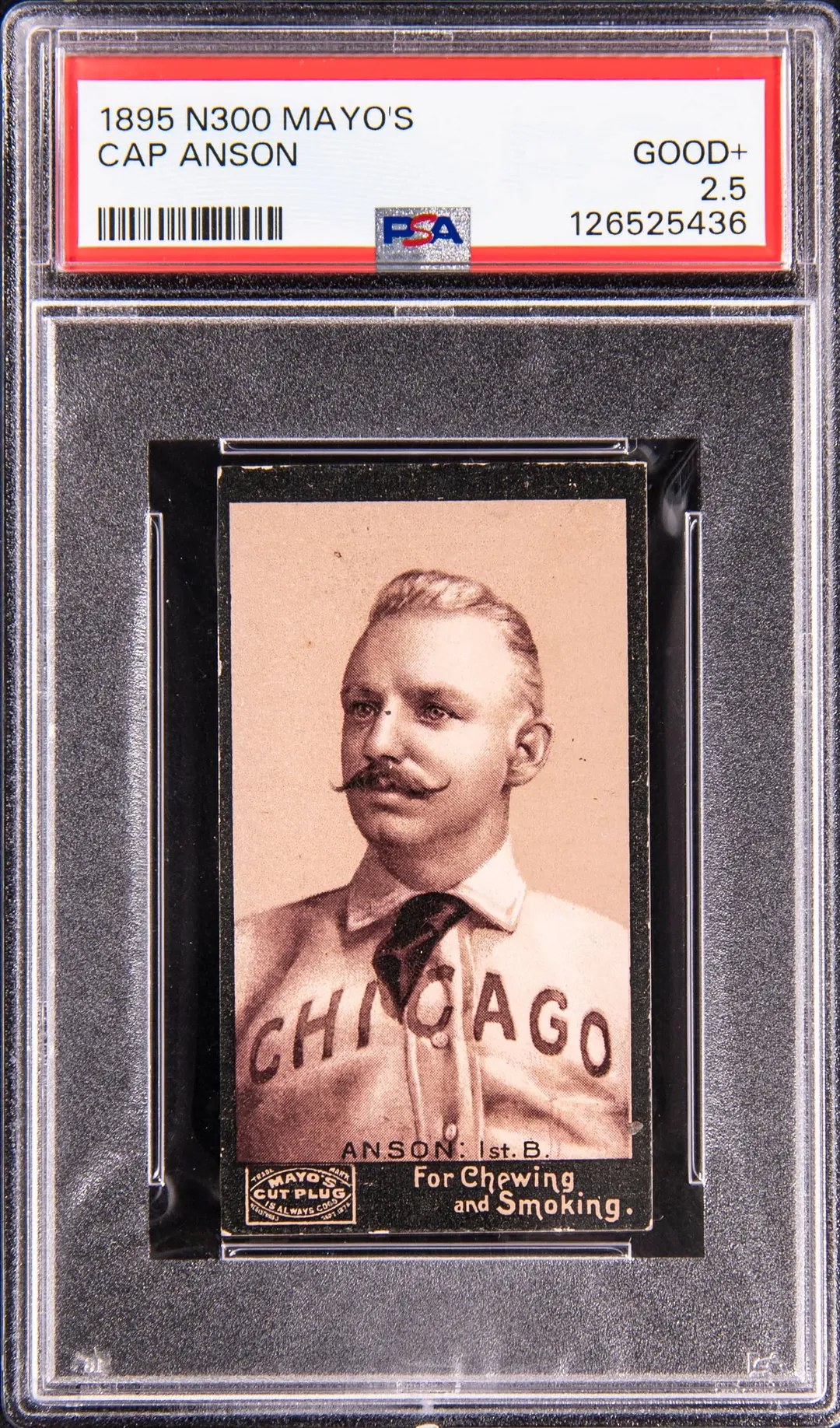
1895 N300 Cap Anson PSA 2.5 sells for $13,441
Goldin sold an 1895 N300 Mayo’s Cut Plug Cap Anson PSA 2.5 for $13,441. See the card’s context, comps, and what it means for vintage collectors.
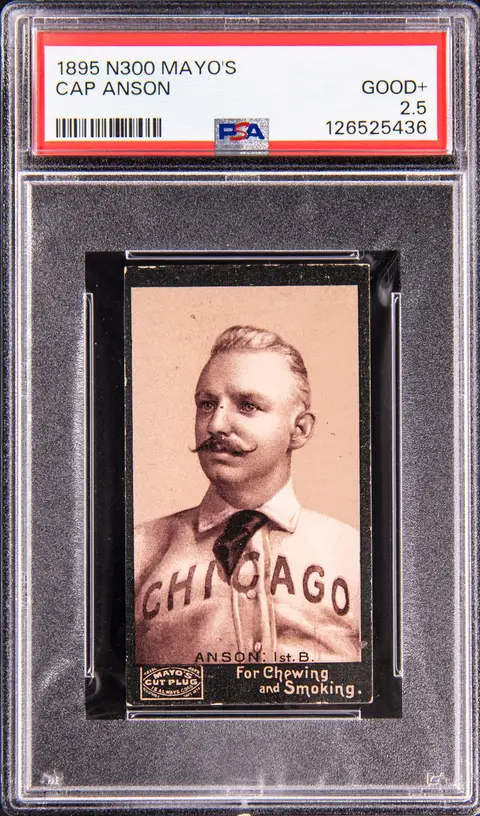
Sold Card
1895 N300 Mayo's Cut Plug Cap Anson - PSA GD+ 2.5
Sale Price
Platform
Goldin1895 N300 Mayo's Cut Plug Cap Anson (PSA GD+ 2.5) Just Closed at $13,441
On February 22, 2026, Goldin sold an 1895 N300 Mayo's Cut Plug Cap Anson graded PSA GD+ 2.5 for $13,441. For a 19th-century Hall of Famer in one of baseball’s most respected early tobacco issues, this is a result that deserves a closer look.
In this breakdown, we’ll walk through what this card is, why collectors care about it, and how this sale fits into the recent market context for N300 Cap Anson cards.
The card at a glance
- Player: Adrian “Cap” Anson (Hall of Fame, 1B)
- Team on card: Chicago (NL)
- Year: 1895
- Set: N300 Mayo’s Cut Plug
- Manufacturer: Mayo’s Cut Plug (tobacco issue)
- Card type: Standard base card from the set (no modern parallels or inserts)
- Era: 19th-century “pre-war” vintage
- Grading company: PSA (Professional Sports Authenticator)
- Grade: GD+ 2.5 (Good Plus)
There is no “rookie card” concept in the modern sense for 19th-century players, but Cap Anson’s N300 is widely treated as a key Hall of Famer card within one of the hobby’s most important early baseball sets. For many vintage-focused collectors, this is a bucket-list piece rather than a set filler.
Why Mayo’s Cut Plug matters
Mayo’s Cut Plug (N300) is an 1895 tobacco card issue, considered one of the foundational sets for advanced pre-war collections.
Key traits collectors care about:
Era and scarcity
These were issued in the mid-1890s, long before the more commonly discussed T206 era (1909–1911). Surviving examples are relatively few, and many are heavily worn.Design and condition challenges
N300s are known for their dark borders and photographic-style portraits. Those black borders chip and show wear very easily, which is why high-grade examples are extremely rare. Even low- to mid-grade copies are tough in straight, presentable condition.Hall of Fame content
The set includes early cards of several notable 19th-century stars. Cap Anson is one of the headliners: a dominant player of his era and a central figure in 19th-century baseball history.
Because of age, print quality, and handling over more than 125 years, PSA 2–3 range examples often represent the realistic “sweet spot” for many collectors who want authenticity and eye appeal without chasing the tiny population of higher grades.
Cap Anson’s hobby significance
Adrian “Cap” Anson is one of the most statistically dominant players of the 19th century, with over 3,000 hits by modern accounting and a major influence on how the game was played and organized. He is also a deeply complicated historical figure, particularly for his role in the racial segregation of baseball.
Collectors approach Anson with that full context in mind. From a card-history standpoint, however, his late-19th-century issues—especially Mayo’s Cut Plug and other tobacco-era cards—remain key pillars in:
- Hall of Fame player runs (collectors building a card of every Hall of Famer), and
- Pre-war master collections, where N300s are considered a top-tier target.
In practical terms, this means demand exists not just from “Anson collectors,” but from broader vintage and pre-war hobbyists who prioritise the major 19th-century sets.
Understanding the PSA 2.5 grade
PSA uses a 1–10 scale, where 10 is Gem Mint and 1 is Poor. A PSA 2.5 (Good Plus) typically allows for:
- Noticeable rounding or chipping on corners
- Surface wear, small creases or wrinkles
- Edge wear, especially on the dark borders
- Some soiling or light staining
For a 19th-century tobacco card, though, the grade tells only part of the story. Collectors also weigh:
- Photo clarity (is the portrait still strong?)
- Registration (is the image sharp, not blurry or misaligned?)
- Back integrity (legible text, no major paper loss)
- Overall balance (centering and how the wear “presents” in hand)
A well-centered, clean-looking PSA 2.5 can be preferred over a technically higher grade that has harsher visual flaws.
Market context: where does $13,441 sit?
When collectors talk about “comps,” they mean comparable recent sales—same card, similar grade, or adjacent grades—to understand current price ranges.
For the N300 Cap Anson, recent public auction results (across major houses and marketplaces) show a familiar pattern for pre-war Hall of Famers:
- Lower-grade authentic/PSA 1–1.5 examples typically sell meaningfully below mid–2s and 3s, reflecting heavier wear, back damage, or major creases.
- PSA 2–3 range is often the most actively traded band: relatively attainable, still scarce, and visually acceptable for most vintage-focused collectors.
- High-grade examples (PSA 5 and above) are extremely scarce and usually trade at a steep premium when they do appear. Those sales can reset expectations for the entire run.
Within that structure, a PSA 2.5 closing at $13,441 on Goldin on 2/22/26 sits in the mid-tier but respectable zone for a key 19th-century Hall of Famer from a blue-chip set. The exact placement versus recent comps will hinge on:
- Eye appeal versus other 2–3 graded copies
- Timing (auction calendar, competing vintage offerings that week)
- The specific buyer base Goldin attracts for pre-war material
Public sales data for this precise card/grade combination are limited, which is typical for 19th-century issues; the population is small and cards move infrequently. Instead of a steady “price ladder” by grade, you usually see:
- Occasional spikes when especially strong examples appear
- Some variance when less attractive copies change hands in the same grade
Against that backdrop, the $13,441 result looks orderly rather than out-of-band—consistent with a market that continues to value foundational pre-war pieces without the sharp swings often seen in modern ultra-rare parallels.
Population and scarcity
“Pop report” is hobby shorthand for population report, a grading company’s tally of how many copies of a card they have graded at each grade level.
For N300 Cap Anson, the PSA population is modest, with:
- A relatively small total number of slabbed copies compared to iconic 20th-century issues like T206 or 1950s Topps, and
- Very few examples in truly high grade because of the age, printing, and black borders.
While exact population figures evolve as more cards are submitted, the long-term story is stable: there is no large hidden supply waiting to flood the market. Most fresh finds surface slowly, often through estate discoveries or long-held family collections.
In practical collecting terms, that means:
- Each auction appearance of a presentable example draws interest from a fairly stable pool of vintage buyers.
- Price swings are driven more by competition on a given day than by large shifts in supply.
How this sale fits broader vintage trends
Stepping back from this single auction, the sale aligns with several ongoing trends in the vintage space:
Sustained respect for pre-war Hall of Famers
While modern and ultra-modern cards can experience fast boom-and-bust cycles linked to performance, news, or prospecting waves, 19th-century Hall of Famer cards tend to move more gradually. The Goldin sale shows that attention and capital are still present for historically important pieces.Preference for established auction houses
High-end vintage material like N300 Anson often gravitates to specialized auction houses such as Goldin. These venues can:- Market directly to advanced pre-war collectors
- Provide detailed descriptions and high-resolution images that matter for condition-sensitive cards
Grade tolerance when eye appeal is there
The strong result for a PSA 2.5 is another data point in a long-running theme: for pre-war, collectors often prioritize authenticity, completeness, and visual strength over the raw numeric grade.
What this means if you collect or sell similar cards
This Goldin sale doesn’t set a new paradigm on its own, but it does provide updated price context for anyone interested in N300 or other late-19th-century Hall of Fame cards.
A few practical takeaways:
For collectors building pre-war runs:
Results like this reinforce that securing a solid 2–3 grade example is still a realistic long-term goal, even if prices are well above modern base cards. Planning around irregular auction appearances remains key.For small sellers or inheritors of vintage collections:
If you encounter 19th-century tobacco cards—especially named Hall of Famers from established sets like N300—professional authentication and grading can materially change how the market receives them. Condition may be rough, but age and set importance still matter.For hobbyists watching the vintage vs. modern balance:
Steady outcomes on cards like this contrast with the more volatile segments of the hobby. They help explain why some collectors gradually rebalance toward historically significant, older issues.
None of this is a prediction of future values; it’s simply an observation that serious collectors continue to allocate budget to foundational pre-war cards, and this 1895 Mayo’s Cut Plug Cap Anson in PSA 2.5 is a clear example.
Final thoughts
The 1895 N300 Mayo's Cut Plug Cap Anson is not just another vintage single; it’s part of the backbone of 19th-century baseball card history. The $13,441 sale at Goldin on February 22, 2026, shows ongoing, measured demand for well-presenting examples, even in modest numeric grades.
For collectors who prioritize the story of the game and the evolution of the hobby, this card remains a key destination. And for the broader market, it’s another data point that early tobacco-era Hall of Famer issues continue to hold a meaningful place in advanced collections.