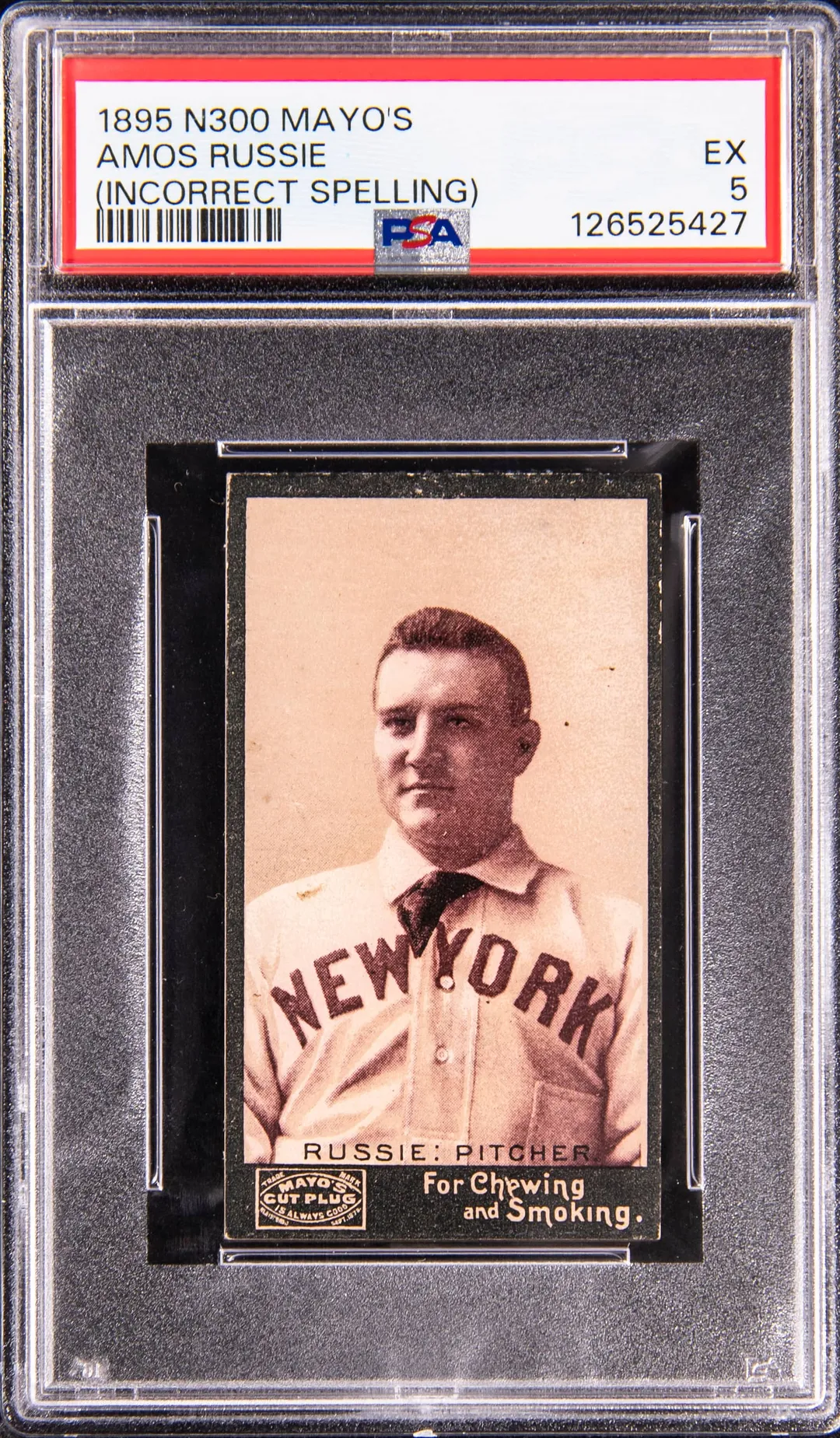
1895 N300 Amos Rusie PSA 5 Mayo’s Cut Plug Sale
Goldin sold an 1895 N300 Mayo’s Cut Plug Amos Rusie PSA EX 5, Pop 1, for $13,433 on Feb 22, 2026. Here’s what this vintage result means for collectors.
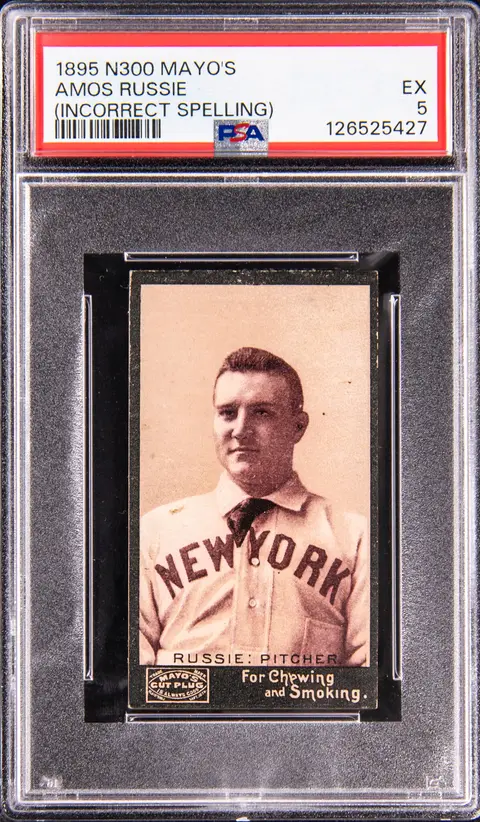
Sold Card
1895 N300 Mayo's Cut Plug Amos Rusie, Incorrect Spelling - PSA EX 5 - Pop 1
Sale Price
Platform
Goldin1895 N300 Mayo's Cut Plug Amos Rusie, Incorrect Spelling - PSA EX 5 - Pop 1: Market Breakdown
A late-19th century Hall of Famer just made some quiet noise in the vintage market. On February 22, 2026, Goldin sold an 1895 N300 Mayo's Cut Plug Amos Rusie, Incorrect Spelling, graded PSA EX 5, for $13,433.
For most of the modern hobby, this card lives well outside the usual lane of rookies, serial-numbered parallels, and case hits. But in the pre-war space, it checks several boxes at once: Hall of Famer, historically important set, tough condition, and a meaningful pop report.
Let’s unpack what sold, why it matters, and how this price fits into the broader market.
- What exactly is this card?
• Player: Amos Rusie (Hall of Fame pitcher) • Team: New York Giants (National League) • Year: 1895 • Set: N300 Mayo’s Cut Plug • Variant: Incorrect Spelling variety (the surname on front/back is mis‑spelled – a key cataloged variation) • Card type: Tobacco-era, pre‑war baseball issue • Grading company: PSA (Professional Sports Authenticator) • Grade: EX 5 • Population: Pop 1 at PSA in this grade, with none higher for this specific incorrect spelling variant (per Goldin’s description and current pop data at the time of sale)
The N300 Mayo’s Cut Plug release is a 19th‑century tobacco set issued by Mayo & Brother, better known for its football counterpart (the 1894 Mayo football set). The baseball run is significantly smaller and tougher. Cards are black‑bordered portraits on thick card stock, which makes high‑grade survivors extremely scarce.
The card is not a rookie card in the modern sense, but for 19th‑century Hall of Famers, any contemporary playing-days tobacco issue functions as a key card. Rusie had multiple 19th‑century appearances, but N300 is firmly considered a premier issue.
- Why Amos Rusie matters to collectors
For newer collectors: Amos Rusie isn’t a household name like Cobb or Ruth, but among pre‑war and Hall of Fame specialists, he is a foundational arm.
• Nickname: “The Hoosier Thunderbolt” • Era: Pitched primarily in the 1890s • Legacy: One of the dominant strikeout pitchers of the 19th century • Hall of Fame: Inducted in 1977 by the Veterans Committee
Rusie’s wildness and velocity were legendary enough that his impact is often linked to the eventual move of the pitching mound distance from 50 feet to 60 feet 6 inches. That kind of historical footprint gives his playing-days issues lasting collector relevance, even if he isn’t a stat-sheet name casual fans recognize.
- The N300 Mayo’s Cut Plug set in context
N300 Mayo’s Cut Plug is widely regarded as a key 19th‑century baseball issue:
• Era: Pre‑war, tobacco era (1800s) • Distribution: Tobacco premium card, originally inserted with Mayo’s Cut Plug tobacco • Design: Thick stock, black borders, portrait style, simple text • Condition difficulty: Black borders chip and show wear easily; surviving examples in EX (Excellent) or better are genuinely tough
Because of how and when these were distributed, the surviving population is small. When you further narrow to specific Hall of Famers like Rusie, and then again to error/incorrect spelling variants, you’re dealing with true scarcity rather than manufactured rarity.
- What “Incorrect Spelling” and “Pop 1” mean
In this case, “Incorrect Spelling” refers to a documented variety where Rusie’s name is not correctly spelled on the card. Many 19th‑century sets include name and team spelling variations; they’re tracked in hobby catalogs and set registries as separate, collectible varieties.
“Pop 1” comes from the population report (often shortened to “pop report”), which is the grading company’s tally of how many copies they’ve graded at each grade level.
• Pop 1: Only one copy has ever been graded PSA EX 5. • Often, auction listings will note if there are any higher examples (e.g., “none higher”). For this sale, the card is described as Pop 1, effectively sitting at or near the top of the population for this exact error variant.
This is different from a modern serial-numbered card. The card isn’t stamped “1/1,” but functionally, in this condition tier at PSA, it behaves like a one-of-one in the registry competition space. For set builders, type collectors, and Hall of Fame specialists, that matters.
- Market context and recent sales
Because this is a 19th‑century niche variant with very low supply, you won’t see a steady stream of comps — the hobby shorthand for “comparable recent sales.” Instead, pricing tends to be set by occasional high‑end auctions, like Goldin, Heritage, REA, and others.
Key points about the $13,433 result:
• Price level: For a 19th‑century Hall of Fame tobacco issue in EX with a documented error variety and Pop 1 status, a low–five‑figure result is consistent with broader pre‑war patterns, especially when you factor in how infrequently these surface. • Comps: Exact, recent auctions of the same N300 Rusie incorrect spelling in the same grade are limited or non‑existent. When sales are this sparse, collectors and auction houses often look sideways to: – Other Amos Rusie tobacco or caramel issues in similar grades. – Other N300 Hall of Famers in comparable condition. – The price curve between VG (Very Good) and EX/EX‑MT (Excellent to Excellent‑Mint) for similar 1890s stars. • Error/variant premium: Pre‑war collectors will often pay a premium for cataloged variations — especially when they are significantly scarcer than the base version. That premium is hard to quantify without multiple data points, but it’s clearly part of the story here.
The combination of:
- N300 being a recognized key 19th‑century set,
- Rusie’s Hall of Fame status and historical significance, and
- Pop 1 in EX 5 for a specific incorrect spelling variety,
helps explain why the card found a home around the $13,000 mark.
- How condition drives value in 19th‑century cards
For modern cards, most collectors focus on sharp corners and centering. Those matter here too, but the baseline is different:
• Surviving base: Many 1890s cards show heavy creasing, paper loss, trimming, and writing. Even a “presentable” 2 or 3 can be very desirable. • EX 5 meaning: At this grade you’re looking at: – Honest edge and corner wear – Limited or no major creasing – Strong overall eye appeal
The jump from a solid VG (3) to EX (5) can represent a big leap in both visual appeal and realized price. When the pop report at 5 and above is extremely thin, competition among condition-focused collectors can push numbers upward even if the card isn’t constantly in the social media spotlight.
- Who chases cards like this?
A card like the 1895 N300 Mayo’s Cut Plug Amos Rusie, Incorrect Spelling, PSA EX 5, Pop 1, lives at the intersection of several collector lanes:
• Hall of Fame player collectors – People who chase one playing-days card of every Hall of Famer. • 19th‑century specialists – Collectors who focus almost entirely on 1800s issues and know the population nuances across sets. • Set builders and registry competitors – Collectors assembling full or near-full N300 runs, often tracked on set registries where the highest-graded examples earn more points. • Variation collectors – Hobbyists specifically targeting error and misprint varieties across early sets.
Because these groups are relatively small but serious, auction outcomes can swing significantly based on whether two or three of them happen to collide on the same lot.
- How this sale fits the broader vintage market
This Goldin sale doesn’t rewrite hobby record books, but it underlines a few ongoing themes in the pre‑war and vintage space:
• Quality scarcity still commands respect – True scarcity (very few surviving copies, especially in higher grade) continues to matter more than manufactured scarcity. • Hall of Fame plus history is a durable combo – Even without mainstream hype, historically important Hall of Famers in key 19th‑century sets retain steady collector interest. • Low‑population variants are firming up – As more collectors learn how to read pop reports and variation checklists, documented mis‑spelled name varieties are increasingly recognized as distinct targets.
While modern segments of the market can be sensitive to player performance and hobby news cycles, 19th‑century Hall of Fame issues like this tend to move more slowly and deliberately. Prices react less to short‑term storylines and more to long‑term collector demand and the appearance of fresh, high‑quality examples.
- Key takeaways for collectors
If you’re newer to pre‑war cards and looking at this sale as a reference point:
• Expect very few direct comps – For many 1800s cards, you may only see a handful of public sales each decade in a given grade. • Focus on card, context, and condition – Player importance, set reputation, and the eye appeal relative to grade usually drive results. • Pop 1 is a strong signal, not a guarantee – A population report tells you about graded supply, not demand, but for registry-level cards like this, Pop 1 in EX or better is meaningful.
The 1895 N300 Mayo's Cut Plug Amos Rusie, Incorrect Spelling, PSA EX 5 Pop 1 sale at $13,433 on February 22, 2026, at Goldin is another data point showing how deep and steady interest in true 19th‑century baseball cardboard remains. It’s not about hype cycles; it’s about history, condition, and the thin supply that comes with 130‑year‑old cardboard.
- How figoca approaches sales like this
At figoca, we track both headline‑grabbing modern auctions and quieter, historically important results like this one. When you see us highlight a pre‑war sale:
• We look at verified auction data, not asking prices. • We consider the pop report and variation details. • We place each sale in its set, era, and player context rather than comparing it directly to modern ultra‑scarce inserts.
For collectors who are curious about venturing into 19th‑century cards, following sales like this is a useful way to learn what experienced vintage buyers are actually prioritizing: real scarcity, iconic sets, and Hall of Fame history that has already stood the test of time.