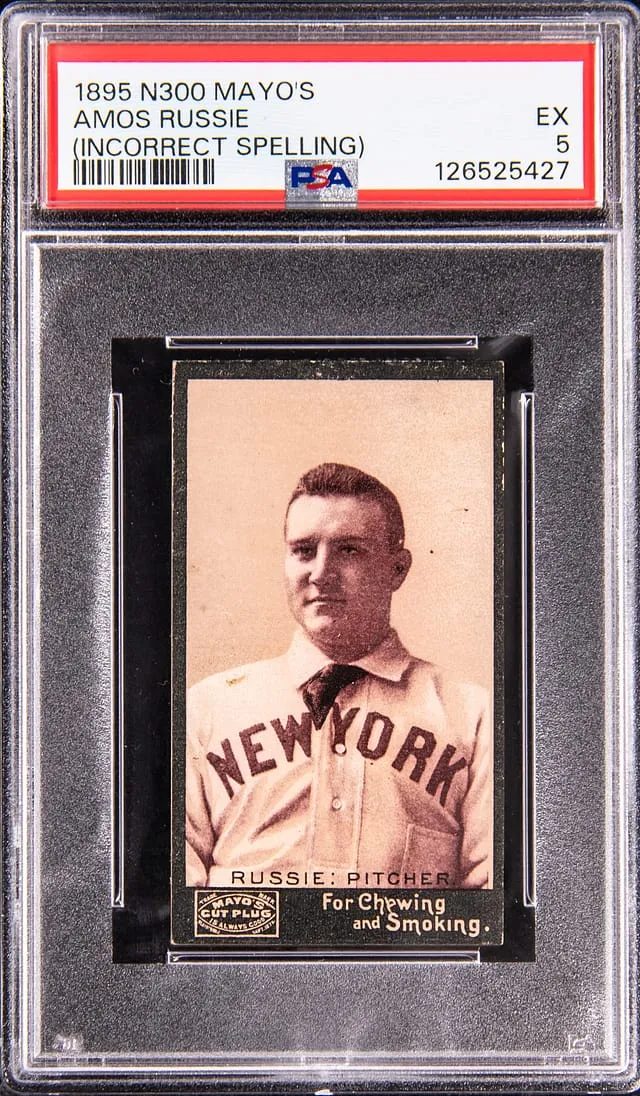
1895 N300 Amos Rusie Error PSA 5 Sells for $13K
Breakdown of the $13,433 Goldin sale of the 1895 N300 Mayo’s Cut Plug Amos Rusie incorrect spelling PSA EX 5, a Pop 1 pre‑war Hall of Famer.
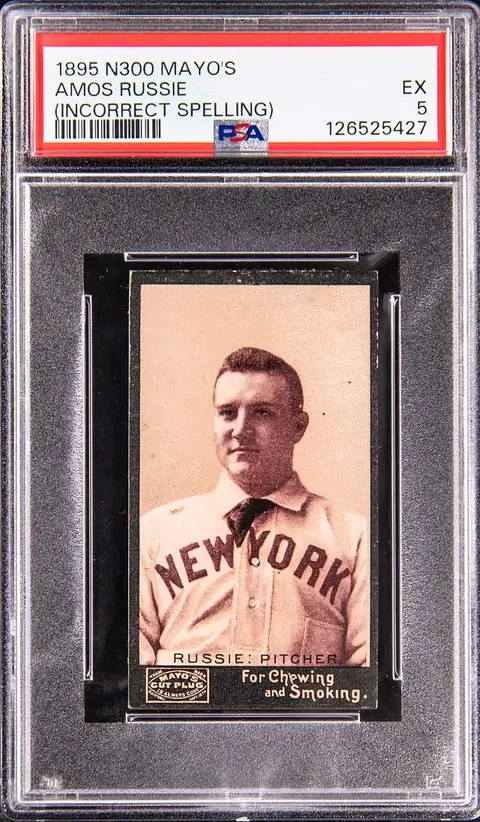
Sold Card
1895 N300 Mayo's Cut Plug Amos Rusie, Incorrect Spelling - PSA EX 5 - Pop 1
Sale Price
Platform
Goldin1895 N300 Mayo's Cut Plug Amos Rusie, Incorrect Spelling - PSA EX 5 - Pop 1 Sells for $13,433 at Goldin
When a 19th‑century Hall of Famer surfaces in a top vintage grade, the market tends to pay attention. That’s exactly what happened with the recent sale of an 1895 N300 Mayo's Cut Plug Amos Rusie “Incorrect Spelling” variation, graded PSA EX 5, which realized $13,433 at Goldin on February 22, 2026.
This card sits at the intersection of three things collectors care deeply about: early baseball history, scarce 1890s tobacco issues, and true condition rarity.
The card at a glance
- Player: Amos Rusie (Hall of Fame pitcher)
- Team: New York Giants (National League)
- Year: 1895
- Set: N300 Mayo’s Cut Plug
- Variation: Incorrect name spelling (often cataloged as the “Rusie/Rusle” type error, depending on the exact card)
- Manufacturer: P.H. Mayo & Bros. (tobacco insert)
- Era: Pre‑war, 19th‑century tobacco
- Grading company: PSA (Professional Sports Authenticator)
- Grade: EX 5 (Excellent)
- Population: Pop 1 at PSA in this grade, none higher for this specific spelling variety as of the time of sale
The N300 Mayo’s Cut Plug set is a classic 19th‑century baseball tobacco issue. Black, portrait‑style fronts with a clean design make it visually distinct from the better‑known white‑border T206 cards that came a decade later. Because these were packaged with tobacco, surviving examples often show heavy wear, creasing, and staining.
In that context, an EX 5 is a high‑end copy. For a 130‑year‑old card that was never meant to be preserved, this is firmly in the “condition rarity” category.
Why the Amos Rusie N300 matters
Amos Rusie is not a modern headline name, but among pre‑war collectors he is a foundational figure:
- Hall of Fame pitcher (Class of 1977) known as “The Hoosier Thunderbolt”.
- One of the dominant strikeout pitchers of the 1890s.
- Often discussed in connection with the evolution of pitching distance and rules changes in his era.
The N300 Mayo’s Cut Plug card is one of his key period issues and is frequently treated as a cornerstone card for 19th‑century Hall of Fame player runs. While it’s not a “rookie card” in the modern, clearly defined sense, it functions as a key early career card for Rusie and a major checklist item for pre‑war Hall of Fame collectors.
The incorrect spelling variety adds an extra layer. Early card makers were inconsistent with names, and misprints or spelling shifts are part of the charm of this era. For player and set specialists, owning a documented spelling variation often feels like having a more nuanced, complete representation of the player’s card history.
Population and scarcity
PSA’s population report (often shortened to “pop report,” which is the census of how many copies have been graded at each grade level) is central to understanding this sale.
For the Amos Rusie incorrect spelling N300:
- The card is Pop 1 in PSA EX 5.
- As of the sale date, there are no higher‑graded copies at PSA for this specific variety.
- The total graded population for this variation across all grades is very small compared to more mainstream pre‑war issues.
With 1890s tobacco cards, scarcity is not just about total population, but grade distribution. Many surviving examples cluster in Poor to Good (PSA 1–2), with a noticeable drop‑off as you move into VG‑EX and above. An EX 5 from this era often sits at the top of what many collectors would practically expect to see.
That is why a Pop 1, none higher label matters. It effectively makes this copy the highest‑graded known example within PSA’s ecosystem for this variation.
Market context and recent sales
Because 1890s Hall of Fame cards appear at auction infrequently—and specific spelling variations even less so—there is usually a limited number of direct comparables (“comps”). Comps are recent, similar sales that collectors use to get a sense of current market ranges.
For this card, the most relevant context comes from:
- Lower‑grade Amos Rusie N300 copies (both standard and spelling‑variant versions) from major auction houses.
- Other Hall of Fame players in the N300 set in similar grades.
- High‑grade examples of comparable 19th‑century tobacco Hall of Famers, where condition rarity drives premiums.
Recent public sales show:
- Lower‑grade N300 Rusie copies (in the Good to Very Good range) typically trade for meaningfully lower amounts than this Goldin result, reflecting the large gap between collector‑grade copies and truly high‑end examples.
- High‑grade N300 Hall of Famers overall have shown steady interest over the last few years, with prices generally firming or gently trending upward as set builders and pre‑war specialists compete for a limited supply of strong examples.
Within that framework, $13,433 for a Pop 1 EX 5 Rusie spelling variant sits toward the upper end of what would be expected for a key N300 Hall of Famer, but it is consistent with the way the market has been valuing:
- 19th‑century Hall of Fame cards in top‑tier grades, and
- Unique or highest‑known population examples.
The sale does not look disconnected from recent pre‑war pricing; it reads more like a strong but rational result in a niche, supply‑starved segment of the market.
Why collectors care about this result
For most collectors, the N300 set is something they see in auction catalogs more than in their personal boxes. But sales like this still matter for a few reasons:
Benchmark for condition premiums
This result reinforces how sharply prices can step up between mid‑grade and true high‑grade in pre‑war issues, especially when the pop report is thin.Validation of 19th‑century focus
There has been a steady undercurrent of interest in 19th‑century cards among advanced collectors. A healthy price for a more specialized card like the Rusie error supports the idea that demand for this segment is stable.Set‑building signal
For N300 set builders or Hall of Fame collectors, this sale provides an updated reference point for how aggressively they may need to bid when a comparable example surfaces. Not as advice—just as a piece of current market evidence.Attention to variations and errors
The fact that a specific spelling variation commands this kind of attention highlights how much nuance exists in pre‑war checklists. It’s a reminder that small details on the front of a card can translate into meaningful differences in scarcity and demand.
How this compares to other eras
Relative to:
- T206 Hall of Famers: N300 Rusie is far rarer in high grade. Even popular T206 names often appear more frequently at auction and in grading populations.
- Post‑war legends (Mantle, Mays, Aaron): Those markets are much more liquid, with frequent comps across many grades. By contrast, a Pop 1 1890s card may not reappear for years.
- Modern and ultra‑modern cards: Modern cards lean on serial‑numbering, parallels, and inserts to create scarcity. Here, scarcity is organic—survival over 130 years, not print design.
For collectors moving from modern into vintage, this sale is a concrete example of how age + condition + low population can create values typically seen in today’s low‑serial modern cards, but driven by history rather than chase design.
Takeaways for collectors and small sellers
A few practical observations from this Goldin sale on February 22, 2026:
- Condition matters exponentially in pre‑war. An EX 5 from 1895 is not equivalent to an EX 5 from 1975. The older you go, the more each incremental grade bump can matter.
- Population reports are tools, not guarantees. A Pop 1, none higher label signals rarity within one grading company, but it doesn’t automatically translate into a fixed value. The market still decides, card by card.
- Variations and errors are worth learning. Especially in pre‑war and early 20th‑century sets, small design or spelling differences can separate a common type card from a specialty piece that draws extra attention.
- Comps are guideposts, not promises. With obscure or thinly traded cards like 1890s Hall of Famers, recent results give you ranges, not precise targets.
For figoca users tracking pre‑war activity, this sale is another data point showing that historically significant, condition‑rare cards from the 19th century continue to see solid interest when they appear at major houses.
Quick summary
- Card: 1895 N300 Mayo's Cut Plug Amos Rusie, Incorrect Spelling
- Grade: PSA EX 5 (Excellent), Pop 1 for this variation, none higher at PSA
- Result: Sold for $13,433
- Auction house: Goldin
- Sale date (UTC): February 22, 2026
It is unlikely that this exact card—or an equal or better copy of this specific spelling variant—will resurface often. For collectors who focus on 19th‑century Hall of Fame material, this Goldin result will likely serve as a reference point the next time a high‑grade N300 Rusie comes to market.