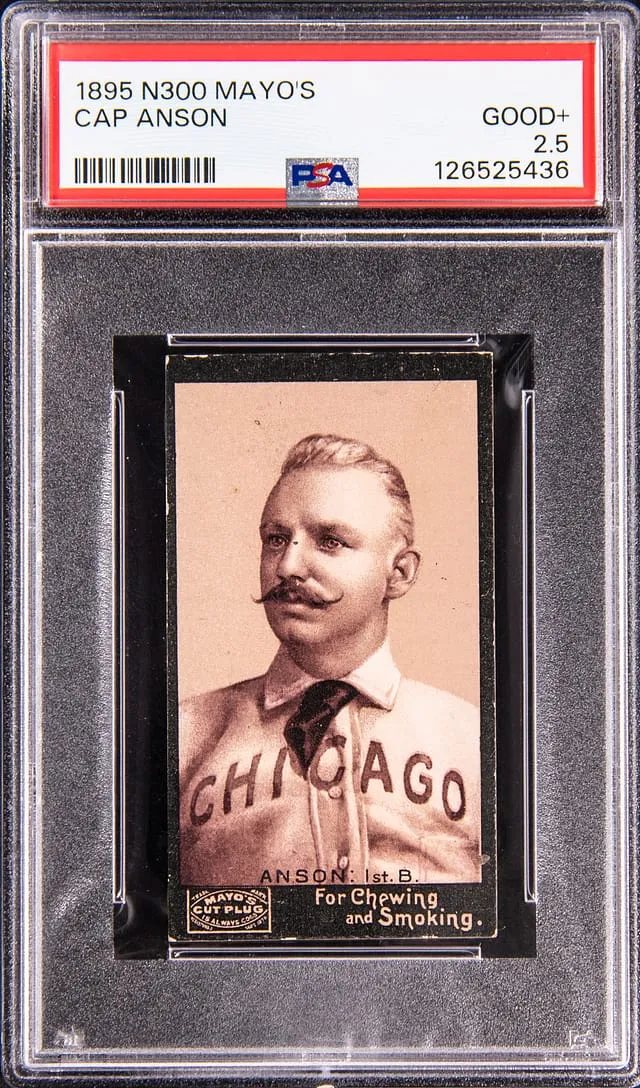
1895 Mayo’s Cap Anson PSA 2.5 Sells for $13,441
Goldin sold an 1895 N300 Mayo’s Cut Plug Cap Anson PSA 2.5 for $13,441 on Feb 22, 2026. See the card’s context, comps, and collector significance.
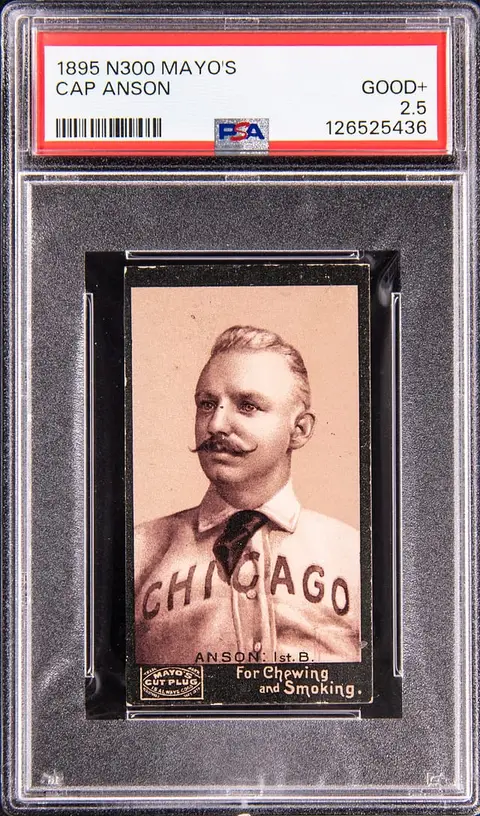
Sold Card
1895 N300 Mayo's Cut Plug Cap Anson - PSA GD+ 2.5
Sale Price
Platform
Goldin1895 N300 Mayo's Cut Plug Cap Anson (PSA GD+ 2.5) Sells for $13,441 at Goldin
On February 22, 2026, Goldin closed the sale of a true 19th-century hobby cornerstone: an 1895 N300 Mayo's Cut Plug Cap Anson graded PSA GD+ 2.5, which realized $13,441.
For many collectors who focus on pre-war and 19th-century baseball, this card is one of the foundational pieces of the entire vintage market. Here’s a closer look at why it matters and how this sale fits into the broader price picture.
Card breakdown: what exactly sold?
- Set: 1895 N300 Mayo's Cut Plug
- Player: Adrian "Cap" Anson
- Team: Chicago (National League)
- Era: 19th-century tobacco issue (pre-war vintage)
- Manufacturer: Mayo’s Cut Plug tobacco (N300 classification)
- Card type: Standard player card (no parallel or serial numbering)
- Grading company: PSA (Professional Sports Authenticator)
- Grade: GD+ 2.5
This is not a rookie card in the modern sense—Anson’s playing career dates back to the 1870s—but his N300 Mayo is considered one of his key playing-days issues. For many collectors, it serves as a flagship visual representation of one of the earliest true baseball stars.
The 1895 Mayo set is a black-bordered, portrait-based tobacco issue. Those black borders chip and show wear very easily, which is why surviving examples with intact borders are so difficult to find in higher grades.
Who was Cap Anson and why does his card matter?
Adrian "Cap" Anson was one of the dominant figures of 19th-century baseball:
- Longtime star for Chicago in the National League
- Over 3,000 hits (depending on how you count 19th-century stats)
- One of the first great offensive stars whose career totals stand out even today
From a purely collecting and historical standpoint, Anson is one of the key names in any pre-1900 run. His cards sit alongside Old Judge (N172), Allen & Ginter (N28/N29), and Mayo’s as the core images that represent that era in cardboard form.
While Anson’s legacy is complicated by his role in baseball’s color line, his playing-days cards remain important primary artifacts for collectors and historians studying the early professional game.
Set significance: 1895 N300 Mayo’s Cut Plug
The N300 Mayo’s Cut Plug set is regarded as one of the landmark 19th-century issues:
- Design: Striking black borders with sepia-toned player portraits
- Condition sensitivity: Black borders show chipping, scuffing, and corner wear clearly, making even low-mid grade copies visually honest but scarce
- Era: True tobacco era, issued with chewing tobacco; many surviving copies show handling and storage wear consistent with their age
For collectors building type sets (one example from each major vintage issue), Mayo’s is often on the short list of must-have 19th-century releases. And within that checklist, Cap Anson is one of the central names.
Understanding the PSA 2.5 grade
PSA’s GD+ 2.5 grade sits in the lower graded tier but is actually a realistic expectation for many 19th-century cards. For an 1895 issue, a 2.5 often means:
- Noticeable corner wear
- Back wear or discoloration
- Possible surface scuffs, light creasing, or edge chipping
However, a 2.5 can still present well, especially with a strong image and relatively even wear. With black-bordered issues like Mayo’s, some collectors accept more technical flaws if the portrait is clean and the borders are not heavily obliterated.
Population reports (often called “pop reports”, which are counts of how many copies have been graded at each grade level by a grading company) for N300s tend to be very low compared to modern-era cards. That low population supports continuing demand even for modest technical grades.
Market context and recent sales
This specific copy sold for $13,441 at Goldin on February 22, 2026.
For context, collectors usually look at “comps” (comparable recent sales of the same or very similar cards) across major auction houses and marketplaces. For 1895 N300 Cap Anson, comps tend to be:
- Older sales spread out over time, reflecting thin supply
- A wide range of outcomes depending on eye appeal, surface wear, registration, and centering, even within the same technical grade
For pre-1900 cards like this, it’s common to see:
- Noticeable price jumps between half-grade steps
- Strong premiums for cards with better-than-typical centering and cleaner portraits, regardless of grade
Because supply is so limited and many copies are locked away in advanced collections, public sales can be irregular. That makes each auction event, especially at a major house like Goldin, a useful reference point but not a rigid pricing blueprint.
Within that context, a realized price in the low-to-mid five figures for a Cap Anson N300 around the PSA 2–3 range fits the broader pattern for key 19th-century Hall of Fame–level subjects in popular tobacco issues.
Why this sale matters for collectors
Several themes make this result interesting from a hobby perspective:
Validation of 19th-century demand
Despite attention often shifting to modern and ultra-modern cards, this sale underlines that deep collector demand still exists for genuine 19th-century baseball issues.Recognition of set importance
The N300 Mayo’s set continues to hold its place as a top-tier target set for pre-war specialists. Seeing a Cap Anson change hands at a major auction platform like Goldin helps reinforce that hierarchy.Realistic grading expectations
The card in question is a PSA 2.5, not a high-grade showpiece. Collectors newer to vintage sometimes assume that only high grades matter. Sales like this highlight how scarcity and historical importance can support strong prices even at modest grades.Thin supply and long holds
Many 19th-century cards, once placed into collections, do not reappear for years. Each public sale becomes a new reference point both for collectors looking to buy and for small sellers considering whether to consign similar material.
Takeaways for different types of collectors
Newcomers and returning collectors
If you’re just getting into pre-war or 19th-century cards, this sale is a good reminder that:
- Condition expectations must adjust for age; a PSA 2 or 3 in this era can be an excellent ownership level.
- Focusing on historically meaningful players and sets can be a more satisfying path than chasing only the highest technical grades.
Active hobbyists
For those already comfortable with pre-war material, this result can be useful as:
- Another pricing data point for Cap Anson tobacco issues
- A reference when weighing raw (ungraded) copies or crossovers to PSA
- A benchmark if you’re considering upgrading or downsizing from similar holdings
Small sellers and consignors
If you own 19th-century pieces and are considering a sale:
- A result like $13,441 for a PSA 2.5 at Goldin highlights the importance of choosing an auction venue that reaches specialized vintage buyers.
- Solid, clear photography and accurate grading submissions are crucial in this segment, where eye appeal drives variance even within the same grade.
Final thoughts
The February 22, 2026 Goldin sale of the 1895 N300 Mayo's Cut Plug Cap Anson in PSA GD+ 2.5 at $13,441 reinforces three central truths about the vintage hobby:
- Historically significant players from foundational sets remain in demand.
- 19th-century scarcity gives even low-to-mid grade copies lasting interest.
- Each new auction result helps refine our understanding of how collectors value these early pieces of baseball history.
For collectors tracking key pre-war and 19th-century cards, this Anson sale is a useful marker—a calm, data-backed reminder that the deepest roots of the hobby continue to attract serious, long-term interest.