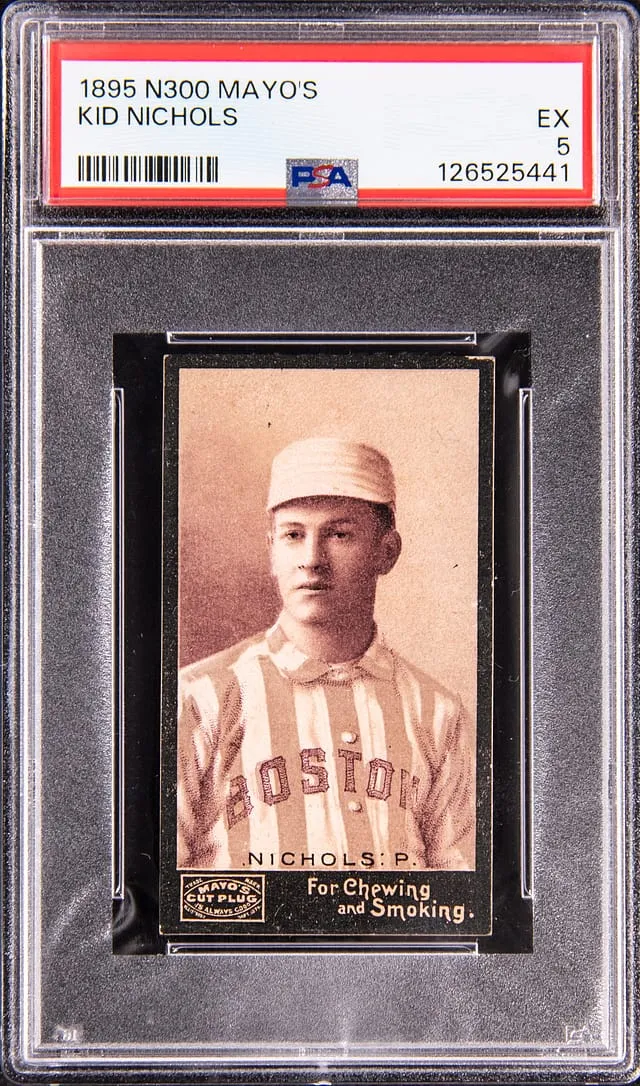
1895 Mayo Kid Nichols PSA 5 Sells for $14,769
Goldin sold an 1895 N300 Mayo’s Cut Plug Kid Nichols PSA EX 5 for $14,769. See how this pre-war Hall of Fame card fits today’s vintage market.
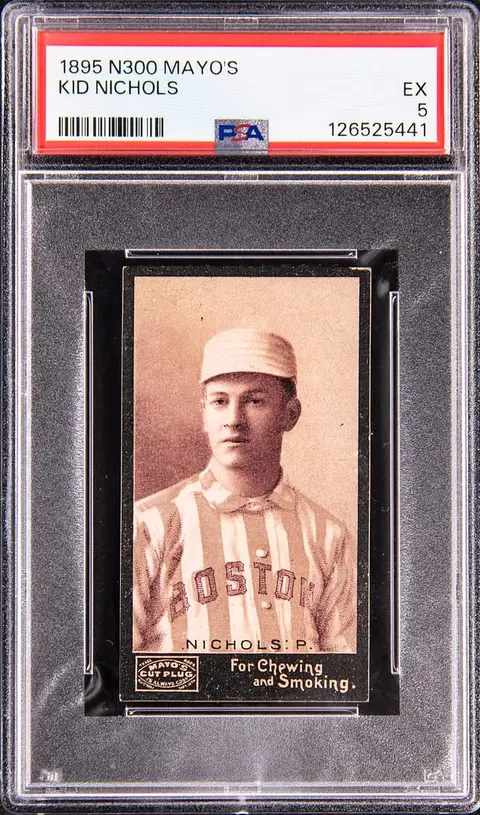
Sold Card
1895 N300 Mayo's Cut Plug Kid Nichols - PSA EX 5
Sale Price
Platform
Goldin1895 N300 Mayo's Cut Plug Kid Nichols PSA EX 5 Sells for $14,769
When a 19th‑century Hall of Famer surfaces in a strong mid‑grade, the vintage community pays attention. That is exactly what happened on February 22, 2026, when Goldin sold an 1895 N300 Mayo's Cut Plug Kid Nichols graded PSA EX 5 for $14,769.
Below is a collector‑focused look at what this card is, why it matters, and how this sale fits into the current market.
Card Snapshot
- Player: Kid Nichols (Hall of Fame pitcher)
- Team: Boston (National League)
- Year: 1895
- Set: N300 Mayo's Cut Plug (tobacco issue)
- Card number: N/A (the set is not numbered)
- Grading company: PSA (Professional Sports Authenticator)
- Grade: EX 5 (Excellent)
- Attributes: Standard issue, no autograph, no memorabilia
- Era: Pre‑war / 19th century
- Rookie or key issue? Not a modern "rookie card" in the strict sense, but a core early card for Kid Nichols and one of his most important cardboard appearances.
The N300 Mayo's Cut Plug baseball set is a landmark 19th‑century issue, known for its black‑border design and prominent portraits. Those black borders make higher‑grade examples very tough; honest edge and corner wear is the norm even on appealing copies.
Why the 1895 Mayo Kid Nichols Matters
1. Hall of Fame Pitching Royalty
Kid Nichols was one of the dominant pitchers of the 1890s:
- Over 300 career wins (a major benchmark for vintage pitching greatness)
- Inducted into the Baseball Hall of Fame in 1949
- A central figure on powerhouse Boston teams of the National League’s early days
For many collectors building pre‑war Hall of Fame runs, a Nichols from the 1890s is a key target. Mayo’s Cut Plug is one of the most recognized ways to add him in true 19th‑century cardboard form.
2. N300 Mayo’s Cut Plug: A Cornerstone Pre‑War Set
Mayo’s Cut Plug (issued mid‑1890s) is widely viewed as one of the hobby’s foundational baseball sets:
- Part of the tobacco era, distributed with chewing tobacco
- Distinctive black borders, which show chipping and wear very easily
- Strong, simple portrait designs that still present well today
Because of that border design and the age of the issue, surviving cards with clean surfaces and relatively strong corners are scarce. That makes a PSA EX 5 stand out even more.
3. 19th‑Century Scarcity and Condition Sensitivity
Compared with post‑war and modern issues, 19th‑century cards were:
- Printed in smaller quantities
- Handled heavily by original owners
- Stored in far less protective environments
As a result, the population of surviving examples in any mid‑ to high‑grade is small. Even if a population report (commonly called a "pop report"—a grading company’s count of how many copies they’ve graded at each grade level) shows a modest number for a player, many will be heavily worn. An EX 5 from this era often represents the upper tier of what realistic collectors can chase without moving into very rare and very expensive territory.
Market Context and Recent Sales
This Goldin result:
- Realized price: $14,769 (converted from 1,476,900 cents)
- Auction house: Goldin
- Sale date: February 22, 2026 (UTC)
Because this is a niche, pre‑1900 Hall of Famer in a condition‑sensitive set, public sales in exactly PSA 5 don’t occur frequently. Instead of a long list of direct comparisons, collectors usually look at a mix of:
- Comps (short for "comparables"—recent sales of the same card or very similar cards) in neighboring grades, such as PSA 4 and PSA 6
- Pricing trends for other Hall of Famers in the N300 Mayo run
- Historical records for top‑graded examples of the same card
Across major auction archives, the pattern for Mayo Hall of Famers tends to be:
- Sharp increases in price as grade climbs from VG (Very Good) into EX and EX‑MT. The visual gap from a 2 or 3 to a 5 can be dramatic because border chipping and paper loss become much more noticeable at lower grades.
- PSA 5 as a “sweet spot” grade where eye appeal is high but the price has not yet reached the steep curve of PSA 6–7 examples, which are much scarcer.
Within that framework, a sale just under $15,000 for a well‑known Hall of Fame pitcher’s Mayo fits as a strong but understandable outcome: high enough to reflect scarcity and demand, but still within the range serious vintage collectors expect for a key pre‑1900 piece in EX condition.
Because public data for this exact card in PSA 5 appears relatively thin, it’s more useful to see this price as part of a broader cluster of Mayo Hall of Famer results rather than as an isolated, record‑breaking anomaly.
How This Sale Fits Broader Trends
Vintage and Pre‑War Stability
Compared with modern "hit‑driven" products (autographs, patches, low‑serial parallels), the pre‑war segment tends to move more gradually. Prices can trend up or down over years, but daily volatility is less pronounced. This Nichols result aligns with that pattern:
- It confirms ongoing demand for core Hall of Famers from iconic 19th‑century sets.
- It illustrates how collectors are still willing to pay a premium for authenticity, historical significance, and eye appeal over flashier modern attributes.
Grade Matters More Than Ever
As more of the surviving Mayo population is graded, condition separation becomes clearer:
- Lower‑grade Nichols examples give budget‑minded collectors an entry point into pre‑war Hall of Fame collecting.
- Mid‑grade copies like this PSA 5 act as a middle ground: still rare, visually appealing, and manageable compared with very high grades.
- Top‑graded examples, when they appear, often establish the ceiling for the card and can anchor expectations for the rest of the grading ladder.
This $14,769 sale fits neatly in that middle tier: not a record‑setting top pop, but a healthy benchmark for a premium mid‑grade.
What Collectors Can Take Away
For newcomers, returning collectors, and small sellers, a few practical observations:
- Set and era research matter. Knowing that N300 Mayo’s Cut Plug is a key 19th‑century set helps you interpret prices that might otherwise seem high for a non‑autograph, non‑patch card.
- Condition is context. EX 5 in a black‑bordered 1890s issue has different meaning than EX 5 in a glossy 1980s set. Surface wear, border chipping, and print quality all play into how collectors see value.
- Comps are guides, not guarantees. When you look up recent sales, use them as context rather than price predictions. Illiquidity in niche vintage cards means each auction can land a bit differently depending on who shows up.
- Hall of Fame anchors help stabilize segments. Cards of well‑established legends like Kid Nichols tend to move with the broader vintage market rather than with short‑term player performance swings.
Final Thoughts
The February 22, 2026 Goldin sale of the 1895 N300 Mayo's Cut Plug Kid Nichols PSA EX 5 at $14,769 underscores how much respect 19th‑century Hall of Fame cardboard still commands.
For collectors building a pre‑war Hall of Fame run, this result reinforces the idea that quality 19th‑century pieces in solid mid‑grade remain a central part of the hobby’s foundation. For sellers, it offers a data point on what the market is currently willing to pay for an appealing, correctly graded example of a classic Mayo Hall of Famer.
As always, treat this sale as one reference point among many. Use it to inform your research—whether you are hunting your first 1890s card or deciding when to bring a vintage gem to market.