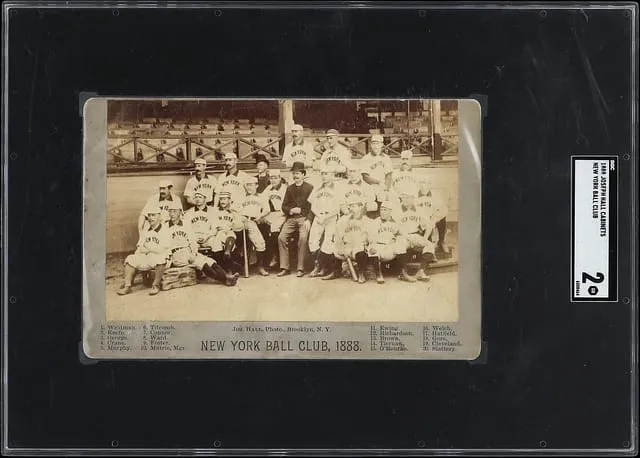
1888 Joseph Hall NY Team Cabinet SGC 2 Sells for $12.2K
Figoca breaks down the $12,200 Goldin sale of an 1888 Joseph Hall New York Ball Club cabinet, SGC 2, POP 2 and highest graded on SGC and PSA.
Sold Card
1888 Joseph Hall Cabinets New York Ball Club Including 6 Hall of Famers (Keefe; Ewing; Ward; Connor; O’Rourke; Welch) - SGC GD 2 – POP 2; Highest Copy on the Combined SGC & PSA Pop Charts
Sale Price
Platform
Goldin1888 Joseph Hall Cabinets New York Ball Club SGC 2 Sells for $12,200 at Goldin
For most modern collectors, team cabinet photos from the 1880s feel like another hobby entirely. But every so often, a sale pops up that connects today’s graded-card market with the very roots of baseball cardboard.
On February 22, 2026, Goldin sold an 1888 Joseph Hall Cabinets New York Ball Club team cabinet, graded SGC GD 2 (Good), for $12,200. This oversized cabinet card includes six Hall of Famers—Tim Keefe, Buck Ewing, John Montgomery Ward, Roger Connor, Jim O’Rourke, and Mickey Welch—and is recorded as POP 2 in this grade, with no higher example shown on the combined SGC and PSA population reports.
Below, we’ll walk through what this piece actually is, why cabinet cards matter, and how this sale fits into the broader vintage market.
What exactly is this card?
Card details
- Issue: 1888 Joseph Hall Cabinets
- Team: New York Ball Club (National League New Yorks, precursors to the modern San Francisco Giants)
- Type: Team cabinet photograph (not an individual player card)
- Key names pictured: Tim Keefe, Buck Ewing, John Montgomery Ward, Roger Connor, Jim O’Rourke, Mickey Welch (all Hall of Famers), plus additional teammates
- Format: Large cabinet card / mounted photograph, typical of the 19th century
- Grading company: SGC
- Grade: GD 2 (Good)
- Population: POP 2 in this grade; highest copy on the combined SGC & PSA pop charts at the time of sale
- Special attributes: Early, original team cabinet showing a cluster of Hall of Fame players together
This is not a traditional pack-issued card in the modern sense. Joseph Hall produced albumen photographic cabinets—studio or team images mounted to card stock—often distributed as premiums or sold as keepsakes. In hobby terms, they function more like ultra-early, oversized team issues than standard trading cards.
Why cabinet cards like this matter to collectors
The 1880s are considered the deep vintage era of the hobby. While sets like N172 Old Judge and N28 Allen & Ginter are widely studied, Joseph Hall team cabinets sit in an even more specialized corner of the market:
- Historical importance: You’re looking at a real-time visual record of one of the defining teams of the 19th century, captured during baseball’s formative professional era.
- Cluster of Hall of Famers: Keefe, Ewing, Ward, Connor, O’Rourke, and Welch are foundational names in early baseball history. Seeing all six on a single original issue gives the piece outsized historical weight.
- Era scarcity: Unlike modern cards, these were not mass-produced, pack-pulled items. Surviving examples depend on fragile 19th-century photo paper, storage conditions, and sheer luck.
- Condition sensitivity: Cabinet photos are large, prone to corner wear, creases, surface soiling, and mounting damage. A straight, intact example—even in SGC 2—is meaningful for this type.
For vintage specialists, these factors make Joseph Hall cabinets more like museum pieces than ordinary singles.
Understanding the grade and population
When collectors talk about pop reports, they mean the population reports published by grading companies like SGC and PSA. These show how many copies of a card have been graded and at which grades.
In this case:
- The card is POP 2 at SGC in GD 2.
- When you combine PSA and SGC data, this example is listed as the highest graded copy known across both major grading companies at the time of sale.
That doesn’t mean there are only two in existence—raw (ungraded) examples and unsubmitted cabinets may still be out there—but it does confirm true graded scarcity, especially at the top of the census.
For niche 19th-century issues, that combination (low absolute population + top of the graded ladder) is a key driver of collector interest.
The $12,200 sale at Goldin in context
- Auction house: Goldin
- Sale date (UTC): February 22, 2026
- Realized price: $12,200 (buyer’s premium typically included in headline price)
Because this is a highly specialized 19th-century team cabinet, direct recent comps—short for “comparables,” or previous sales of the same card—are limited or episodic. These pieces don’t appear in every auction cycle, and when they do, condition, image clarity, and eye appeal can vary heavily.
From what the public auction record shows:
- Joseph Hall team cabinets of prominent 19th-century clubs tend to surface infrequently, often years apart.
- Lower-grade or compromised examples (heavy trimming, major staining, large creases) have historically sold for markedly less, though exact figures vary widely.
- Well-preserved, sharply imaged cabinets, especially those featuring multiple Hall of Famers, sit toward the top of the range.
Within that framework, $12,200 for an SGC GD 2, highest-graded example is consistent with what you’d expect when collectors chase a historically important but thinly traded issue. The limited data doesn’t support calling this a clear record or a bargain; instead, it reflects what the market was willing to pay on that specific date for a museum-grade piece of baseball history.
How this fits into the broader vintage card market
A few broader themes help explain interest in a piece like this:
Deep vintage resilience
19th-century material doesn’t swing as wildly as modern prospect cards. Demand is smaller but more stable, anchored by long-term collectors, vintage-focused dealers, and institutional buyers.Shift from “star hunting” to “history collecting”
Rather than chasing a single breakout player, buyers of an 1888 New York team cabinet are collecting baseball itself: its origins, its early champions, and the physical artifacts that survived.Grading as infrastructure
With SGC encapsulating and labeling these cabinets, a once-opaque corner of the hobby becomes more accessible. A clear grade, scan, and pop position help newer vintage collectors understand what they’re looking at.Scarcity over serial numbering
In modern cards, scarcity is usually defined by print runs, serial numbers, and parallels. Here, scarcity is organic: fragile 19th-century materials, small original distributions, and a very limited number of surviving, gradable copies.
What collectors can learn from this sale
Whether or not you collect 19th-century material, this sale offers a few practical takeaways:
- Context matters more than any single number. Without frequent comps, understanding this sale requires looking at the era, the team, the Hall of Famers involved, and the graded population.
- Top-of-pop in true vintage is different from modern. In ultra-modern cards, “POP 1” might still mean dozens more could eventually surface in gem mint when they’re submitted. For 1880s cabinets, the surviving pool is likely much smaller and fairly mature.
- Condition expectations should match the era. A GD 2 from 1888 is not the same as a GD 2 from 1958. On genuinely antique paper, even “Good” can represent a strong surviving example.
- Photographic issues deserve more attention. Photos, cabinets, and premiums are crucial pieces of hobby history, even if they sit outside the usual checklist-and-parallel mindset.
Final thoughts
The 1888 Joseph Hall Cabinets New York Ball Club team cabinet that sold for $12,200 at Goldin on February 22, 2026, is a strong reminder that some of the hobby’s most meaningful items don’t fit into the usual “base, parallel, rookie” framework.
Six early Hall of Famers, one of the game’s great 19th-century clubs, and a highest-graded, POP 2 entry on the combined SGC/PSA reports combine to make this more than just a line item in a price guide. It’s a surviving artifact from the frontier of baseball cardboard, now encapsulated—and newly legible—for modern collectors.
As always, this information is for collecting context only. It’s not a prediction of future prices or a recommendation to buy or sell. But for anyone drawn to the very beginning of baseball’s visual history, this Joseph Hall cabinet is a compelling benchmark for what high-grade, deep-vintage material can look like in today’s market.