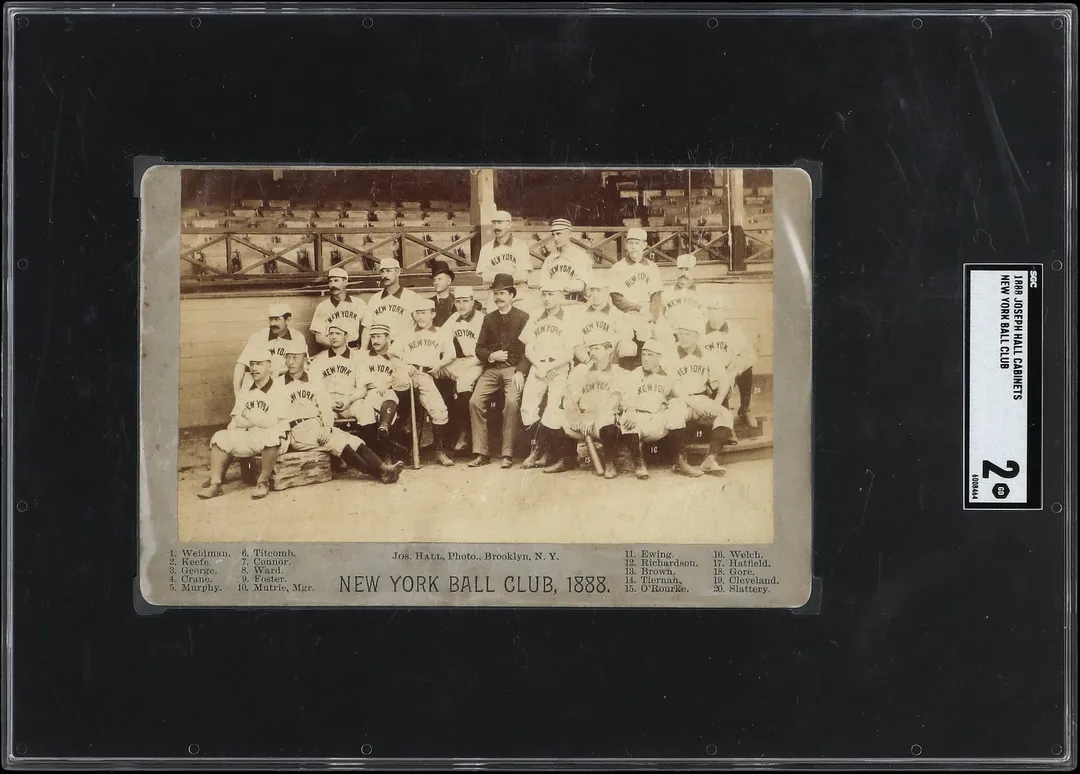
1888 Joseph Hall NY Team Cabinet Sells for $12,200
Goldin’s $12,200 sale of the 1888 Joseph Hall New York Ball Club SGC 2, the top graded copy, shows steady demand for key 19th‑century pieces.
Sold Card
1888 Joseph Hall Cabinets New York Ball Club Including 6 Hall of Famers (Keefe; Ewing; Ward; Connor; O’Rourke; Welch) - SGC GD 2 – POP 2; Highest Copy on the Combined SGC & PSA Pop Charts
Sale Price
Platform
Goldin1888 Joseph Hall Cabinets New York Ball Club – Why This $12,200 Sale Matters
On February 22, 2026, Goldin sold an 1888 Joseph Hall Cabinets New York Ball Club team cabinet for $12,200. Graded SGC GD 2, this example includes six Hall of Famers—Tim Keefe, Buck Ewing, John Montgomery Ward, Roger Connor, Jim O’Rourke, and Mickey Welch—and is labeled as POP 2, the highest copy on the combined SGC and PSA population reports.
For a lot of modern-focused collectors, this piece might be unfamiliar. But in the prewar baseball lane, Joseph Hall cabinets are quietly significant hobby artifacts. Let’s unpack what this card is, why it matters, and how this sale fits into the broader vintage market.
What Exactly Sold at Goldin?
Card details
- Year: 1888
- Issuer / Set: Joseph Hall Cabinets (New York Ball Club team cabinet)
- Team: New York (National League)
- Format: Cabinet card (large photographic card mounted on cardboard)
- Key subjects on the cabinet:
- Tim Keefe (Hall of Fame)
- Buck Ewing (Hall of Fame)
- John Montgomery Ward (Hall of Fame)
- Roger Connor (Hall of Fame)
- Jim O’Rourke (Hall of Fame)
- Mickey Welch (Hall of Fame)
- Plus additional non-Hall of Fame teammates
- Grading company: SGC
- Grade: GD 2 (Good)
- Population: POP 2 in this grade, and noted as the highest graded copy on the combined SGC & PSA population reports
This is not a modern “card” in the usual sense, but a large team cabinet photograph. In the 1880s, these cabinet photos were one of the main collectible formats for baseball imagery, predating the tobacco card boom of the 1900s.
Why Collectors Care About Joseph Hall Cabinets
A window into 19th-century baseball
The 1888 Joseph Hall cabinets sit in the prewar era of collecting—well before mass-produced gum cards. Surviving examples are limited, and condition is almost always a challenge due to their age, size, and how they were handled or stored over 135+ years.
Key reasons collectors pay attention:
Historical importance
These are among the more recognizable 19th-century team cabinets, showing real photographic images of some of the game’s earliest stars. For Hall of Fame player collectors (Keefe, Ewing, Ward, Connor, O’Rourke, Welch), this type of piece is a major cornerstone.Multiple Hall of Famers on one piece
Instead of a single-player card, this cabinet captures an entire New York ball club lineup, including six eventual Hall of Famers. For collectors who build type collections or focus on 19th-century teams, that density of star power in one item is unusual.Set and era scarcity
Pre-1900 issues were printed in far smaller numbers than modern cards. Survival rates are low, particularly in presentable shape. That’s why even a Good 2 can be near the top of the grading ladder.Grading scarcity (pop report)
A “pop report” is the grading company’s census of how many copies of a specific card or piece have been graded at each grade level. Here, this cabinet is POP 2 at SGC in Good 2, with no higher-graded copies at SGC or PSA. For set and player specialists, “highest graded known” carries real weight.
Market Context: How Does $12,200 Fit In?
The hammer price converted from cents is $12,200 USD. For modern ultra-high-end cards, that might sound modest; for 19th‑century memorabilia, it sits in a thoughtful, mid–high range.
Because this is a niche, low-population item, there are very few directly comparable, recent public sales of the exact same cabinet in the exact same grade. Instead, collectors often look at:
- Other Joseph Hall team cabinets (different teams, similar years)
- Other 19th-century team cabinets featuring multiple Hall of Famers
- High-end single-player cards or cabinets of Keefe, Ewing, Ward, Connor, O’Rourke, or Welch from similar years
From what’s visible in public auction archives and population reports:
- Joseph Hall and comparable 1880s team cabinets often trade infrequently, sometimes with gaps of several years between notable appearances.
- When they do come up, prices can vary widely depending on which team, how many Hall of Famers are pictured, image clarity, and condition.
- Pieces that combine iconic 19th-century franchises with multiple Hall of Famers and top-of-pop status tend to land at stronger price points relative to more common team or studio issues.
Within that context, $12,200 feels like a meaningful but not extreme realization: strong enough to reflect the historical significance and pop status, without entering record-chasing territory that you sometimes see with headline-grabbing modern cards.
Because this particular cabinet is the highest graded example across SGC and PSA, future sales of the same item will likely reference this Goldin result as a key data point for “comps.”
Comps: short for “comparables,” comps are recent sales of the same or very similar cards that collectors use as a reference point for current market value.
Grade, Condition, and Why a 2 Can Be a Trophy
In modern ultra‑modern cards (2018–present), collectors often chase Gem Mint 10s. In 1880s material, the grading scale works differently in practice:
- Survival is the first hurdle. Many 19th-century cabinets were tossed, glued into albums, or damaged by humidity and handling.
- Size invites wear. These cabinets are physically larger than standard cards, so corners, edges, and surfaces are more exposed.
- Authenticity and eye appeal matter as much as the number. A technically low grade with a strong image and honest wear is often preferred over a higher-grade example with heavy damage to the photo or restoration.
Here, the SGC GD 2 label comes with the important qualifier: it is the highest graded on the combined SGC & PSA population reports. For seasoned vintage collectors, that often matters more than whether the numeric grade is 2, 3, or 4.
How This Sale Fits Today’s Hobby
Vintage stability vs. modern volatility
Over the last few years, the hobby has seen sharp swings in prices for modern and ultra-modern cards. In contrast, true prewar and 19th-century material—especially historically important pieces—tends to transact less frequently and with somewhat more measured movement.
A sale like this:
- Reinforces that deep vintage and prewar material still attracts serious interest, even when hobby attention is often on modern stars.
- Adds a new reference point for 1880s team cabinets featuring multiple Hall of Famers.
- Highlights the role of grading population data in niche segments, where “highest known” can significantly influence demand.
Player and theme collectors
This Joseph Hall cabinet is particularly relevant to:
- Hall of Fame player collectors chasing early representations of Keefe, Ewing, Ward, Connor, O’Rourke, and Welch.
- Team historians and New York collectors focused on pre‑Yankees, pre‑Giants origins.
- Type collectors who aim for one key example from each important 19th‑century issuer or format.
For many of these collectors, a single item that checks all these boxes—era, team, players, pop status—can be a long-term target.
Key Takeaways for Collectors and Small Sellers
If you’re newer to this part of the hobby or thinking about dipping into prewar material, here are a few practical points based on this sale:
Learn the format.
Team cabinets are not standard trading cards. Size, mounting, and photographic quality all matter. Understanding what typical wear looks like helps when you evaluate raw (ungraded) examples.Study population reports, but keep perspective.
Low pop doesn’t always mean high demand—but when you have low pop, multiple Hall of Famers, and a respected issuer like Joseph Hall, that combination is noteworthy.Expect irregular comps.
You may not find neat, recent comps on marketplaces for this exact card. Instead, look at related issues, similar teams, and comparable levels of historical importance.Authenticity first.
For 19th-century pieces, third‑party grading (SGC and PSA) is often as much about confirming authenticity as about assigning a numeric grade.Use sales like this as a reference point, not a rule.
The $12,200 Goldin result on February 22, 2026, is a useful benchmark, but not a guarantee of future prices. Condition nuances, auction timing, and bidder pools all matter.
Final Thoughts
The 1888 Joseph Hall Cabinets New York Ball Club team cabinet sold by Goldin on February 22, 2026, sits at the intersection of history, scarcity, and grading data:
- It captures six Hall of Famers from a foundational era of professional baseball.
- It represents a scarce 19th-century photographic format that predates the familiar tobacco and gum cards.
- As an SGC GD 2, POP 2, and highest graded across SGC and PSA, it occupies a top rung in a very narrow population.
For collectors who view the hobby as a way to connect with baseball’s earliest chapters, this sale is less about chasing headlines and more about quietly documenting another important piece of prewar history finding its place in the modern graded market.