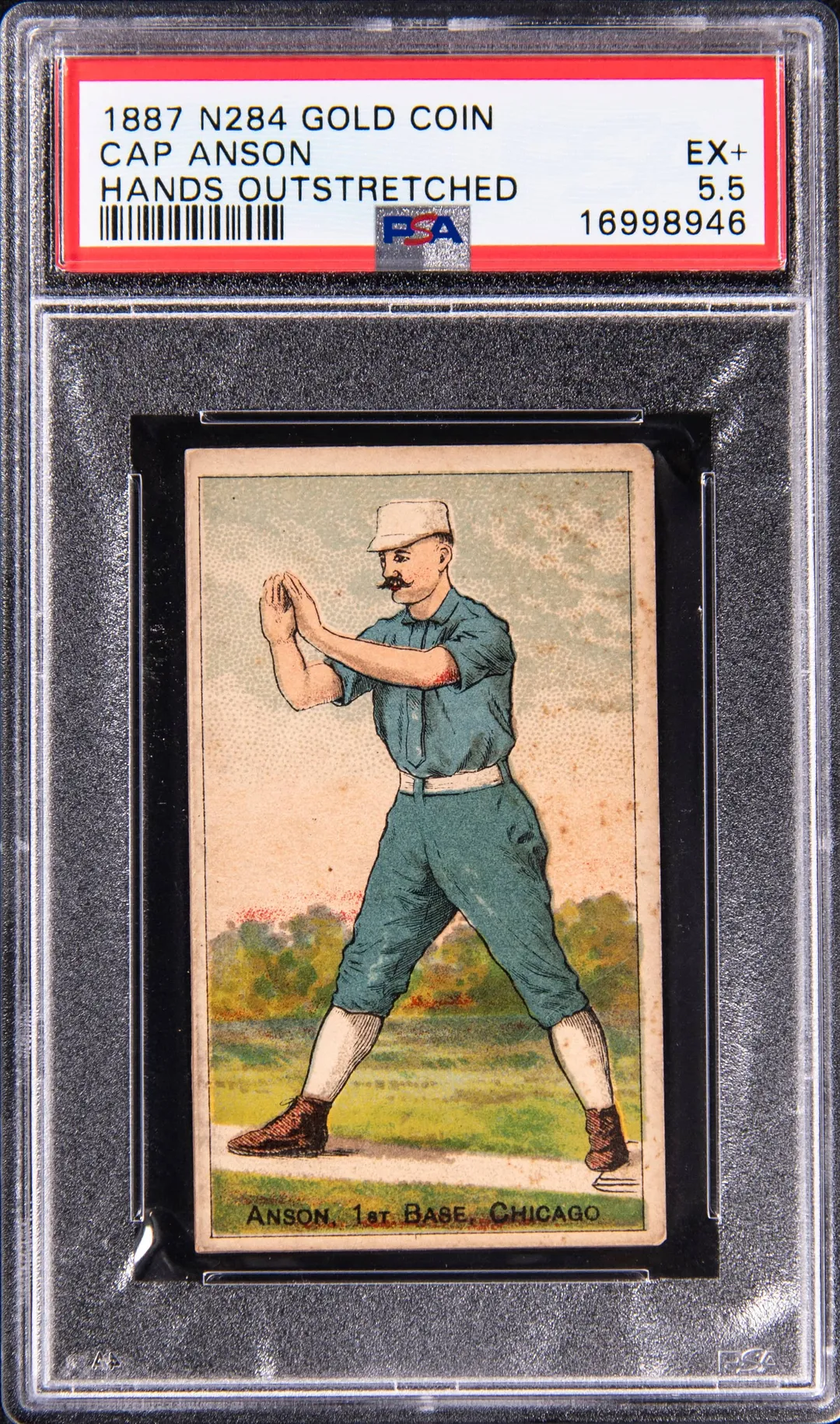
1887 N284 Cap Anson PSA 5.5 Sells for $14,651
Goldin’s Feb. 22, 2026 sale of an 1887 N284 Gold Coin Cap Anson PSA EX+ 5.5 at $14,651 highlights true 19th‑century Hall of Fame scarcity.
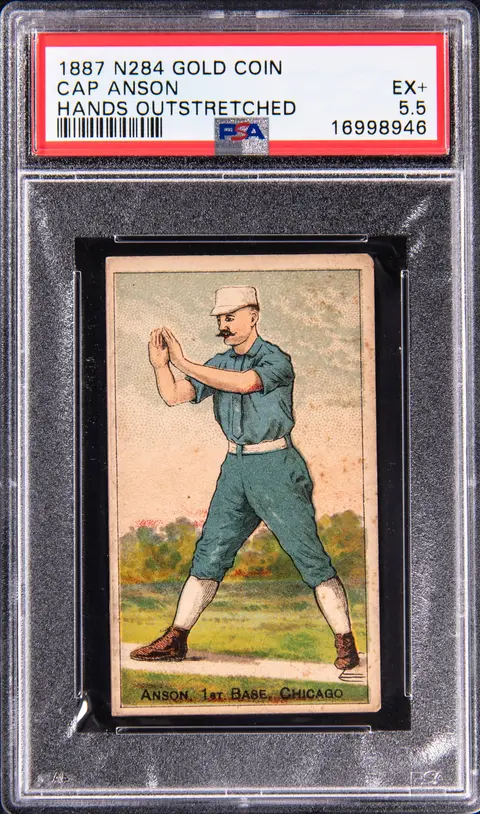
Sold Card
1887 N284 Gold Coin Buchner Cap Anson, Hands Outstretched – PSA EX+ 5.5 – POP 1; Only One Higher PSA Copy for Both Poses
Sale Price
Platform
Goldin1887 N284 Gold Coin Buchner Cap Anson, Hands Outstretched – PSA EX+ 5.5 – POP 1; Only One Higher PSA Copy for Both Poses
On February 22, 2026, Goldin closed a quiet but important vintage baseball sale: an 1887 N284 Gold Coin Buchner Cap Anson, “Hands Outstretched” pose, graded PSA EX+ 5.5, realized $14,651. For a 19th‑century Hall of Famer with extreme condition rarity, this is the kind of result that tends to catch the attention of serious prewar collectors.
Below, we’ll walk through what this card is, why it matters, and how this price fits into the broader market.
The card at a glance
- Player: Adrian “Cap” Anson (Hall of Fame first baseman)
- Team: Chicago (National League)
- Year: 1887
- Set: N284 Gold Coin (Buchner Gold Coin)
- Manufacturer: D. Buchner & Co. (tobacco insert)
- Pose / Variant: Hands Outstretched
- Rookie or key issue? Not a rookie, but a major 19th‑century Hall of Fame issue
- Grading company: PSA (Professional Sports Authenticator)
- Grade: EX+ 5.5
- Population note: PSA population 1 in this grade for Anson’s N284, with only one higher PSA example across both known Anson poses
The N284 Gold Coin set is a classic 19th‑century tobacco issue. These were small, fragile cards inserted with tobacco products—survival alone is a story, and eye‑appealing mid‑grade examples are significantly tougher than most modern collectors realize.
Cap Anson is one of the cornerstone names in 19th‑century baseball cardboard. For collectors who focus on pre‑1900 material, his cards form part of the backbone of any serious Hall of Fame run.
Why the N284 Gold Coin Anson matters
A few key reasons this card draws attention:
Era scarcity (19th‑century cardboard)
The earlier you go, the thinner the surviving population gets. N284s are over 130 years old, printed on relatively thin stock, and were not produced for “collectors” in the modern sense. Damage, loss, and uneven storage over decades mean truly collectible examples are few.Hall of Fame cornerstone
Anson is one of the defining names of baseball’s earliest professional period. While his role in baseball history is complicated and includes significant negative aspects, his on‑field impact and presence in foundational sets make his cards central to vintage Hall of Fame collecting.Set reputation
Among pre‑1900 issues, the N284 Gold Coin series is respected for:- Attractive lithography for the era
- Broad subject checklist
- Difficult condition profile
Pose variation
Anson appears in more than one pose in N284. The “Hands Outstretched” version visually stands out and is often discussed alongside his other Buchner pose in population and price conversations.
Grade, eye appeal, and population
This copy is graded PSA EX+ 5.5. For a modern card, a 5.5 may feel “mid‑grade,” but for an 1880s tobacco card, EX+ can be considered very strong:
- Corners and edges: typically show honest wear but no major paper loss
- Surface: generally clean, with printing still strong and legible
- Registration: when good, it adds a lot of premium in this era
The population note is important here:
- PSA pop in 5.5: 1 (this card is alone at that grade)
- Only one higher PSA copy across both Anson N284 poses
In other words, if you’re building:
- a high‑end 19th‑century Hall of Fame run, or
- a focused Anson player collection, or
- a type run of N284 Gold Coins,
…there are only a handful of PSA‑graded Ansons that can legitimately sit “above” this example in a registry sense. That scarcity can matter a lot when two or more collectors are trying to finish or defend high placements on PSA Set Registry leaderboards.
Market context and price positioning
The Goldin sale closed at $14,651. To understand what that means, it helps to put it into context with:
- Other Cap Anson prewar issues
- Other 19th‑century Hall of Fame stars in comparable grades
- The overall scarcity of this set
Comps and recent sales
For highly scarce, pre‑1900 cards like N284s, the “comps”—short for comparable recent sales—are often:
- Sparse (few copies trade each year), and
- Spread out across grades and auction houses.
Recent public sales for this precise combination (N284 Anson, Hands Outstretched, PSA EX+ 5.5) are effectively non‑existent, because this is a pop 1 card that rarely surfaces. Most of the useful context comes from:
- Lower‑grade N284 Ansons (both poses) that have sold in the past
- Other Anson issues from the 1880s (such as N172 Old Judge) in comparable technical grades
- Other N284 stars (especially Hall of Famers) in the EX range
Across those categories, patterns that typically emerge with 19th‑century Hall of Famers include:
- Large step‑ups between VG (around PSA 3) and EX (PSA 5) examples
- Strong premiums for cards that combine technical grade with above‑average eye appeal
- Price variability due to very thin transaction volume—sometimes the last sale is years old
Within that landscape, a realized price in the mid‑five‑figure range for a pop 1, EX+ 5.5 Anson from 1887 sits comfortably in line with how the market has been valuing high‑end 19th‑century Hall of Famers in recent years. It doesn’t read as a sudden outlier spike, but rather as a continuation of gradual strength in the prewar niche.
Because public data for this exact card and grade is limited, the more useful takeaway is relative:
- This sale confirms that the market still places a meaningful premium on strong‑grade 19th‑century tobacco issues.
- Registry‑worthy copies with population 1 status and virtually no higher examples continue to attract solid bidding.
What this sale signals to collectors
For collectors, a single sale rarely “sets” the market, but it can tell you where serious buyers and sellers are currently meeting. In this case, the Goldin auction suggests a few things:
Condition scarcity still commands attention
Even in a hobby that increasingly tracks serial numbers and modern parallels, traditional scarcity—age, survival, and grade—remains very relevant. A pop 1, EX+ 5.5 example of a key 1880s Hall of Famer still draws competitive interest.Prewar focus remains healthy
While much of the day‑to‑day discourse in the hobby centers on modern and ultra‑modern issues, there is steady, less‑visible demand for foundational 19th‑century cards. This sale adds one more data point to that slow‑moving but steady trend.Auction venues matter
High‑end prewar material often finds its way to established auction houses like Goldin, which tend to have the bidder base needed to surface strong prices. For thinly traded cards, the venue can be nearly as important as the card itself in reaching a fair market outcome.
For newer and returning collectors
If you are newer to vintage or returning to the hobby after a long break, here are a few takeaways from this sale you can apply broadly:
Understand the era:
19th‑century cards behave differently from post‑war staples like 1950s Topps. Fewer copies exist, grades are harder to come by, and price history is less frequent.Use population reports carefully:
A pop report is the grading company’s count of how many copies they’ve graded at each grade. For rare vintage, a pop 1 in mid‑grade can be significantly more meaningful than for a modern release where thousands of high‑grade copies exist.Don’t over‑generalize from one sale:
Thin markets mean one sale can come in higher or lower depending on who shows up to bid. It’s more useful to view each result as a data point in a longer‑term pattern rather than a hard “price.”
Final thoughts
The 1887 N284 Gold Coin Buchner Cap Anson, Hands Outstretched, PSA EX+ 5.5 that sold at Goldin on February 22, 2026, for $14,651 is a strong representation of pre‑1900 Hall of Fame collecting:
- Historically significant player
- Revered 19th‑century tobacco issue
- Population 1 status with only one higher PSA example across both poses
For focused vintage collectors, this sale isn’t about chasing a spike. It’s another confirmation that truly scarce 19th‑century Hall of Fame material continues to find committed homes at solid prices, even as the broader hobby cycles through newer releases and trends.
As always, treat this as context, not a prediction—especially in a segment of the market where patience, research, and a long‑term view tend to matter more than short‑term moves.