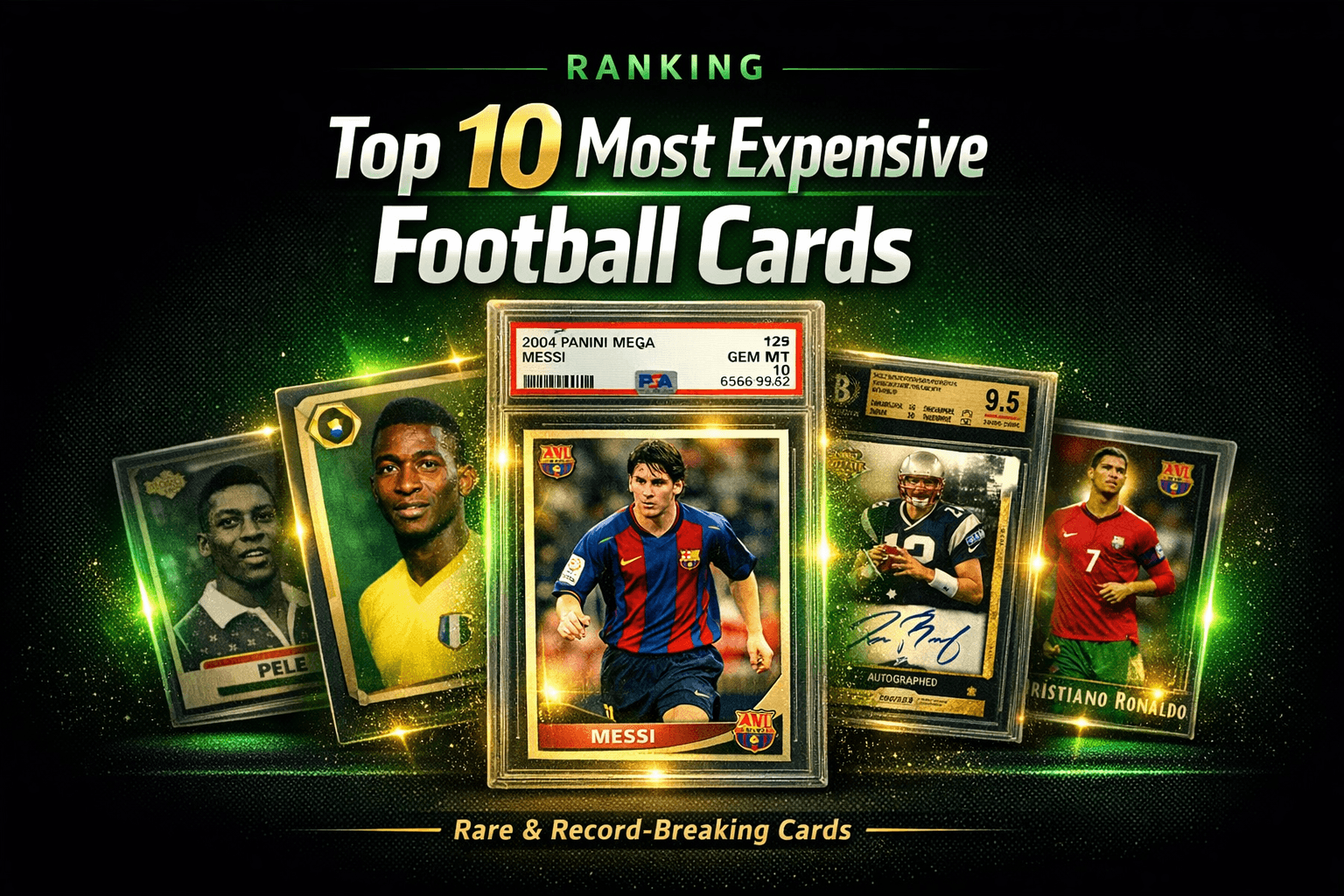
Ranking Top 10 Most Expensive Football Cards
Ranking the 10 most expensive football cards ever sold, showcasing rare collectibles, record-breaking prices, & iconic players driving the premium card market.
Imagine cleaning out your childhood closet and finding a piece of cardboard worth more than a five-bedroom house. For a few lucky individuals, this lottery dream is a documented reality. We usually think of wealth-building in terms of buying shares in Apple or Amazon, but high-end sports cards have quietly emerged as a powerful alternative asset class over the last decade.
According to historical sales data from major auction houses like Goldin and Heritage, the secondary market has fundamentally shifted from a nostalgic basement hobby to global commerce. Think of an investment-grade collectible exactly like a limited-edition Bugatti supercar, when only a handful exist and thousands of wealthy enthusiasts want one, that intense scarcity inevitably drives up the price.
Why would someone pay millions for a picture of Tom Brady or Patrick Mahomes? Industry data reveals that a professional inspection changes everything. Just as a vintage sports car is worth more in factory-fresh condition with original paint, a card independently graded as "gem-mint" by experts transforms into a verifiable financial instrument, clearly distinguishing casual collecting from high-stakes investing.
Legendary player origin stories directly fuel these massive market booms. The psychology behind recent record-breaking sports memorabilia auction results proves why the right paper is now treated as a modern blue-chip asset.
The Three Pillars of Value: Scarcity, Legacy, and the 'Perfect 10' Grade
Why would a piece of cardboard sell for the price of a luxury mansion? What determines football card market value comes down to three critical factors:
- The Player: A superstar's "Rookie Card" acts like the first-edition printing of a classic novel , it represents their legendary origin story.
- The Scarcity: Strict supply and massive demand dictate the market.
- The Condition: Flawless preservation commands an astronomical premium.
Professional authentication provides the ultimate verification of condition. Third-party companies evaluate the factors affecting sports card condition and grade, scoring them on a strict 1-to-10 scale. While collectors often debate the nuances of a PSA vs. BGS grading standards comparison, the ultimate goal remains the same: securing a "gem-mint" 10. A perfect score confirms that the corners are sharp, the image is perfectly centered, and the surface is entirely scratch-free.
Even if an item looks pristine to the naked eye, its true rarity is confirmed by a "Population Report." Think of this as a census for collectibles; it tells buyers exactly how many perfect copies exist in the entire world. When a legendary quarterback's rookie card has a population of just one or two, eager investors will gladly break auction records to claim it. The interplay of perfection and scarcity drives these massive valuations, setting the standard with the vintage icons that built the modern market.
Ranking #10 to #8: The Vintage Icons That Built the Modern Market
Tracing the history of the most valuable NFL cards reveals a market built on legendary releases like the 1957 Topps set, featuring the rookie debuts of Bart Starr and Jim Brown. Because kids in the 1950s actually played with their collections, shoving them into bicycle spokes and pockets, a pristine survivor achieves what experts call "Condition Rarity." When weighing vintage vs. modern football cards worth, remember that new items are strictly protected from day one, making an older card's six-figure price tag a reflection of its miraculous survival against the odds.
Nowhere is this clearer than with the most expensive Joe Namath rookie card ever sold. Fetching an astonishing $2.81 million in 2021, the 1965 Topps Namath is widely considered the "Mona Lisa" of vintage football. Its extreme rarity in perfect condition comes down to its unique "Tallboy" design, being significantly taller than standard issues, these oversized prints rarely fit into normal protective shoeboxes, leaving their edges completely vulnerable to damage over the decades.
When a flawless vintage copy finally hits an auction block, buyers are acquiring a museum-quality piece of American history. However, while these old-school masterpieces rely on time to create scarcity, today's companies engineer rarity on purpose through the power of the "1-of-1" parallel.
Football Legends Pack, 30 Cards, HOF Guaranteed
Pack includes 30 assorted football cards plus one guaranteed NFL Hall of Famer card. Mix of teams, years, and brands for collectors and gift buyers.
1K+ bought in past month
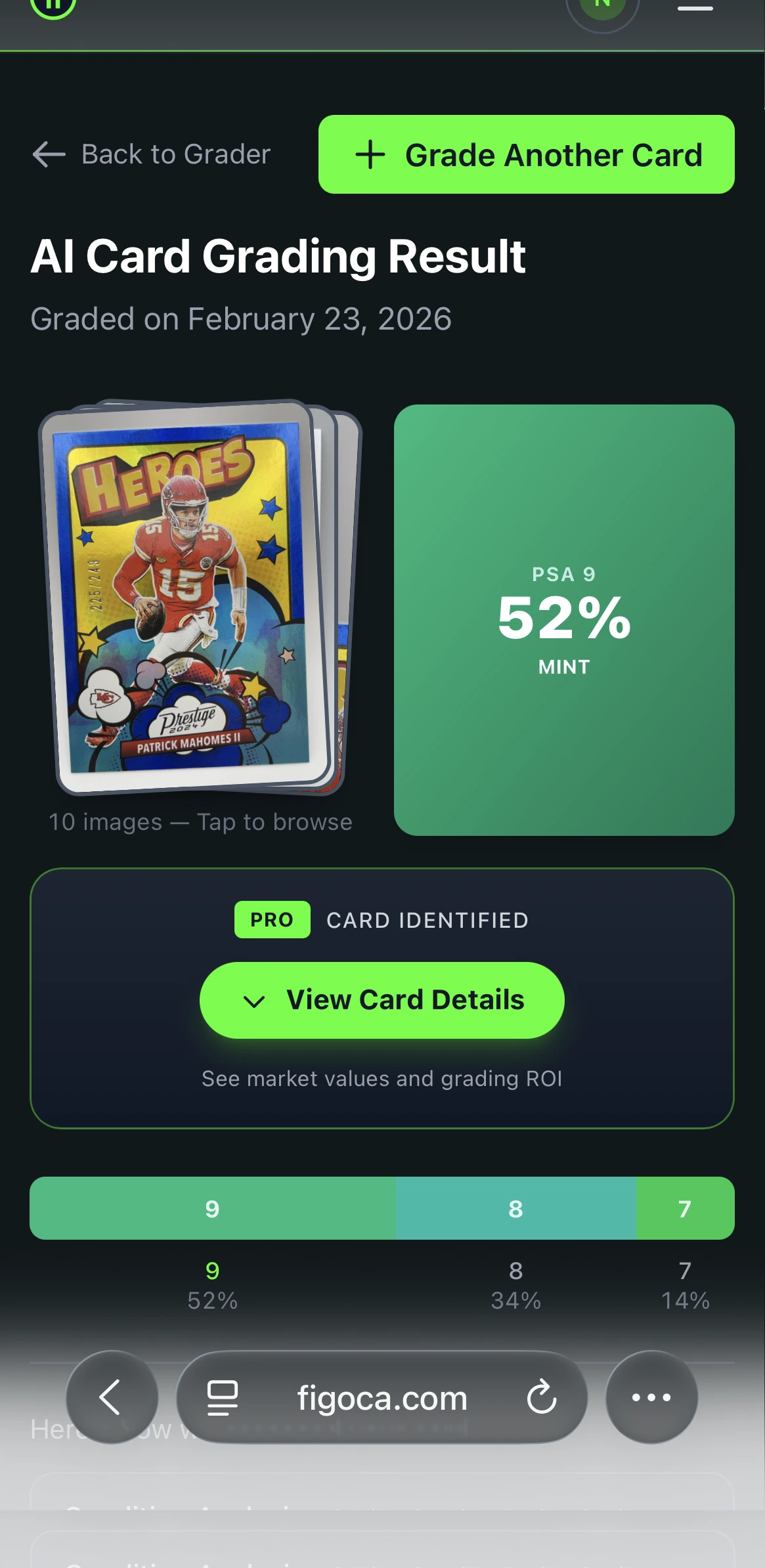
AI Card Grader
Know your card's grade before you submit
Snap a photo with your phone and get an instant AI-powered grade estimate. Check centering, corners, edges, and surface — just like the pros.
- Instant grade estimate
- Sub-grades for all 4 pillars
- Built-in ROI calculator
- Free to use
Ranking #7 to #5: Modern Icons and the Power of the '1-of-1' Parallel
While vintage pieces became rare by surviving decades of wear, today's companies engineer scarcity intentionally. Instead of waiting fifty years, modern collectors chase releases that act as instant lottery tickets. When comparing standard Panini Prizm vs. National Treasures football cards, the latter represents peak modern luxury. These high-end boxes cost thousands of dollars because they feature Rookie Patch Autographs (RPAs), premium cards containing an authentic player signature and a physical piece of their game-worn jersey.
The manufacturer's playbook regarding short print and one-of-one card parallels dictates why these modern creations command private-jet prices. Think of card production like manufacturing luxury vehicles:
- Base Cards: The standard edition, printed thousands of times for the general public.
- Parallels: The same image, but featuring a special colored border and restricted to a strictly limited production run.
- The 1-of-1 (One-of-One): The ultimate masterpiece. The manufacturer produces exactly one copy in the entire world, stamping it with "1/1" to guarantee its absolute uniqueness.
That guaranteed exclusivity is what drives astronomical prices for today's elite quarterbacks. For instance, the most expensive Justin Herbert rookie card , a 1-of-1 National Treasures RPA featuring an actual NFL shield jersey patch , sold for a staggering $1.8 million in 2021. Patrick Mahomes has seen similar one-of-a-kind masterpieces eclipse the $4 million mark. Yet, these massive modern sales still fall short of the seven-figure barriers broken by the Tom Brady dynasty.
Ranking #4 to #2: The Tom Brady Dynasty, Breaking Seven-Figure Barriers
We usually measure investments through stocks or real estate, but Tom Brady's legendary seven Super Bowl rings transformed his early cardboard into blue-chip assets. Among these historic pieces, the 2000 Playoff Contenders Rookie Ticket stands as the most vital release in hobby history. As Brady's legacy grew from a sixth-round draft pick to the undisputed greatest of all time, the value of this specific card mirrored his ascent, dominating the most expensive Tom Brady rookie card sales ever recorded.
The reason this piece commands millions hinges on specific manufacturing techniques unique to the Trading Card Glossary. Unlike modern releases featuring "sticker autographs" , where athletes sign clear labels that factory workers later attach to the cards , Brady held these rookie cards in his hands to sign the cardboard directly. This "on-card" autograph provides a tangible, physical link to the player.
Furthermore, the crown jewel of this release is the exclusive "Championship Ticket" parallel. To guarantee extreme scarcity, the manufacturer utilized "serial numbering," physically stamping each card with a unique number to prove only 100 total copies were produced.
When an immaculate copy of this limited-edition Championship Ticket surfaces, it routinely leads record-breaking sports memorabilia auction results. Fetching $3.1 million at auction in 2021, it perfectly illustrates how verified rarity and legendary achievement create unprecedented financial value. Yet, even Brady's most iconic masterpiece was eventually dethroned by a modern marvel , paving the way for the $4.3 million Patrick Mahomes National Treasures record.
Ranking #1: The $4.3 Million Unicorn , The Patrick Mahomes National Treasures Record
Why would someone pay $4.3 million for a piece of modern cardboard? While Tom Brady represents decades of established greatness, Patrick Mahomes captured the imagination of a new generation, becoming the undisputed face of the current collecting hobby. This shift in generational wealth culminated in a massive 2021 transaction, when the most expensive Patrick Mahomes card in existence completely shattered previous industry records.
Commanding the absolute peak of the market requires something far more unique than a simple autograph. This specific 2017 Panini National Treasures rookie card features an actual piece of Mahomes' jersey embedded directly inside the border. More importantly, the fabric contains the "NFL Shield" logo cut straight from the collar of his uniform , making it the ultimate, singular prize for a serious collector.
Securing a true "1-of-1" masterpiece , meaning it is the only copy ever produced in the world , often happens behind closed doors. Instead of a traditional public bidding war, this historic purchase was a "private treaty sale" brokered by the PWCC marketplace, where high-net-worth buyers negotiate directly in private. This combination of extreme scarcity and elite back-room matchmaking perfectly illustrates what determines football card market value at the highest financial tiers.
Even a one-of-a-kind NFL Shield wouldn't command the price of a luxury estate if it suffered from bent corners or faded ink. Before these multi-million dollar deals close, fragile treasures must undergo rigorous professional inspections to verify their flawless physical condition and protect their overall value.
AI Card Grader
Know your card's grade before you submit
Snap a photo with your phone and get an instant AI-powered grade estimate. Check centering, corners, edges, and surface — just like the pros.
- Instant grade estimate
- Sub-grades for all 4 pillars
- Built-in ROI calculator
- Free to use
Choosing Your Armor: How PSA, BGS, and ACE Grading Protect Your Value
Imagine buying a luxury watch , you wouldn't pay thousands without a certificate of authenticity. The collectibles market acts similarly. Unprotected cards straight from packs are considered "raw," making them vulnerable to damage and counterfeits. When experts verify authenticity, evaluate condition on a strict 1–10 scale, and seal the item in a tamper-proof plastic "slab," buyer trust skyrockets.
The impact of professional grading on card price is monumental, often turning a fifty-dollar raw card into a five-thousand-dollar certified treasure. Choosing the correct authentication armor comes down to a few major players:
- PSA: The recognized industry standard, consistently commanding the highest financial premiums at auction.
- BGS: Valued for sturdier cases ideal for thicker jersey pieces, making the PSA vs. BGS grading standards comparison a constant debate among buyers.
- Emerging Challengers: Services like Golden Grading, alongside international alternatives earning positive AP Grading and ACE Grading review scores, are offering newer hobbyists faster turnaround times.
Securing your prized possession in a professional slab is only the beginning of the journey. Transforming that authenticated cardboard into real-world profit requires specific strategies to value, track, and sell a collection.
Essential Toolkit: How to Value, Track, and Sell Your Football Card Collection
Finding out your grade your card is worth thousands is thrilling, but turning that plastic-encased cardboard into cash requires strategy. Just as a realtor wouldn't list a mansion without checking recent sales, smart collectors never guess a card's value. You need a reliable system to monitor the market and protect your investment.
Before deciding where to sell expensive football card collections, equip yourself with four essential digital tools for card valuation and sales:
- Rookie Cards Database: Verify a player's true first-year releases, which always command the highest market premiums.
- Trading Card Tools: Track real-time price trends to see exactly what buyers are currently paying.
- Auction Archives: Search past sales from major auction houses to establish historical value baselines.
- eBay Fee Calculator: Accurately project your final net profit by calculating platform cuts and shipping costs upfront.
Armed with accurate data and clear profit projections, you are finally prepared to navigate the open market safely. Mastering these digital resources ensures you never leave money on the table when moving from the attic to the auction block.
From Attic to Auction: Your Strategic Plan for High-Value Collecting
You no longer look at vintage sports memorabilia as just printed cardboard, you recognize it as a legitimate, wealth-building asset. While you should absolutely raid your childhood closet tonight, remember to manage your expectations since those million-dollar treasures remain exceptionally rare.
If you do uncover a potential gem, follow these three steps:
- Identify standout players with enduring cultural legacies.
- Research professional grading services to authenticate rare sports cards and lock in their condition and value.
- Decide whether to auction your find or hold onto it.
If you hold, protect your portfolio by using archival storage for valuable trading cards to prevent fading and moisture damage. Ultimately, the greatest investments combine pristine preservation with an athlete whose legendary story will continue captivating fans for generations to come.
300 ct Slab Sleeves for Graded Cards
Acid-free clear sleeves for graded slabs, fitting BGS, SGC, ACE and PSA. Protects against scratches, dust, and moisture while showing labels clearly.
100+ bought in past month

Card enthusiast, figoca founder, and independent software developer
Nico is a card enthusiast who built figoca after running into the same problems many collectors face: uncertain pre-grading decisions, too much tab switching for comps, and no fast way to price cards on the go. He is also a big Kansas City Chiefs fan (❤️💛), follows the Kansas City Royals (💙), and enjoys Formula 1 and Golf.
- Sports Card enthusiast
- Founder of figoca
- Independent software developer with a TypeScript and AWS background