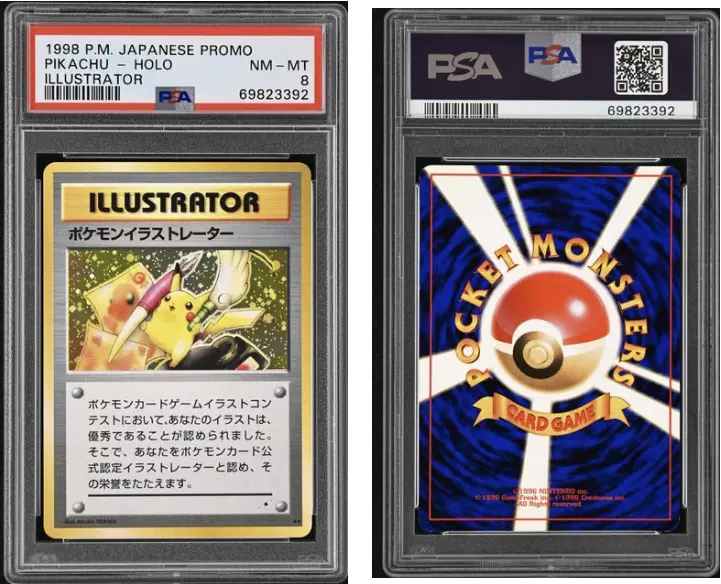
How Many Pikachu Illustrator Cards Are There? Rarity, History & Value
Only 39 Pikachu Illustrator cards were originally awarded, and far fewer survive today. See the full history, current values, and how to authenticate one.
Pikachu Illustrator Card: Rarity, History & Value
The Pikachu Illustrator card is widely considered the most iconic Pokémon card ever made. It is not a booster-pack pull. It is a prize card from Japan, with a tiny known supply and a long history of headline-grabbing sales.
Only 39 copies were originally awarded through a Japanese illustration contest, and the number of surviving cards today is unknown. This guide explains the full story: how many exist, why so few survive, what drives value, and how to authenticate one safely.
TL;DR
- It is a prize card awarded through a Japanese illustration contest, not a regular set release.
- Rarity is the story: the original distribution is widely cited as 39 cards, with the number of surviving copies unknown.
- Condition matters more than most Pokémon cards because supply is so thin and grading is extremely picky.
- Authenticity checks are non-negotiable: the value attracts altered cards, fake listings, and scammy provenance claims.
- Buy the holder, the seller, and the paper trail before you buy the card.
figoca extension
Get card comps on eBay in seconds
See comps directly on eBay listings and search results. Save time, avoid overpaying, and learn faster while you browse.
- Comps inline on item and search pages
- Automatic card detection and parsing
- Fast, privacy-first, and free
- Built for newcomers and hobbyists
Notable sales (why this card became mainstream)
On February 16, 2026, the Pikachu Illustrator card made history again. Logan Paul’s PSA 10 (Pop 1) copy sold at Goldin for a record-breaking $16,492,000—the new world record for any trading card.
This sale validates the card's status as the ultimate "trophy" in the hobby, trading at a valuation comparable to the world's most expensive fine art and sports memorabilia.
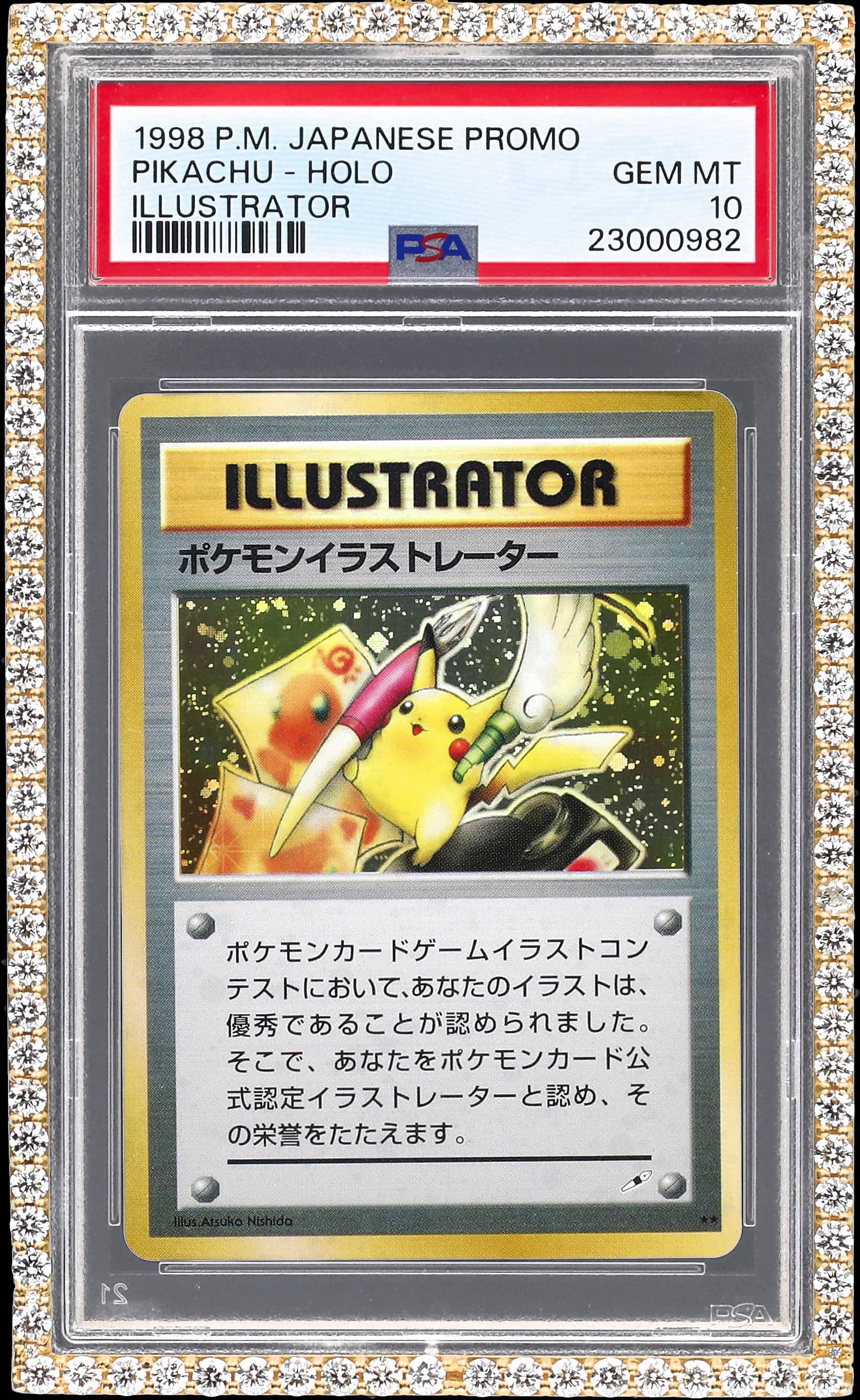
- Read the full breakdown: Logan Paul’s PSA 10 Pikachu Illustrator Sale at Goldin
- View the auction: Goldin Auction Listing
The most-cited modern headline before this was Logan Paul’s acquisition of a PSA 10 copy for $5.275 million in a private sale, recognized by Guinness World Records.
| Event | Price (USD) | What it tells you |
|---|---|---|
| Feb 16, 2026 (Goldin) | 16,492,000 | The new world record for any trading card |
| Guinness World Records private sale (PSA 10) | 5,275,000 | Top-grade trophy cards can trade like fine art |
Expert Opinion: What this means for the hobby
This sale reinforces a key hierarchy in card collecting: Condition is a multiplier, but population is the ceiling.
A PSA 10 Pop 1 of a card with this historical weight doesn't just trade on "comps"—it trades on scarcity and prestige. The gap between this $16.5M result and lower-grade copies confirms that for the highest-end collectors, the "perfect" copy is a distinct asset class, separate from the rest of the market. It signals that Pokémon has firmly established itself alongside vintage sports cards as a blue-chip alternative asset.
What is the Pikachu Illustrator card?
The Pikachu Illustrator card is a rare Japanese Pokémon prize card awarded to winners of a CoroCoro Comic illustration contest in the late 1990s. It is famous for its tiny known distribution, unique “Illustrator” design, and record-setting sales, including a $16.5 million Goldin auction in February 2026.
Key facts at a glance
| Detail | What to know |
|---|---|
| Card type | Japanese prize promo |
| Why it exists | Awarded to contest winners, not sold in packs |
| Why collectors care | Extremely scarce, culturally iconic, and highly liquid at the top end |
| Record headline | Feb 16, 2026: $16.49 million at Goldin (world record for any trading card) |
| Biggest risks | Fakes, altered surfaces, swapped provenance, and overpaying for weak condition |
The origin story: how the card was awarded
Pikachu Illustrator was awarded through illustration contests connected to CoroCoro Comic in Japan. Instead of being printed as a normal “Trainer” card, it uses the “Illustrator” label and includes visual design cues that make it feel like a trophy.
Most modern summaries cite an original distribution of 39 cards to contest winners.
If you want a simple mental model:
- If a card comes from packs, supply is tied to print runs.
- If a card comes from a contest prize, supply is tied to a tiny winner pool.
That second category is why this card sits in a completely different rarity tier.
How many Pikachu Illustrator cards are there?
The short answer: 39 copies were originally awarded, and the number surviving today is unknown.
Collectors regularly ask "how many Pikachu Illustrator cards are there?" and the answer has two layers:
- Originally distributed: most sources cite 39 cards given to winners of the CoroCoro Comic illustration contest in the late 1990s.
- Surviving today: nobody knows the exact count. Some copies are lost, damaged, or permanently locked away in private collections and will likely never surface.
A practical way to think about the surviving supply:
- Grading-company populations are the best public signal, but they change over time as new copies are submitted or reholdered.
- Not every surviving copy is graded, and some owners will never grade or sell.
If you are comparing copies, do not anchor on a single population snapshot. Treat pop reports as a moving reference point, not a definitive census.
What makes the Pikachu Illustrator card unique
Even if you have never collected Pokémon, this card stands out.
- The label: it says “Illustrator” instead of “Trainer.”
- The vibe: it reads like an award certificate more than a game piece.
- The story: it is attached to early Pokémon culture and contest history.
Those factors create demand that goes beyond set builders.
Value drivers (what actually moves the price)
Condition and eye appeal
Because so few trade publicly, condition premiums can be extreme.
- If the surface has scratches, dents, or gloss wear, the market will discount it hard.
- If centering and corners are clean, the market will pay up, especially for high-end collectors who only want one “forever copy.”
Grade, but also the grading company
At this level, the slab is part of the asset.
- If it is graded, buyers typically want a widely recognized grading company and a verifiable cert.
- If it is raw, you need a stronger provenance story and better photos than usual.
If you are new to grading decisions, start with this framework: Should you grade that card? The EV method
Provenance and liquidity
High-end buyers care about who owned the card, where it traded, and whether the transaction is clean.
- If you can document prior sales (auction results, invoices, cert verification), it reduces buyer risk.
- If the listing has a fuzzy story, price can be lower even when the card looks strong.
How to authenticate a Pikachu Illustrator card (step-by-step)
This is the checklist I would use before sending real money.
- Verify the holder
- If it’s graded, verify the cert number on the grading company site.
- If you’re buying a PSA slab, do a fast scam screen: Fake PSA slabs: the 60-second check
- Demand high-resolution photos
- Front, back, edges, corners, and close-ups of any defects.
- Cross-check the story
- If the seller claims “known copy,” ask for auction links, invoices, or third-party references.
- Check the seller’s incentives
- Prefer established auction houses or long-tenured high-feedback sellers for any private sale.
- Treat urgency as a red flag
- If someone pressures you to wire quickly, walk.
If you’re shopping on eBay, this guide helps you avoid common traps: How to buy sports cards on eBay (ultimate guide)
For faster price context while browsing, the figoca extension surfaces comps directly on eBay.
Buying guide: what to pay attention to
Choose your target: trophy ownership vs investment
A card like this is often bought for identity and collection prestige, not short-term profit.
- If you want a “forever” copy, prioritize eye appeal and a strong holder.
- If you care about resale, prioritize liquidity: clean provenance, mainstream grading, and minimal defects.
Fees and logistics you should budget for
| Cost driver | Why it matters |
|---|---|
| Payment fees | Wire, escrow, and card fees can be significant at high prices |
| Shipping and insurance | You want full declared-value insurance and a secure chain of custody |
| Taxes and customs | Import taxes can apply depending on destination |
| Reholdering or crossover | Sometimes buyers pay to reholder, regrade, or cross to another company |
EU and Germany note (high-level)
If you import a high-value collectible into the EU, you may face VAT and customs handling depending on the shipping terms and declared value. For deals of this size, professional shipping and clear paperwork are worth the cost.
Common mistakes (and how to avoid them)
- Overweighting a single pop snapshot: pop counts change, and not every copy is graded.
- Ignoring provenance: at this price level, the story can be part of the asset.
- Buying “raw to save money”: raw trophy cards can be the riskiest way to buy.
- Assuming a high grade means no risk: you still need to verify the cert, seller, and chain of custody.
If you’re building hobby fundamentals before you chase trophy cards, start here: 10 secrets every card collector needs to know
If you want a quick intro to how modern card buying works (boxes, breaks, and hype cycles), this is a helpful primer: How does a box break work?
Quick glossary
- Prize card: a card given as an award, not sold in packs.
- Provenance: the ownership and sale history that supports authenticity.
- Population report: how many copies a grading company has graded at each grade level.
- Liquidity: how easily an asset can be sold at a fair price.
FAQ
Is the Pikachu Illustrator card the rarest Pokémon card?
It is one of the rarest and most famous, but “rarest” depends on how you define it. Some test prints or obscure promos may have fewer surviving copies, but Pikachu Illustrator has unmatched fame and demand.
How many Pikachu Illustrator cards were originally made?
Most sources cite an original award count of 39 copies tied to contest winners.
How many copies exist today?
Nobody knows for sure. The best public signal is grading-company populations, but some cards are ungraded and some owners never sell.
Why is it called “Illustrator” instead of “Trainer?”
It was designed as a prize card for an illustration contest, so the label reflects the award theme.
Who designed the card?
The artwork is commonly credited to Atsuko Nishida, one of Pikachu’s original designers.
What is the highest known sale price?
Guinness World Records recognizes a $5.275 million private sale for a PSA 10 copy.
Was the $5.275 million transaction an auction?
No. Guinness describes it as a private sale that included a card trade plus cash.
Should you buy one raw (ungraded)?
Only if you have exceptional expertise and strong provenance. For most buyers, graded copies reduce risk.
What grading company matters most for this card?
At the very top, buyers usually prefer widely recognized grading companies, but the best choice depends on the buyer pool you want to sell to later.
Does a higher grade always mean a better buy?
Not always. Eye appeal, cert verification, and provenance can matter more than a one-point difference at the top end.
Why do pop reports differ between grading companies?
Each company has its own database and submission history, and cards can cross over or be resubmitted over time.
Is this card legal tender for the Pokémon TCG?
It is a real Pokémon card, but it is collected as a trophy promo and is not relevant for competitive deck play.
What is the biggest scam risk when buying this card?
Fake listings and false provenance claims. Always verify the seller, the cert, and the paper trail.
Is eBay a safe place to buy it?
It can be, but you need strict seller standards and careful verification. Use this approach: How to buy sports cards on eBay (ultimate guide)
How do you check recent comps when there are so few sales?
Track reputable auction results, follow grading-company data, and compare against the last few confirmed public sales. Tools that surface comps while browsing can help: figoca extension
Is it worth buying if you’re new to collecting?
Usually no. Most collectors are better served learning condition, grading, and buying basics first, then moving up to trophy cards later.
Sources and further reading
- Guinness World Records: Logan Paul owns a $5.275 million Pokémon card
- Guinness World Records: most expensive Pokémon trading card sold at a private sale
- CGC Cards: Pikachu Illustrator population and a Heritage sale recap
- Overstreet Access: Pikachu Illustrator sale coverage
Last updated: 2026-02-16

Card enthusiast, figoca founder, and independent software developer
Nico is a card enthusiast who built figoca after running into the same problems many collectors face: uncertain pre-grading decisions, too much tab switching for comps, and no fast way to price cards on the go. He is also a big Kansas City Chiefs fan (❤️💛), follows the Kansas City Royals (💙), and enjoys Formula 1 and Golf.
- Sports Card enthusiast
- Founder of figoca
- Independent software developer with a TypeScript and AWS background