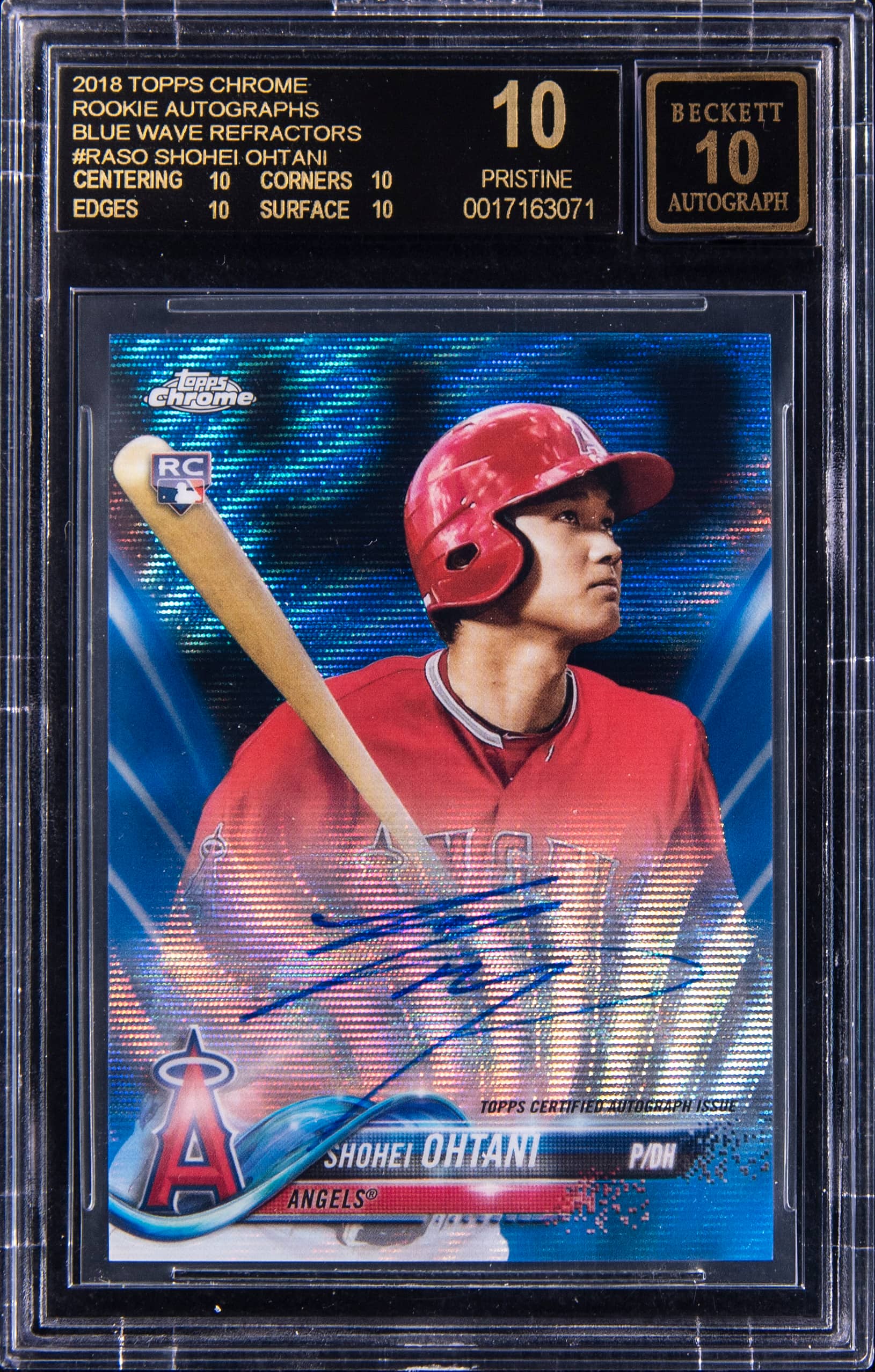
Ohtani 2018 Blue Wave Auto BGS Black Label Sells
Goldin sold a 2018 Topps Chrome Shohei Ohtani Blue Wave Rookie Auto BGS Black Label 10 (pop 1) for $640,500. Here’s what it means for collectors.
Sold Card
2018 Topps Chrome Rookie Autographs Blue Wave Refractor #RA-SO Shohei Ohtani Signed Rookie Card (#116/150) - BGS PRISTINE/Black Label 10, Beckett 10 - Pop 1
Sale Price
Platform
GoldinWhen a true modern cornerstone card surfaces in a top grade, the market tends to pay attention. That’s exactly what happened with the recent sale of a Shohei Ohtani blue wave rookie autograph that quietly set a new bar for one of his key chromium rookies.
On December 7, 2025, Goldin sold a 2018 Topps Chrome Rookie Autographs Blue Wave Refractor #RA-SO Shohei Ohtani, serial numbered 116/150, for $640,500. The card is graded BGS PRISTINE/Black Label 10 by Beckett, with perfect 10 subgrades across the board, and is currently a population 1 (the only copy to reach that grade). For collectors who follow grading closely, a black label on a serial-numbered, on-card rookie auto of a generational player is about as premium as it gets in the ultra-modern lane.
Card overview: what exactly sold?
Let’s break down the card in hobby terms:
- Player: Shohei Ohtani
- Team pictured: Los Angeles Angels
- Year: 2018
- Product: Topps Chrome
- Card: Rookie Autographs #RA-SO
- Parallel: Blue Wave Refractor, serial numbered to 150 (this copy is #116/150)
- Autograph: On-card (signed directly on the card, not on a sticker)
- Rookie status: Major chromium rookie autograph and a cornerstone Ohtani rookie issue
- Grading company: Beckett Grading Services (BGS)
- Grade: BGS PRISTINE / Black Label 10, with four 10 subgrades
- Population: Pop 1 at this grade (no other black label copies as of the sale date)
Topps Chrome rookie autographs are often seen as a player’s key “flagship chrome” rookie auto – meaning the main, widely recognized chromium rookie autograph from a major licensed release. Among Ohtani’s many 2018 rookies, his Topps Chrome autos sit near the top of the hierarchy for a lot of collectors.
The Blue Wave Refractor parallel adds color, serial numbering to 150, and a distinctive wave pattern. It isn’t the rarest Ohtani chrome auto (there are lower-numbered colors), but it sits in that sweet spot of being both scarce and still recognizable/accessible within the overall Topps Chrome rainbow.
Why this card matters to collectors
1. A cornerstone Ohtani rookie autograph
Shohei Ohtani’s 2018 season marked the official start of his MLB career with the Angels. His rookie cards from that year were heavily produced across multiple brands, but certain issues stand out:
- Topps Series 1 & Update: flagship base rookies
- Topps Chrome Rookie Autographs: premier chromium auto rookies
- High-end brands (Definitive, Dynasty, etc.): premium but niche
Within that landscape, the 2018 Topps Chrome Rookie Autographs #RA-SO is widely treated as one of his core rookie autograph cards. It combines an on-card signature, MLB licensing, and the Chrome brand that has been a hobby staple since the late 1990s.
2. A premium color parallel
Not all rookie autos from the same set carry the same weight. Collectors generally sort them by scarcity and visual appeal:
- Base chrome autos: unnumbered, more common
- Refractor / color autos: serial-numbered, more limited
- Wave / shimmer / special textures: often slightly tougher and more visually distinct
The Blue Wave Refractor /150 sits above the base and standard refractor tiers in terms of rarity, while still being a recognizable color that collectors chase. It’s not so rare as gold or red, but it has enough scarcity that high-grade examples are meaningfully limited.
3. The significance of a BGS Black Label 10
Beckett’s Black Label 10 is one of the strictest grading outcomes in the hobby:
- A card must earn 10.0 on all four subgrades (centering, corners, edges, surface).
- The label is literally black, distinguishing it from standard gold 9.5 and 10 slabs.
- Population numbers for Black Labels, especially on colored, serial-numbered, on-card autos, are often extremely low.
On modern chromium cards, small flaws are common – minor print lines, faint surface issues, or tiny edge touches. That makes a serial-numbered on-card chrome auto with four 10 subgrades quite difficult to achieve.
In this case, Beckett’s pop report showed this Ohtani Blue Wave auto in Black Label as a population 1, meaning this is the only known copy with that perfect grade at the time of sale. There may be other BGS 9.5s and BGS 10s, as well as strong PSA 10 examples, but the black label designation sets this card apart within its own parallel.
Market context: how does $640,500 fit in?
Whenever a population 1 Black Label sells, it’s hard to find direct apples-to-apples comparisons. Still, we can look at nearby data points to understand the range this sale sits in. (In hobby shorthand, these recent comparable sales are often called “comps” – just meaning other sales you can compare it to.)
Based on available public records around similar Ohtani cards:
- Base 2018 Topps Chrome Rookie Auto PSA 10s have typically sold in the low five-figure range, depending on timing and Ohtani’s performance stretches.
- Color Ohtani chrome autos (e.g., blue, purple, gold) in strong BGS or PSA 10 grades have ranged from the mid five-figure to low six-figure levels at various points, influenced heavily by Ohtani’s awards and milestones.
- Lower-numbered color autos (e.g., gold, orange, red) at top grades sit in higher tiers still, sometimes testing or exceeding major six-figure prices, especially during peak Ohtani momentum.
Against that backdrop, this $640,500 Goldin sale for the Blue Wave Refractor /150 in BGS Black Label 10 stands at the high end of Ohtani’s non-superfractor, non-1/1 chrome rookie autos. The driver here isn’t just the card itself, but the combination of:
- A flagship chrome rookie autograph issue
- A desirable numbered color parallel
- A true pop 1 Black Label grade
Because Black Labels are so rare, it’s normal for their prices to sit well above standard gem mint grades, even when the card itself is the same parallel.
Ultra-modern era and Ohtani’s ongoing story
This card comes from the ultra-modern era (roughly mid-2010s onward), where production volumes are higher but top-graded, low-population cards still stand out because grading standards and condition sensitivity create real scarcity.
With Ohtani, several factors keep demand for his top rookies steady:
- Two-way excellence: A historic combination of elite hitting and frontline pitching.
- Awards and milestones: Multiple MVP-level seasons and record-setting performances have kept his name at the center of baseball conversation.
- Global fan base: Strong interest from both U.S. and international collectors.
- Team transitions and media coverage: Team changes and playoff expectations can create waves of attention, which often spill into the card market.
When news cycles are positive, demand for his key rookies can spike, particularly for the most recognizable brands: Topps Chrome, Bowman Chrome, and other flagship-style rookie issues. This sale fits into that broader pattern—while not every Ohtani card is affected equally, the very top of his market tends to move first.
How collectors might interpret this sale
For active collectors and small sellers, it’s helpful to treat this result as a reference point, not a price prediction:
- For Ohtani collectors: This confirms that his elite, low-population, flagship rookie autos continue to attract serious attention.
- For set and rainbow builders: It underscores the importance of condition on color parallels; the same /150 card with a lower grade will live in a very different price tier.
- For grading-focused collectors: It’s a reminder of the premium that a true top grade (especially a Black Label) can command in the ultra-modern space.
This does not mean that every 2018 Ohtani card, or even every Topps Chrome auto, will follow the same trajectory. Instead, it highlights the gap between:
- Routine, widely available Ohtani rookies, and
- His absolute top-tier, low-pop, flagship autographs.
Takeaways for newer and returning collectors
If you’re newer to the hobby or coming back after some time away, here are some practical lessons from this sale:
Know the card’s role in the player’s rookie landscape
Not all rookies are equal. Understanding which sets are considered “flagship” or “key chromium” helps you see why certain cards carry more weight.Pay attention to parallel and numbering
A colored, numbered parallel like a Blue Wave /150 will naturally sit above a base version, but also within a tiered structure of color scarcity.Learn what grading levels actually mean
A PSA 10, BGS 9.5, BGS 10, and BGS Black Label 10 all occupy different pricing tiers. Pop reports—how many copies exist at each grade—are central to understanding scarcity.Use comps as context, not guarantees
Recent sales give you a rough range for what the market has paid, but they’re not promises about future prices. Factors like timing, auction visibility, and bidding competition all matter.Separate the player’s performance from the specific card
Ohtani’s on-field success drives general interest, but each individual card’s performance is shaped by brand, parallel, and grade.
Summary
The 2018 Topps Chrome Rookie Autographs Blue Wave Refractor #RA-SO Shohei Ohtani, #116/150, that sold at Goldin on December 7, 2025 for $640,500 is a clear example of how concentrated value can become at the very top of the modern card market:
- It’s a cornerstone Ohtani rookie autograph from a flagship chrome release.
- It features a numbered Blue Wave Refractor parallel.
- It carries a BGS PRISTINE / Black Label 10 grade with a population of 1.
For collectors tracking Ohtani’s key rookies, this sale helps frame the upper tier of his market and reinforces how much condition and scarcity matter—especially when they intersect on a card that the hobby already recognizes as important.