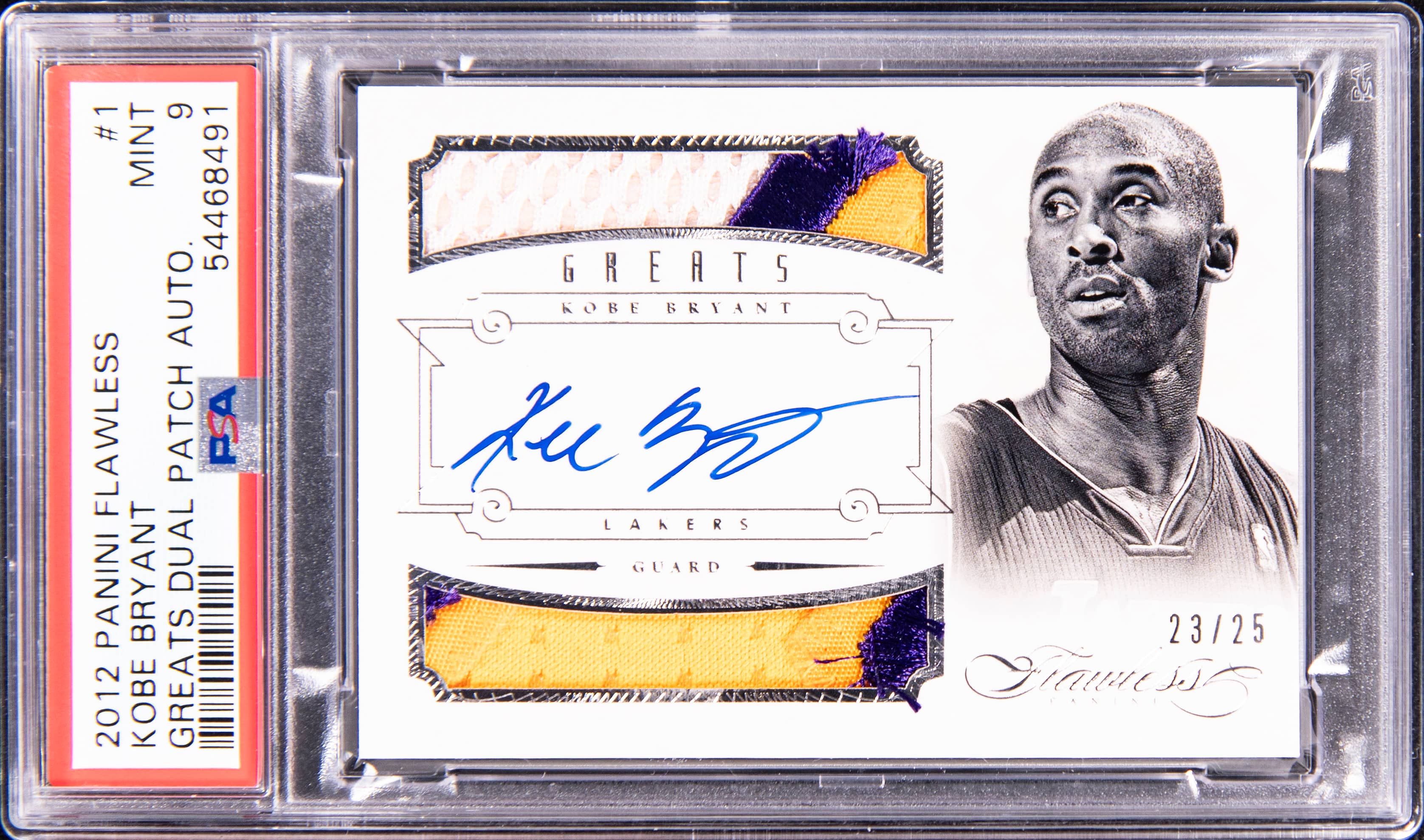
Kobe 2012-13 Flawless Dual Patch Auto Sells Big
Goldin sold a 2012-13 Panini Flawless Greats Dual Patch Auto Kobe Bryant /25 PSA 9 for $62,520 on Jan 4, 2026. Here’s what it means for collectors.
Sold Card
2012-13 Panini Flawless Greats Dual Patch Autograph #1 Kobe Bryant Signed Patch Card (#23/25) - PSA MINT 9
Sale Price
Platform
Goldin2012-13 Panini Flawless Greats Dual Patch Autograph #1 Kobe Bryant Signed Patch Card (#23/25) - PSA MINT 9 Sells for $62,520
On January 4, 2026, Goldin closed a notable modern Kobe Bryant sale: a 2012-13 Panini Flawless Greats Dual Patch Autograph #1, serial numbered 23/25, graded PSA MINT 9, realized $62,520.
For collectors who focus on premium Kobe autos, Flawless, and early high-end Panini-era Lakers pieces, this is the kind of card that quietly anchors a collection.
Card Overview
Let’s break down exactly what this card is and why it matters.
- Player: Kobe Bryant
- Team: Los Angeles Lakers
- Year: 2012-13
- Set: Panini Flawless – Greats Dual Patch Autographs insert
- Card number: #1
- Serial numbering: Hand-numbered 23/25
- Autograph: On-card (signed directly on the card, not a sticker)
- Memorabilia: Dual multi-color game-used patch pieces
- Rookie status: Not a rookie card; this is a premium veteran autograph/patch issue
- Grading company: PSA (Professional Sports Authenticator)
- Grade: PSA MINT 9
- Era: Modern / early Panini high-end
2012-13 Flawless was among Panini’s first attempts at a true super-premium basketball product. Each box came in a metal briefcase with extremely limited, low-serial-number content. For many collectors, these early Flawless releases represent the beginning of what we now think of as the modern “ultra-premium” era: low print runs, on-card autos, and patches from star and legend players.
The “Greats” Dual Patch Autograph subset focuses on established stars and Hall of Famers rather than rookies. For Kobe, it offers:
- A hard-signed autograph, which many collectors prefer because the player signs the actual card surface.
- Two patch windows, typically with strong colors from Lakers jerseys.
- A short print run of just 25 copies, putting it into true scarcity territory rather than mass-produced memorabilia.
Significance of PSA MINT 9
PSA’s MINT 9 grade indicates a high-end copy with only minor, largely invisible-to-the-eye issues under close inspection. For patch auto cards, centering, edges, and surface can be especially challenging, and corners often show wear from the thick stock.
Within a small print run like /25, condition spreads can be wide, and not every copy will grade well. That means PSA 9 and PSA 10 examples are typically treated as clear tier upgrades over raw (ungraded) copies or lower grades, especially for high-end sets like Flawless.
While specific population (pop) data – the count of how many copies PSA has graded at each grade – can change frequently, it is common for niche, low-numbered patch autos to show:
- A small total population (few graded at all).
- Only a handful of PSA 9s and 10s, making each high-grade copy an important comp.
A “pop report” is simply the grading company’s census of how many cards of a particular issue exist in each grade.
This Sale: $62,520 at Goldin
- Auction house: Goldin
- Sale date (UTC): 2026-01-04
- Realized price: $62,520
Goldin frequently handles high-end basketball cards, especially iconic names like Kobe. A sale of this magnitude in a large, visible auction house helps establish a public price reference for other buyers and sellers.
In hobby shorthand, these public sale prices are often called “comps” (short for “comparables”)—recent, verifiable sales that collectors use to gauge current market ranges.
Market Context and Comparable Cards
For a low-numbered 2012-13 Flawless Kobe auto patch like this, direct, perfectly matched comps (same serial-number, same grade, same sub-series) can be thin. These cards do not trade nearly as often as more common inserts or base parallels.
Because of that, market context usually comes from a mix of:
- Other 2012-13 Flawless Kobe Greats Dual Patch Autos in different grades (BGS, PSA, raw).
- Similar Kobe Flawless patch autographs from the same year but different subsets.
- High-end Panini-era Kobe autos from comparable premium sets (e.g., Immaculate, National Treasures) with similar serial numbering.
Across those categories, publicly reported sales in recent years have often landed in a wide band, influenced by:
- Grade: PSA 9 versus BGS 8.5 versus raw.
- Patch quality: Number of colors, visible stitching, and visual appeal of the memorabilia pieces.
- Eye appeal: Centering, autograph strength, and overall presentation.
- Market timing: Broader hobby cycles and Kobe-specific demand.
Within that context, a PSA MINT 9 copy of a dual patch, on-card auto Kobe from early Flawless at $62,520 sits comfortably in the tier of serious, high-end Kobe pieces rather than speculative modern parallels.
Without a dense history of identical PSA 9 sales to chart, this result functions less as an outlier and more as a fresh reference point. For many collectors, it helps define what a premium, low-numbered, early Flawless Kobe autograph can command in a mature auction setting.
Why Collectors Care About This Card
Several factors combine to give this card lasting interest among Kobe and high-end basketball collectors:
Kobe Bryant’s enduring hobby status
Kobe’s passing in 2020 shifted many of his important cards from speculative modern pieces into the realm of established hobby blue chips. His high-end autos, especially on-card examples from respected sets, tend to be treated as long-term anchors for collections.Early Panini Flawless era
2012-13 marks one of Panini’s first truly luxury basketball products. For collectors who value “firsts,” early Flawless runs are often seen as foundational for today’s ultra-premium market.True scarcity: serial numbered to 25
Unlike mass-produced jersey cards from the 2000s, a print run of 25 is genuinely small. When you account for:- Copies locked in long-term personal collections, and
- The fact that not all 25 will grade at PSA 9 level or equivalent,
the number of comparable-quality copies that could realistically come to market is very limited.
On-card autograph and dual patch design
Many collectors place a premium on:- A clean, on-card signature with strong ink.
- Multiple patch windows with visible color breaks.
The Greats Dual Patch Autograph format checks both boxes and showcases Kobe prominently.
Modern-but-not-ultra-modern sweet spot
2012-13 is modern, but not in the ultra-modern, hyper-parallel, post-2018 era. Production volumes and design philosophies were still relatively focused, and major sets from this window often feel more restrained and timeless compared to later explosion of parallels.
Reading This Sale as a Collector or Small Seller
A single auction result should never be read as a prediction. Instead, it’s most useful as part of a pattern.
Here are a few grounded takeaways:
For Kobe PC (personal collection) builders:
This sale reinforces that early Flawless Kobe autos—especially low-numbered, on-card, multi-patch pieces—continue to be treated as significant. If you own one, this Goldin result is a clear, public data point that supports viewing it as a centerpiece rather than a peripheral card.For sellers:
If you have similar Kobe patch autos from 2012-13 Flawless or comparable premium sets, this sale can function as a high-end comp. When pricing, factor in grade, patch strength, autograph quality, and whether your card is a dual patch, single patch, or from a different subset.For newer entrants to high-end Kobe collecting:
This auction is a reminder that not all Kobe autos are treated equally. Key questions you can ask when evaluating a card:- Is the autograph on-card or a sticker?
- How many copies were produced (serial number)?
- What set is it from, and how is that set viewed by long-time collectors?
- What is the grade and pop report?
Using those questions as a framework will help you understand why a card like this commands over $60,000 while other autographs from the same player might be available for a fraction of that.
Final Thoughts
The $62,520 sale of the 2012-13 Panini Flawless Greats Dual Patch Autograph #1 Kobe Bryant, numbered 23/25 and graded PSA MINT 9, at Goldin on January 4, 2026, is a clear reminder of how the hobby values:
- Early ultra-premium brands like Flawless,
- True scarcity in print runs,
- On-card signatures with strong design, and
- Hall of Fame-caliber legacies.
For Kobe collectors and high-end basketball enthusiasts, this result doesn’t rewrite the market so much as it confirms what many already felt: cornerstone Kobe autos from respected, early Panini high-end sets remain among the most stable and respected pieces in the modern part of the hobby.
As always, it’s best to treat this sale as one data point rather than a promise—but it is a meaningful one for anyone tracking the long-term story of Kobe Bryant in the trading card market.