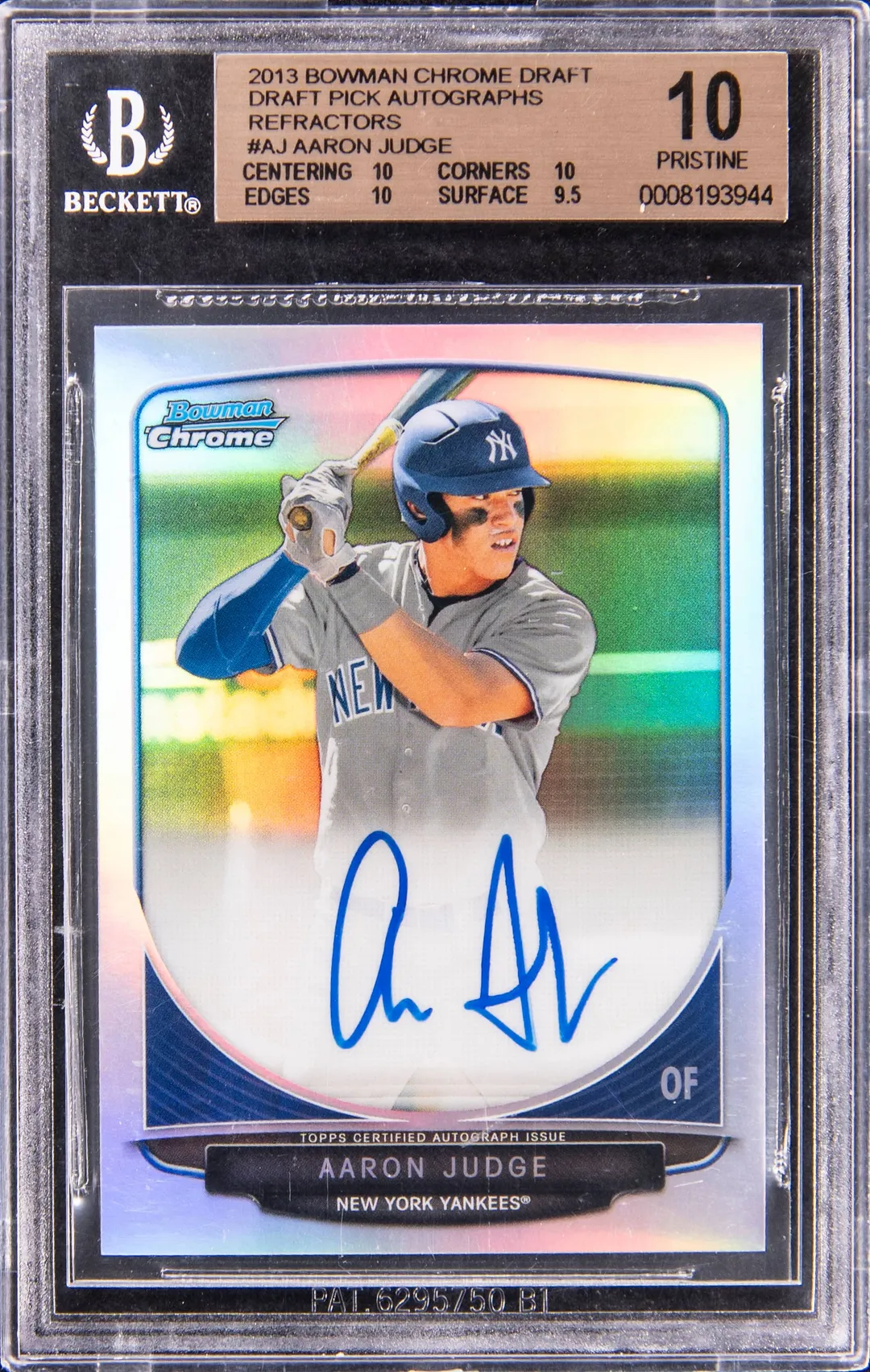
2013 Bowman Chrome Aaron Judge BGS 10 Sells at Goldin
Figoca breaks down the $14,661 Goldin sale of a 2013 Bowman Chrome Draft Aaron Judge Refractor Auto BGS Pristine 10 and what it means for collectors.
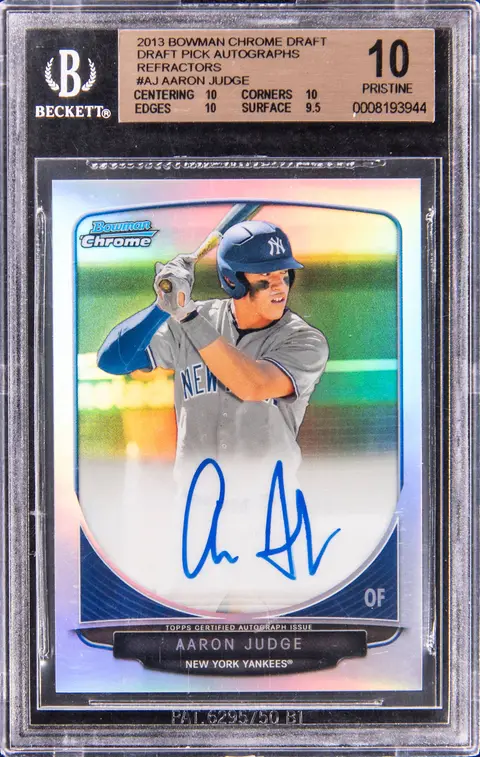
Sold Card
2013 Bowman Chrome Draft Pick Autographs Refractor #BCA-AJ Aaron Judge Signed Rookie Card - BGS PRISTINE 10, Beckett 10
Sale Price
Platform
Goldin2013 Bowman Chrome Draft Aaron Judge Auto Refractor BGS 10 Sells for $14,661 at Goldin
On December 12, 2025, Goldin closed a notable modern baseball sale: a 2013 Bowman Chrome Draft Pick Autographs Refractor #BCA-AJ Aaron Judge Signed Rookie Card, graded BGS PRISTINE 10, realized $14,661.
For Aaron Judge collectors and modern baseball investors, this is a useful reference point. It combines a key prospect-era autograph, a premium Refractor parallel, and one of the toughest grades in the hobby.
Card overview: what exactly sold?
Let’s break down the card details:
- Player: Aaron Judge
- Team: New York Yankees (pictured in his prospect-era Yankees uniform)
- Year: 2013
- Set: Bowman Chrome Draft Pick Autographs
- Card number: #BCA-AJ
- Parallel: Refractor (the standard chrome Refractor version, not a colored / serial-numbered parallel)
- Card type: Signed first Bowman Chrome autograph rookie/prospect card
- Autograph: On-card (Judge signed directly on the card surface, not on a sticker)
- Grading company: Beckett Grading Services (BGS)
- Grade: BGS PRISTINE 10 (often called “Black Label” quality when all four subgrades are 10, though this specific label configuration wasn’t provided in the listing details)
- Certification: Beckett 10 (indicates a 10-grade autograph)
In the modern baseball card hobby, 2013 Bowman Chrome Draft is widely viewed as the key early-issue product for Aaron Judge. While some collectors debate “rookie card” versus “prospect card” terminology, Judge’s 2013 Bowman Chrome autos function as his flagship first Bowman autograph in the market.
Why this card matters to collectors
- First Bowman Chrome autograph
When collectors talk about “first Bowman autos,” they mean the first licensed Bowman Chrome autograph card of a player in their MLB pipeline uniform. For modern stars, that card has often become more important than their later, logoed “RC” (rookie card) stamped issues.
For Aaron Judge, this 2013 Bowman Chrome Draft Pick Autographs card is that first Chrome auto. The Refractor version is a step up from the base autograph:
- Base autograph: standard chrome finish, more common.
- Refractor autograph: rainbow shine, lower print run, and more emphasis from collectors.
- Ultra-modern era centerpiece
This card sits firmly in the ultra-modern era (roughly mid-2010s onward). In this period:
- Print runs rose, but so did grading and population transparency.
- High-end collectors increasingly focused on the highest grades (BGS 9.5/10, PSA 10, and especially BGS 10).
- Autographed chrome rookie/prospect cards became the main “blue-chip” items for star players.
For Judge — a face of the Yankees, single-season American League home run record holder, and an MVP winner — the 2013 Bowman Chrome autos are considered core holdings in a Judge-focused collection.
- The significance of a BGS PRISTINE 10
Beckett’s Pristine 10 grade sits above Gem Mint 9.5 and on par or above many PSA 10s in perceived strictness:
- BGS 9.5: Gem Mint, very strong grade, but relatively attainable for clean modern chrome cards.
- BGS 10: Pristine, requiring near-perfect centering, corners, edges, and surface.
- BGS 10 Black Label (all four subgrades 10): the strictest standard and typically the scarcest.
While population report details for this exact card and grade can change over time, BGS Pristine 10s for 2013-era chrome autos are generally far less common than BGS 9.5s or PSA 10s. That scarcity helps explain why a BGS 10 Refractor can sell for a multiple of the price of the same card in a 9.5.
Market context and recent sales
Because auction archives and marketplace logs are constantly updating, it’s useful to think in ranges rather than fixed numbers. Based on recent public sales leading into late 2025, here’s how this Goldin result fits into the broader picture:
- Raw or ungraded versions of the 2013 Bowman Chrome Judge Refractor auto typically sell for significantly less than top-graded copies, with prices adjusting depending on autograph quality and visible surface/centering issues.
- BGS 9.5 and PSA 10 versions of the same Refractor auto have tended to cluster meaningfully below $14,661, depending on subgrades, eye appeal, and timing (for example, during or after a big playoff run vs. a quiet offseason period).
- Colored Refractor autos (Blue, Gold, Orange, Red) with serial numbering often out-sell the standard Refractor in equivalent grades, because they are more clearly limited and visually distinct. In several past cycles, high-grade colored Judge autos from 2013 Bowman Chrome have set the top-end benchmarks for his pre-rookie issues.
Within that framework, a $14,661 sale for a BGS PRISTINE 10 Refractor auto:
- Sits comfortably in the upper tier for non-colored Judge autos from this product.
- Reflects a premium for grade scarcity over more plentiful Gem Mint copies.
- Tracks with the broader pattern where the very best-conditioned examples command significant multiples over the same card in standard high grades.
Again, this isn’t a price prediction tool, but a single data point in a longer series. Each auction’s result is influenced by bidder competition, market sentiment, and timing.
Where this sale fits in Judge’s card history
A few broader points about Aaron Judge’s card market help frame this Goldin result:
- Established star status
Judge’s credentials by late 2025 include:
- An American League MVP award.
- The AL single-season home run record.
- Long-term contract status as the face of the New York Yankees.
For collectors, this means his key early cards have moved past “prospect speculation” and into more established territory. While prices can still move up or down, the player’s core resume is already significant.
- 2013 Bowman Chrome as a foundational set
Within modern baseball:
- Bowman Chrome Draft is known as a pipeline set; many future stars debut their first Bowman autos here.
- For Judge, this set is viewed as the foundation of his high-end market, similar to how first Bowman autos function for players like Mike Trout or Juan Soto.
In that context, a high-end graded autograph from this product is less of a niche parallel and more of a core card that serious Judge collectors typically track.
- Grade scarcity and pop concentration
Although exact population numbers change as more cards are graded, it’s typical for:
- BGS 9.5s and PSA 10s to make up the majority of graded 2013 Judge autos.
- BGS 10 Pristine to remain a small fraction of the total.
This sort of “thin population at the top” is what often drives distinctive pricing for the very best examples.
How collectors can use this sale as a reference
For newer or returning collectors, here’s how to interpret this Goldin auction in practical terms:
- Use it as one comp, not the only comp
“Comps” (comparable sales) are recent public transactions used to help understand what similar cards have sold for. A single $14,661 sale for a BGS 10 Refractor auto:
- Is an important data point.
- Should be considered alongside recent sales of BGS 9.5s, PSA 10s, and raw copies, as well as other auction results for BGS 10s.
- Adjust for grade, eye appeal, and timing
When looking at comps, it’s useful to adjust for:
- Grade tier: BGS 10 vs BGS 9.5 vs PSA 10.
- Autograph grade: 10 auto vs streaky or smudged sigs.
- Surface and centering: even within the same numeric grade, visual appeal can shift what buyers are willing to pay.
Seasonality can matter as well. Big performances, award announcements, or postseason runs can all correspond with more aggressive bidding on key cards.
- Understand where this fits in the Judge hierarchy
Within Aaron Judge’s broader card lineup, this sale highlights:
- The durability of demand for his first Bowman Chrome autos.
- The pricing gap between top-graded Refractors and base autos.
- The continued importance of grading for ultra-modern key issues.
For collectors, that can inform how you prioritize future pickups: whether to chase one high-end cornerstone card, or multiple mid-tier cards across different sets.
Takeaways for different types of collectors
Newcomers to the hobby: This sale is a good case study in how a player’s first Bowman chrome autograph, a parallel like a Refractor, and an elite grade come together to create a premium result. You don’t have to start at this price tier, but the structure of the market is the same at lower levels.
Returning collectors: If you collected in earlier eras, think of this as the modern analog to a key rookie plus an autograph and a condition premium — all rolled into one card. Learning the grading scale (especially BGS vs PSA) is worth the time.
Active hobbyists and small sellers: This Goldin result gives you a fresh data point for any 2013 Judge autos you’re holding or considering. It can help you gauge relative pricing between raw, mid-grade, Gem Mint, and Pristine copies.
Final thoughts
Goldin’s December 12, 2025 sale of the 2013 Bowman Chrome Draft Pick Autographs Refractor #BCA-AJ Aaron Judge BGS PRISTINE 10 at $14,661 reinforces a few ongoing themes in the modern hobby:
- First Bowman Chrome autographs remain central to how collectors value star players.
- Grade scarcity at the very top continues to command meaningful premiums.
- Established on-field production from a marquee franchise anchor supports sustained interest in core early issues.
For anyone tracking Aaron Judge’s card market, this auction doesn’t rewrite the story, but it adds a clear, data-backed chapter to it — one that underlines how important condition and set selection are in today’s ultra-modern landscape.