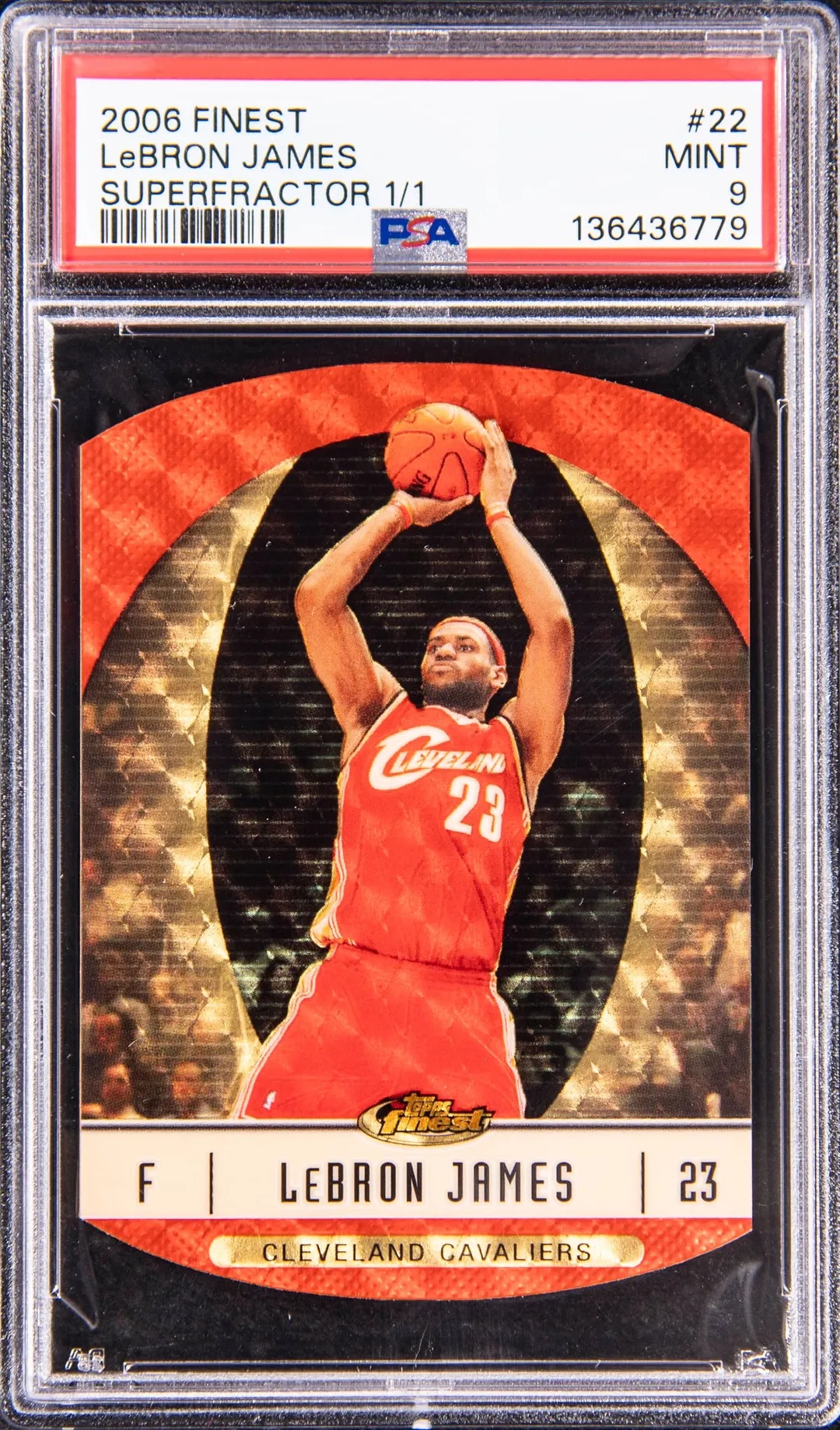
2006-07 Finest LeBron SuperFractor 1/1 PSA 9 Sale
A closer look at the 2006-07 Topps Finest SuperFractor 1/1 LeBron James PSA 9 that sold for $52,460 at Goldin on December 7, 2025.
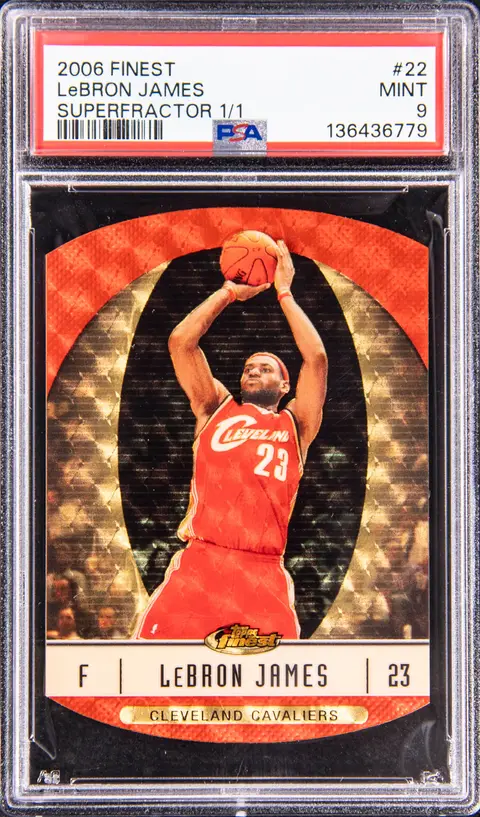
Sold Card
2006-07 Topps Finest SuperFractor #22 LeBron James (#1/1) - PSA MINT 9
Sale Price
Platform
Goldin2006-07 Topps Finest SuperFractor #22 LeBron James (#1/1) – PSA 9 Sells for $52,460
On December 7, 2025, Goldin closed the auction of a major LeBron James parallel: a 2006-07 Topps Finest SuperFractor #22, serial-numbered 1/1 (one of one), graded PSA MINT 9. The final price was $52,460.
For collectors who follow rare chrome-era LeBron cards, this sale offers a useful datapoint in a segment of the market where public sales are infrequent and true one-of-ones rarely change hands.
Card overview
Let’s break down exactly what this card is:
- Player: LeBron James (Cleveland Cavaliers)
- Year: 2006-07 season
- Set: Topps Finest Basketball
- Card number: #22
- Parallel: SuperFractor (gold, spiral/"swirl" refractor finish, serial-numbered 1/1)
- Serial number: 1/1 (only one copy produced)
- Rookie status: Not a rookie card (LeBron’s rookie year sets are 2003-04)
- Era: Modern (mid-2000s chromium issue)
- Grading company: PSA (Professional Sports Authenticator)
- Grade: MINT 9
SuperFractors are among the flagship rare parallels across Topps chromium products. While the term is most closely associated with Topps Chrome and Bowman in baseball, Finest SuperFractors occupy a similar tier: essentially the top of the parallel ladder with a single copy of each card.
Why this card matters to collectors
1. A key LeBron James one-of-one from the mid-2000s
Although this is not a rookie card, it is an early-career LeBron from a well-known chromium line. By 2006-07, LeBron was already a central figure in the league and in the hobby, but the print environment was still far more restrained than many ultra-modern releases.
Within LeBron’s broader market, rookie cards from 2003-04 understandably command the most attention. However, early non-rookie one-of-ones from respected brands—Topps Chrome, Finest, Bowman Chrome—often attract advanced player collectors who focus on long-term career narratives rather than just rookie-year issues.
2. Topps Finest as a chromium pillar
Topps Finest has been a mainstay in basketball’s chromium category when Topps held the NBA license. The 2006-07 release sits in a transition period: after the initial LeBron rookie-year wave and before the hobby’s later explosion of parallel volume.
For newer collectors:
- Chromium cards are printed on shiny, metalized cardstock (like Topps Chrome, Prizm, Finest), known for their reflective finish.
- Parallels are alternate versions of a base card with different colors or patterns, often serial-numbered to show how many exist.
Within 2006-07 Finest, standard refractors and colored parallels are scarce but obtainable. The SuperFractor tier is at the top: the true one-of-one.
3. PSA 9 on a one-of-one
Because this is a 1/1, the population report (or “pop report”, a grading company’s count of how many copies they’ve graded at each grade) can’t be compared the same way as with multi-copy cards.
However, condition still matters:
- PSA 9 (MINT) typically indicates sharp centering, clean surfaces, and strong corners, with only minor flaws.
- For a one-of-one, a strong grade can influence how collectors perceive relative desirability, even though there is no competing graded copy.
The fact that this card achieved a PSA 9 rather than, for example, a PSA 7 or 8, likely supported confidence in the realized price.
Market context and price perspective
Because this is a true one-of-one, direct comps—that is, recent sales of the exact same card—are often unavailable or very sparse. Instead, collectors often look at:
- Sales of other LeBron 1/1s from comparable years and brands
- Prices of 2006-07 Finest LeBron parallels (like gold refractors, X-Fractors, or black refractors) to understand the hierarchy
- Broader LeBron market direction, including key rookie refractor and numbered parallel sales
Based on publicly available auction results and marketplace data up to late 2024/2025, the landscape looks roughly like this:
- Early- to mid-2000s LeBron 1/1s from chromium brands (Topps Chrome, Finest, Bowman Chrome) have shown steady collector demand, especially in strong grades.
- Non-rookie one-of-ones typically sell at lower levels than true rookie one-of-ones or premium rookie refractors, but they sit in a respected lane for advanced LeBron collectors.
- Parallel tiers like gold refractor /25 or /50 and lower-numbered colored refractors often serve as guideposts. When those tiers move upward or downward, it usually filters into how collectors frame the value of a 1/1.
Many one-of-one LeBron cards from this era change hands privately, making it hard to build a complete pricing picture. In that context, public auction results like this Goldin sale at $52,460 function as anchor points for future negotiations and appraisals.
How this sale fits the broader LeBron market
A few useful angles when thinking about this result:
Rookie vs. non-rookie gap
- Top-tier LeBron rookie cards (for example, chromium refractor rookies in high grades or low-numbered rookies) continue to occupy a significantly higher price tier.
- This 2006-07 Finest SuperFractor sits in the next layer down: a highly desirable, early-career, non-rookie one-of-one.
Brand and eye appeal
- Finest doesn’t always command the same premium as Topps Chrome for some collectors, but it is still an established chromium brand with recognizable aesthetics.
- For one-of-ones, the visual look of the SuperFractor pattern, combined with team colors and player imagery, can make a card stand out even within a player’s 1/1 portfolio.
Auction setting and timing
- The sale took place at Goldin, a major auction house that regularly handles high-end basketball cards, which generally helps ensure broad visibility among serious collectors.
- December 7, 2025 (UTC) is outside the playoff window, but by this point in his career, LeBron is well past the stage of speculation. The market for his key pieces is more about long-term legacy than short-term performance.
Given the limited number of truly comparable public sales of mid-2000s LeBron SuperFractors, this $52,460 result appears consistent with the idea that early LeBron one-of-ones remain a defined, but not speculative, segment of the market: driven by long-term collectors, not quick flips.
Collector takeaways
For newcomers, returning collectors, and small sellers, here are a few practical lessons from this sale.
1. Understand the hierarchy within a set
Within 2006-07 Topps Finest, the rough order of desirability for LeBron parallels looks something like:
- SuperFractor 1/1 – top tier, only one copy
- Extremely low-numbered refractors – for example, black or gold, depending on the checklist
- Standard refractors and colored refractors – more available, but still sought after
Knowing where a parallel sits in the set’s structure helps you compare it to other cards when you’re browsing auctions or building a PC (personal collection).
2. One-of-ones behave differently than numbered parallels
With /25 or /50 cards, you can often find multiple graded copies on the market within a year or two, which leads to clearer comp data. With a 1/1:
- Transaction data is sparse – years can pass between public sales.
- Condition and eye appeal matter even more because there’s only one example.
- Collector preference is amplified – a single bidder with strong interest can have an outsized effect on price.
This means price discovery for 1/1s is less about strict comparables and more about triangulating from related cards and broader market sentiment.
3. Grading is still relevant for 1/1s
Even though there’s just one copy, grading adds:
- Condition clarity – buyers know what they’re getting.
- Authenticity assurance – especially important for high-end pieces.
- Market language – PSA 9 vs. PSA 8 vs. BGS 9.5 gives collectors a shorthand to compare cards.
For sellers of rare parallels or potential 1/1s from different years and players, this sale reinforces how a strong grade from a major third-party grader can support confidence at auction.
4. Use sales like this as reference points, not targets
It’s important not to treat any single auction hammer price as a promise for your own card. Instead, you can use it to:
- Place your card on a spectrum of rarity and demand.
- Compare it to similar players, sets, and parallels.
- Understand how major auction houses are currently positioning and marketing comparable items.
If you own lower-tier parallels from 2006-07 Finest or similar chromium sets, this sale does not mean those cards will follow the same path. It simply illustrates where the very top of that parallel ladder can land for a long-established star.
Final thoughts
The 2006-07 Topps Finest SuperFractor #22 LeBron James (#1/1) in PSA MINT 9 encapsulates a specific slice of the basketball card hobby:
- A top-tier player, firmly in the legacy phase of his career.
- A recognized chromium brand from the mid-2000s.
- The rarest parallel tier, confirmed by a major grader.
At $52,460 through Goldin on December 7, 2025 (UTC), this sale won’t reset the LeBron record books, but it does add a clear datapoint to the ongoing story of how collectors value early-career one-of-ones from the Topps chromium era.
For collectors tracking LeBron, chromium parallels, or one-of-one market behavior, it’s the kind of transaction worth bookmarking and referencing whenever the next rare LeBron surfaces at auction.