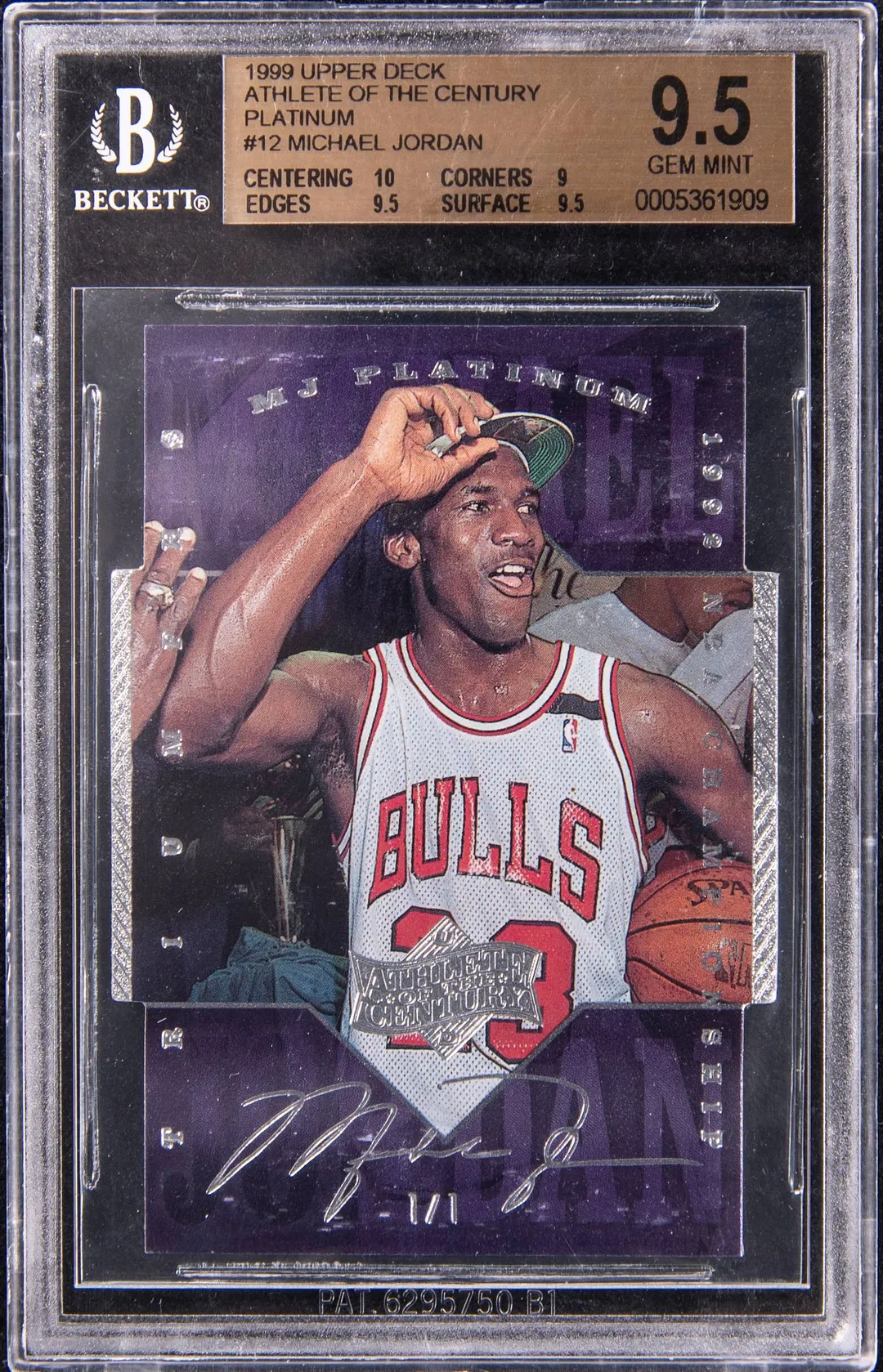
1999 UD Athlete of The Century Jordan 1/1 Sold
A look at the 1999 Upper Deck Athlete of The Century Platinum Michael Jordan 1/1 BGS 9.5 that sold for $152 at Goldin on November 30, 2025.
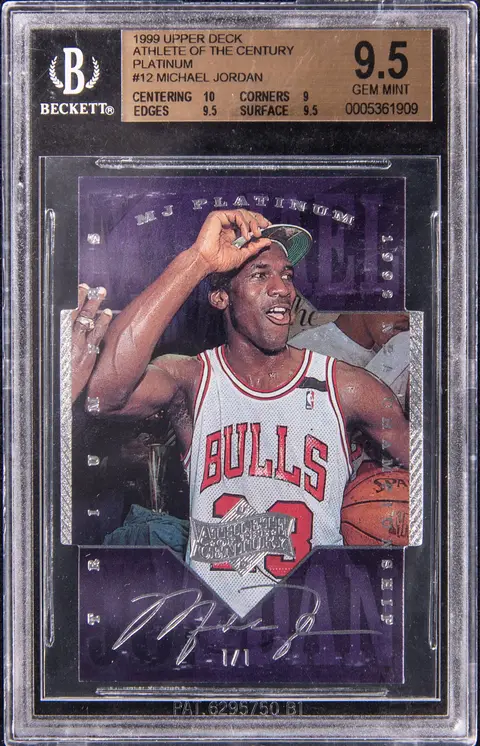
Sold Card
1999 Upper Deck Athlete of The Century Platinum #12 Michael Jordan (#1/1) - BGS GEM MINT 9.5
Sale Price
Platform
Goldin1999 Upper Deck Athlete of The Century Platinum #12 Michael Jordan (#1/1) - BGS GEM MINT 9.5 Sold for $152 at Goldin on 11/30/25
For Jordan collectors, late‑90s Upper Deck inserts and parallels are a deep rabbit hole. One of the more interesting pieces in that puzzle is the 1999 Upper Deck Athlete of The Century Platinum #12 Michael Jordan – and an especially notable copy just changed hands.
On November 30, 2025 (UTC), Goldin sold a 1999 Upper Deck Athlete of The Century Platinum #12 Michael Jordan, serial‑numbered 1/1 and graded BGS GEM MINT 9.5, for $152.
In this breakdown, we’ll walk through what this card is, why it matters to some collectors, and how this sale fits into the broader Jordan market.
Card snapshot
- Player: Michael Jordan
- Team (era): Chicago Bulls (late‑career / legacy phase)
- Year: 1999
- Set: Upper Deck Athlete of The Century
- Card number: #12
- Parallel: Platinum
- Serial number: 1/1 (one‑of‑one)
- Rookie card?: No – this is a late‑90s insert/parallel, not a rookie
- Grading company: Beckett Grading Services (BGS)
- Grade: GEM MINT 9.5
- Key attributes: 1/1 parallel, high‑grade slab from a respected grader
Upper Deck’s Athlete of The Century line was part of the brand’s push in the late 1990s to celebrate all‑time greats with premium photography and multi‑sport checklists. The Platinum parallel is a rarer tier within that release. In this case, the card is marked as #1/1, which means it was intended to be a true one‑of‑one parallel.
While not a rookie or a flagship base card, it’s the sort of late‑90s Jordan parallel that appeals to collectors who like the experimental, creative insert era rather than just chasing the 1986 Fleer or 1997–98 Precious Metal Gems.
Where this card fits in the Jordan landscape
In Jordan’s overall card universe, there are a few broad tiers:
- Core rookies and early‑career issues – 1984‑85 Star, 1986 Fleer, and key early‑90s inserts.
- High‑end 90s inserts and PMGs – Precious Metal Gems, jambalaya‑style die cuts, and iconic case hits.
- Late‑90s and early‑2000s rare parallels – smaller print runs, one‑of‑ones, and brand experiments from Upper Deck, SkyBox, Fleer, etc.
- Post‑playing‑career and modern tribute sets – ongoing tributes, autos, and patches.
The 1999 Upper Deck Athlete of The Century Platinum #12 sits squarely in tier 3. It’s not one of the headline grails that define the Jordan market, but it’s a niche, low‑print, late‑90s parallel that can matter a lot to player‑collectors who specialize in this era.
Market context and comps
When collectors talk about “comps”, they mean recent comparable sales used as a rough reference for what a card tends to sell for. For this specific card:
- It is a 1/1, so by definition there are no other identical copies to compare directly.
- Public sales history for this exact BGS 9.5 copy is limited, and there is no deep pattern of repeated auction appearances.
- Closely related cards – such as other Athlete of The Century Jordan inserts and lower‑tier parallels – have historically sold in a wide range depending on design, numbering, and grading.
That means this Goldin result at $152 functions more as a data point than a firm benchmark.
How $152 fits the broader picture
Looking at the wider late‑90s Jordan market:
- Non‑serial or high‑print inserts in strong grades often land from tens of dollars into the low‑hundreds.
- Numbered inserts and parallels (not in the marquee lines) can range from low‑hundreds to several thousand dollars depending on brand, eye appeal, and how pursued that specific insert run is.
Against that backdrop, a one‑of‑one BGS 9.5 Jordan selling for $152 is on the modest side. A few possible contextual factors:
- Brand and set awareness: While Upper Deck is a major brand, Athlete of The Century is not as widely chased as the most famous 90s insert lines.
- Design and checklist competition: Jordan has a large catalog of 90s inserts competing for collector attention; the hobby’s focus naturally narrows to the most iconic designs.
- Market conditions: Broader hobby cycles can push prices up or down for anything that isn’t among the very top‑tier grails.
Instead of reading this as a “new normal” for all Jordan 1/1s, it’s more useful to see it as a specific outcome for a niche parallel in a crowded part of Jordan’s timeline.
Why collectors care about this card
Even if it’s not a headline grail, this card checks several boxes that matter to many Jordan collectors:
Late‑90s Upper Deck heritage
The late 1990s were a creative period for Upper Deck. Sets like Athlete of The Century blended photography, premium card stock, and unique design choices across multiple sports. Collectors who focus on this era often try to build mini‑runs of specific inserts across athletes.1/1 parallel appeal
A one‑of‑one (1/1) is a card where only a single copy was produced with that exact design and serial number. For player‑collectors, that means true exclusivity: if you own it, no one else can ever complete a “true master run” without dealing with you.High‑grade Beckett slab
A BGS GEM MINT 9.5 is a strong grade, especially for 90s issues where centering, edges, and surface often keep cards in the 8 to 9 range. For some collectors, a high Beckett grade reassures them about condition and protects the card long‑term.Part of a deeper PC story
PC, or “personal collection,” is hobby shorthand for the cards you keep rather than flip. A card like this tends to speak more to PC builders who enjoy hunting down unusual parallels and commemorative sets, rather than purely chasing maximum resale value.
What this sale might signal
This Goldin result doesn’t reset the Jordan market, but it does offer a few practical takeaways:
- Not all 1/1s are treated equally. Brand, design, and set prestige still matter. A 1/1 from a less‑chased insert line can sell closer to strong numbered cards than to the most celebrated grails.
- Storytelling helps value. Cards like this can benefit when sellers take the time to explain the set, print run, and context. Without that narrative, they can blend into a busy auction catalog.
- Jordan depth remains enormous. Even within one player’s market, there are multiple layers – from iconic rookies to niche parallels like this – each attracting a different kind of buyer.
Tips for collectors and small sellers
If you collect Jordan or are sorting through 90s inserts:
- Look up the set, not just the player. Two Jordan cards from 1999 can have very different demand profiles depending on the insert line.
- Check population reports when possible. A “pop report” is the grading company’s count of how many copies of a card exist at each grade. For true 1/1s, pop reports won’t show multiple copies of the same serial‑numbered card, but they can help you understand how many similar parallels have been graded.
- Use comps as a guide, not a promise. With niche 1/1s, a single sale can vary significantly from the next.
For small sellers:
- Photograph the serial and label clearly. Make sure the 1/1 stamp and BGS 9.5 label are easy to see.
- Include set details in your title and description. Mention “1999 Upper Deck Athlete of The Century Platinum #12 Michael Jordan 1/1 BGS 9.5” so search filters pick it up.
- Reference notable auction results carefully. You can say a card is “similar to” or “from the same run as” a card that sold at Goldin on 11/30/25, but avoid implying that your card should bring the exact same price.
Final thoughts
The $152 Goldin sale on November 30, 2025 places this 1999 Upper Deck Athlete of The Century Platinum #12 Michael Jordan 1/1 BGS 9.5 in an interesting spot: clearly special within the context of the set and era, yet priced in line with the more modest end of the Jordan insert spectrum.
For collectors, it’s a reminder that there is still a lot of room in the Jordan market between the iconic, headline‑making grails and the affordable, quietly rare pieces that only dedicated set and player collectors tend to notice.
As always, treat any single sale as one piece of the puzzle, and focus on the cards – and eras – that fit your own collecting story.