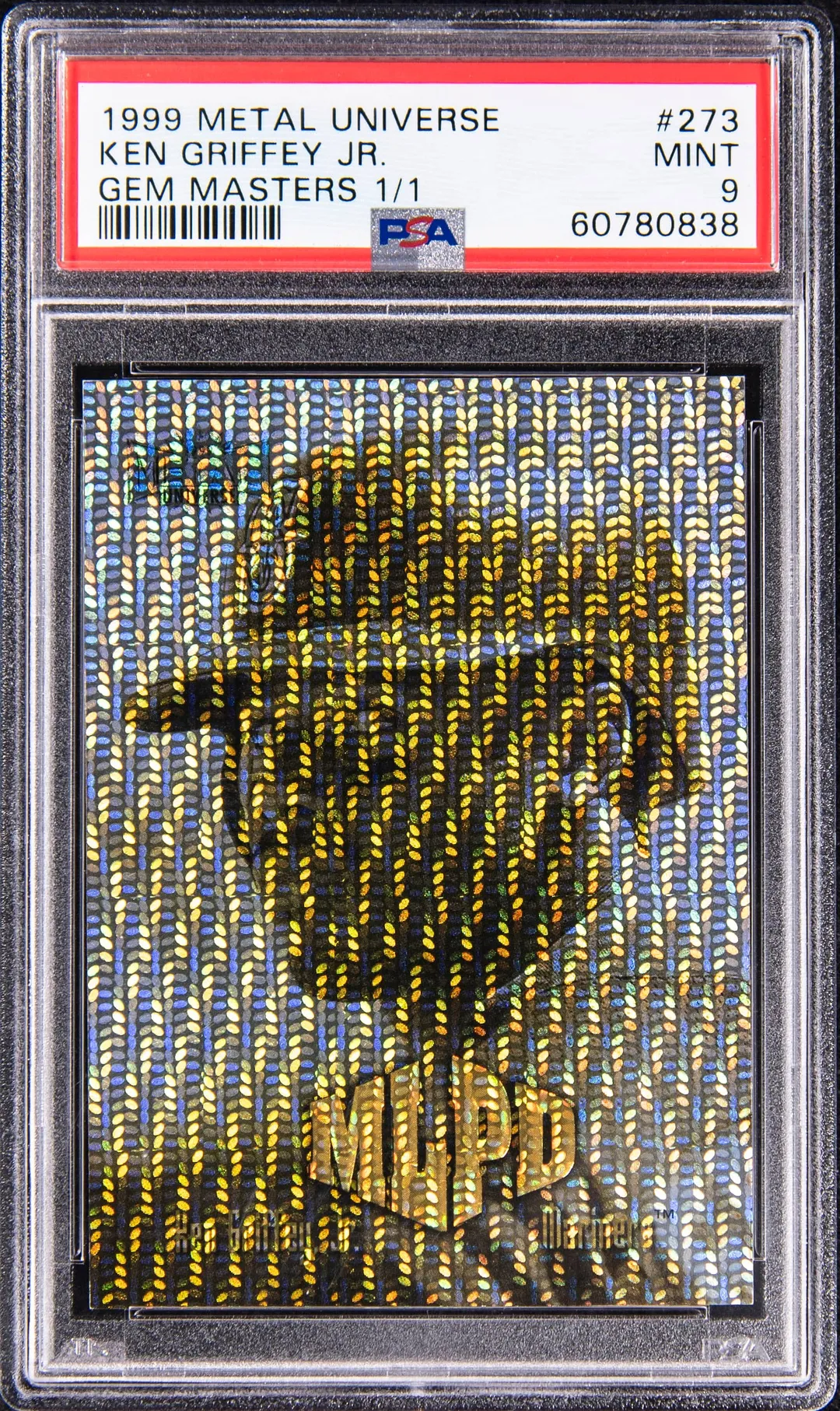
1999 Gem Masters Ken Griffey Jr. PSA 9 sells for $58K
A calm, data‑driven look at the $58,560 Goldin sale of the 1999 SkyBox Metal Universe Gem Masters Ken Griffey Jr. 1/1 in PSA MINT 9.
Sold Card
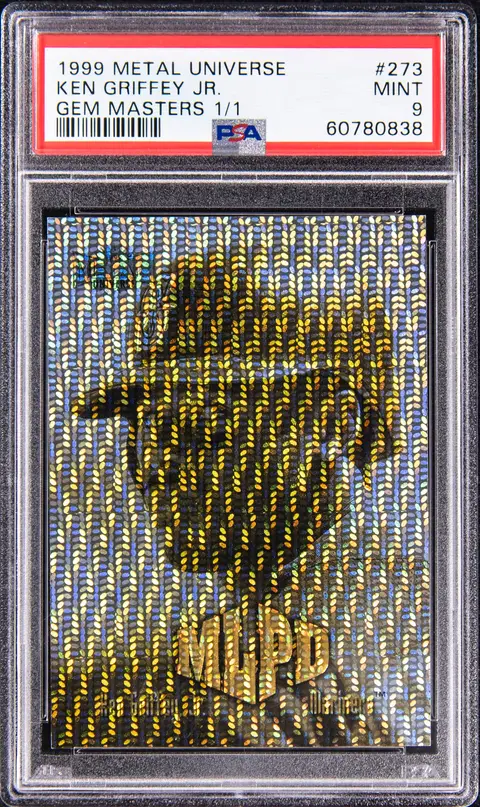
1999 SkyBox Metal Universe Gem Masters #273 Ken Griffey Jr. (#1/1) - PSA MINT 9
Sale Price
Platform
Goldin1999 SkyBox Metal Universe Gem Masters cards live in a very small, very serious corner of 90s baseball collecting. When a Ken Griffey Jr. copy surfaces—especially a 1/1—it tends to get attention from both player collectors and high‑end 1990s insert specialists.
On December 7, 2025, Goldin sold a 1999 SkyBox Metal Universe Gem Masters #273 Ken Griffey Jr. (#1/1) graded PSA MINT 9 for $58,560. For a late‑90s insert of a non‑rookie Hall of Famer, that’s a meaningful result.
In this breakdown, we’ll walk through what this card is, why it matters, and how this sale fits into the broader market for Griffey and 1990s inserts.
The card at a glance
- Player: Ken Griffey Jr.
- Team: Seattle Mariners
- Year: 1999
- Set: SkyBox Metal Universe
- Insert/Parallel: Gem Masters
- Card number: #273
- Serial numbering: Stated 1-of-1 (one‑of‑one copy in the run)
- Grading company: PSA (Professional Sports Authenticator)
- Grade: PSA MINT 9
- Rookie card? No – Griffey’s rookies are from 1989, but this is a key late‑career insert
Gem Masters are the pinnacle parallel from 1999 Metal Universe Baseball: a one‑of‑one tier that sits above the Precious Metal Gems (PMG) parallels in terms of stated scarcity. For player and set collectors, this is about as “top of the pyramid” as 1990s Griffey can get outside of true oddball pieces or 1/1s from other premium issues.
Why 1999 Metal Universe and Gem Masters matter
The Metal Universe line
SkyBox Metal Universe, especially in the late 1990s, has become one of the defining brands for insert and parallel collectors. The series is known for:
- Bold, illustrated card designs with sci‑fi, industrial, and cosmic themes.
- Layered insert structures (base, serial‑numbered parallels, and ultra‑scarce chase cards).
- Crossover appeal between baseball, basketball, and other sports, particularly among Precious Metal Gems collectors.
In baseball, PMGs and Gem Masters sit at the top of that food chain. They aren’t just rare for the year; they’re part of a design language that’s now iconic across the hobby.
Gem Masters: the true chases
Within 1999 Metal Universe, Gem Masters parallels are:
- Serially limited to 1/1 – only one copy for each player.
- Heavily condition‑sensitive due to the foil and surface treatments that defined the set.
- Viewed as the apex parallel for many star players from this release.
For someone building a serious 1990s Griffey run, the Gem Masters is effectively the end‑boss card for this particular year and brand.
Understanding the PSA MINT 9 grade
PSA, or Professional Sports Authenticator, is one of the two most widely tracked grading companies in the hobby (alongside BGS and, more recently, SGC). A PSA MINT 9 grade generally means:
- Sharp corners
- Clean edges
- Strong centering
- Minor print or surface touches only visible on close inspection
On a 1999 Metal Universe GEM Masters, that matters. Foil‑heavy, full‑bleed designs often come out of packs with edge chipping, print lines, or small dents. A 1/1 can only exist in one copy, so there’s no population report comparison within PSA for this exact parallel; however, a Mint 9 on a 90s foil 1/1 is broadly regarded as a strong outcome.
Market context: how does $58,560 fit in?
The Goldin result of $58,560 on December 7, 2025 sits within a niche but well‑defined segment of the market: high‑end 1990s inserts of inner‑circle Hall of Famers.
To understand context, collectors often look at “comps” (short for comparables), which are recent sales of the same or closely similar cards.
For a one‑of‑one like this, exact comps don’t really exist. Instead, collectors look at:
- Other 1990s Griffey 1/1 inserts from high‑profile brands
- PSA 9 and BGS 9.5 Griffey Precious Metal Gems and other top‑tier parallels
- Cross‑sport analogues, such as 1990s basketball Gem Masters or PMGs for all‑time greats
Across major marketplaces and auction houses, recent data points for comparable pieces (not this exact card, but similar tiers) suggest:
- Top‑tier 1990s Griffey inserts with extreme scarcity (serial numbered to 25 or fewer, especially in PSA 9 and above) tend to range from the mid‑four‑figures into the five‑figure range, depending on set and eye appeal.
- True 1/1s in key 1990s brands can move substantially higher, especially when they belong to Griffey, who is still one of the most actively collected modern Hall of Famers.
Within that framework, $58,560 positions this Gem Masters as a high‑end Griffey insert sale, aligned with the upper tier of what the market has been willing to pay for 1990s 1/1s of major stars. Because a one‑of‑one doesn’t trade often, each appearance tends to reset expectations more than follow an established price ladder.
Instead of saying this is high or low in absolute terms, it’s more accurate to say:
- It reflects strong demand for 1990s Griffey grails.
- It’s consistent with the premium collectors attach to Metal Universe brand‑level cards, especially Gem Masters and PMGs.
- It underscores how much weight the hobby still gives to era‑defining insert designs rather than just rookie cards.
Griffey’s place in the hobby
Ken Griffey Jr. occupies a special tier in baseball collecting:
- Rookie era: Flagship rookies in 1989 products (notably Upper Deck) helped define modern baseball cards.
- Peak hobby popularity: In the 1990s, Griffey was a face of the sport and the hobby, long before widespread serial‑numbered parallels became the norm.
- Post‑playing career: Induction into the Hall of Fame and an overall positive reputation have kept demand stable.
While milestones and short‑term news can move ultra‑modern players’ markets, Griffey’s key cards tend to be driven more by long‑term collector demand than by current‑season performance. That’s especially true for niche, high‑end inserts like this one, where buyer pools are relatively small but very focused.
1990s inserts vs. modern parallels
For newer or returning collectors, it can help to understand why a late‑career insert can rival or exceed rookie card prices.
A few key dynamics are at play:
Era scarcity vs. print runs
The late 1990s preceded today’s explosion of parallels. Ultra‑scarce 1/1s and low‑numbered inserts were still relatively new. For many star players, that means only a handful of truly rare, brand‑defining parallels exist.Design and brand prestige
Sets like Metal Universe, Precious Metal Gems, and Gem Masters have become hobby milestones. The designs are instantly recognizable and heavily referenced in modern products.Established collector bases
Player collectors, set collectors, and 90s insert specialists all converge on cards like this. When a 1/1 appears, those collecting lanes often overlap in a single auction.Condition sensitivity
Foil surfaces, chipping, and print lines mean high grades are genuinely difficult, especially on cards that were not always carefully handled in their original era.
The result: for a Griffey card like this, collectors aren’t just paying for a 1/1. They’re paying for the combination of player, era, design, and the specific brand story behind Metal Universe.
What this sale means for collectors and small sellers
This Goldin sale doesn’t rewrite the entire Griffey market, but it’s a useful marker for how the hobby currently values high‑end 1990s inserts.
Key takeaways:
High‑end 90s inserts remain a focused but healthy segment. Prices for top‑tier pieces are still supported by collectors who grew up in the era and now have more resources.
Brand matters. Not all 1/1s are equal. Being the top parallel in a set like 1999 Metal Universe carries more weight than in a lesser‑known product.
Grading adds structure even to one‑of‑ones. There is only one copy of this card, but a PSA MINT 9 still helps buyers calibrate condition, especially in a surface‑sensitive set.
For small sellers, mid‑tier 90s inserts can be worth a second look. While you might not have a Gem Masters 1/1 in a shoebox, parallels and inserts from the same family can be more valuable than base cards from the same years.
How figoca looks at sales like this
At figoca, we treat results such as the December 7, 2025 Goldin sale of the 1999 SkyBox Metal Universe Gem Masters #273 Ken Griffey Jr. (#1/1) – PSA MINT 9 for $58,560 as data points in a bigger picture.
Instead of viewing them as price predictions, we use them as:
- Anchors for understanding tiering: how true grails for a player compare to their more accessible cards.
- Signals of collector focus: what sets, parallels, and years are attracting sustained attention.
- Context for newcomers and returning collectors: a way to show that the hobby values not just rookies, but also historically important designs and inserts.
For collectors, this sale is another reminder that:
- The 1990s insert era still has depth and room for discovery.
- Griffey remains one of the core players around which that era is built.
- When it comes to Metal Universe and Gem Masters, even occasional appearances at auction can help define how the market views the very top of the Griffey hierarchy.
As always, sales like this are best seen as information, not instruction. They tell us where serious collectors have recently chosen to allocate funds; they don’t dictate where anyone else should follow.
For those exploring 1990s inserts, this Griffey Gem Masters is a clear, well‑documented example of how design, scarcity, and player popularity can intersect in a single, memorable card.