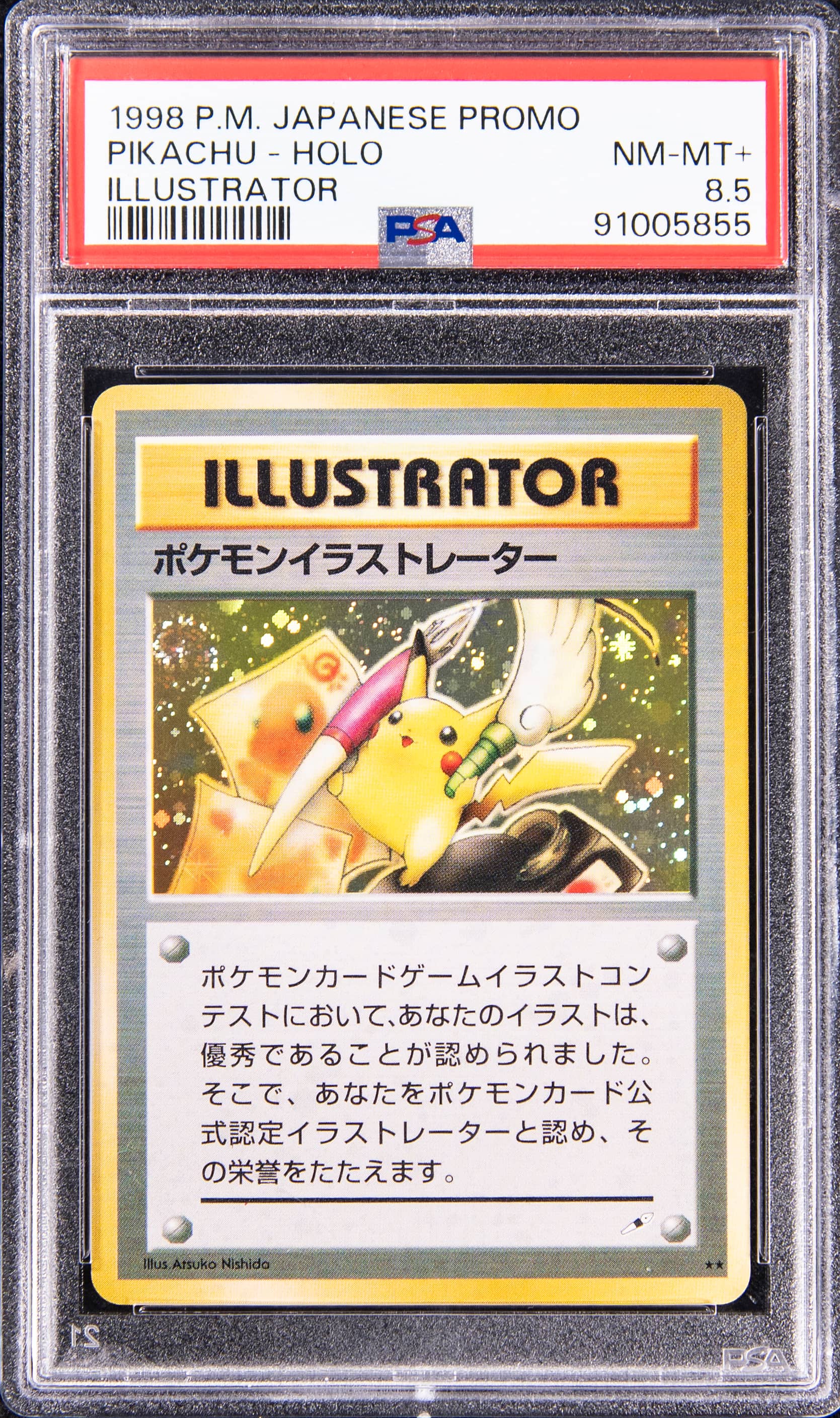
1998 Illustrator Pikachu PSA 8.5 Sells for $610,000
Breakdown of the $610,000 Goldin sale of a 1998 Pokémon Japanese Promo Holo Illustrator Pikachu graded PSA 8.5 and what it means for collectors.
Sold Card
1998 Pokemon Japanese Promo Holo Illustrator Pikachu - PSA NM-MT+ 8.5
Sale Price
Platform
Goldin1998 Pokémon Japanese Promo Holo Illustrator Pikachu (PSA NM-MT+ 8.5) Sold for $610,000 at Goldin
The Illustrator Pikachu promo has long been a cornerstone of high‑end Pokémon collecting. On 12/07/25 (UTC), a copy of the 1998 Pokémon Japanese Promo Holo Illustrator Pikachu graded PSA NM-MT+ 8.5 sold at Goldin for $610,000. For a card that already sits in a tier of its own, this result adds another important data point to one of the hobby’s most watched markets.
What exactly is this card?
- Card: 1998 Pokémon Japanese Promo Holo Illustrator Pikachu
- Character: Pikachu (illustrated by Atsuko Nishida)
- Language/Region: Japanese, original release in Japan
- Type: Trophy promo card (not pack-pulled)
- Issue: Winner prize card for CoroCoro Comic Pokémon Card Illustrator contests
- Year: 1998 (early Pokémon era, often treated as pre–WOTC English era)
- Rarity: Extremely limited distribution; generally considered one of the rarest Pokémon TCG cards
- Grading company: PSA (Professional Sports Authenticator)
- Grade: PSA 8.5 (NM-MT+)
- Attributes: Original holofoil Japanese trophy card, no serial numbering but very low known population
This is not a standard set card, nor a traditional “rookie.” Instead, it is a trophy card: a prize given to winners and top finishers of early Japanese illustration contests run through CoroCoro Comic. For many collectors, that combination—early Pokémon, Pikachu, and a true contest prize—makes it a key issue for the entire franchise.
Why the Illustrator Pikachu matters to collectors
Trophy card status and extreme scarcity
Unlike mass-produced pack cards, Illustrator Pikachu promos were awarded directly to contest winners, with a very small number ever printed. Exact print numbers are not fully documented publicly, but population reports and historical research consistently show a tiny surviving supply.
On PSA’s population report (PSA’s public count of how many copies exist in each grade), the Illustrator Pikachu sits at very low total numbers compared with nearly any modern chase card. That scarcity is structural: there is no fresh supply coming from sealed product, and most copies are already in long-term collections.
Historical importance in the Pokémon hobby
Released in 1998, this card predates—or sits right at the dawn of—many of the sets that Western collectors consider foundational (such as 1999 Base Set in English). It has become a symbol of:
- The early Japanese competitive/promo scene.
- The connection between fan art and the official TCG, since it rewarded illustrators.
- Pikachu’s emergence as the clear face of the brand.
For serious Pokémon historians, the Illustrator Pikachu is often grouped with the rarest prize cards and early tournament issues that define what high-end Pokémon collecting looks like.
A flagship “grail” for the franchise
In collector language, a “grail” is a card that represents the pinnacle of a character, era, or niche. The Illustrator Pikachu is widely treated as a grail-level card for Pokémon because of:
- Its combination of rarity and importance, not just its condition.
- The way it has anchored headline auction results for more than a decade.
- Its role as a crossover item that is known even beyond dedicated TCG circles.
This means each public sale—especially through a major auction house—is watched closely by both collectors and market analysts.
Market context: how does $610,000 compare?
A single sale never tells the whole story, so it helps to look at comps, short for “comparables,” meaning recent sales of the same card or similar versions.
Recent and historical range
Public auction records over the years show that Illustrator Pikachu copies have achieved some of the highest prices ever paid for Pokémon cards. While exact figures vary by grade and specific copy, broader patterns are clear:
- Top-graded copies (such as PSA 9 and PSA 10) have previously reached seven-figure territory in headline transactions when market conditions were especially strong.
- Mid-to-high grades (roughly PSA 7 to PSA 9) have traded in the hundreds of thousands of dollars, depending on timing, auction venue, and card eye appeal.
The $610,000 sale price for a PSA 8.5 sits comfortably in that established high-end band. It does not appear to be a sudden outlier compared with the broader historical trajectory of Illustrator sales; rather, it extends a pattern in which the card’s better-preserved copies consistently command six-figure results.
Where PSA 8.5 fits in the hierarchy
PSA’s 8.5 grade (Near Mint–Mint Plus) is above a standard PSA 8 but below a PSA 9. For a card as scarce as the Illustrator, this half-grade can matter:
- Population: The number of PSA 8.5s is typically very low, often significantly fewer than mass-market chase cards even in higher grades.
- Positioning: Some collectors see 8.5 as a way to get closer to 9-level eye appeal without paying full PSA 9 prices, especially when there are so few total copies to choose from.
In that context, $610,000 at Goldin aligns with the idea that PSA 8.5 lives in the upper half of Illustrator pricing, though still with a discount versus true mint or gem mint examples. It’s a meaningful data point but not a shock compared with where top-end prize cards have been trading.
Goldin sale: details and significance
- Auction house: Goldin
- Sale date (UTC): 12/07/25
- Realized price: $610,000
Goldin is one of the best-known auction houses in the trading card and collectibles space, especially for high-value items. A sale at this level, in this venue, provides a transparent public benchmark for future negotiations, whether private or auction-based.
For collectors who track pricing trends, the combination of a respected grading company (PSA), a central grail card (Illustrator Pikachu), and a major auction platform (Goldin) makes this result particularly useful when thinking about:
- The current appetite for six-figure Pokémon cards.
- How buyers are valuing mid-to-high grades versus top-pop (highest-graded) examples.
- The relative strength of trophy cards compared with more broadly available chase cards.
How this sale fits into the broader Pokémon market
Trophy cards vs. pack-pulled chase cards
Over the last several years, the Pokémon market has seen waves of interest in different categories:
- Mass-market chase cards (like modern alternate arts) that are rare but still obtainable from packs or singles marketplaces.
- Vintage holos and key promos (e.g., early Japanese and English releases) with strong nostalgia appeal.
- True trophy cards, where supply is fixed, tiny, and largely in long-term collections.
The Illustrator Pikachu sits firmly in the last bucket. Even as interest in some modern releases has cooled or cycled, trophy cards have tended to move more slowly but with substantial attention to each sale.
This $610,000 result supports the idea that trophy-level scarcity combined with historical significance still commands a premium, even in a more data-aware, cautious market environment.
Grade scarcity and collector behavior
On a card with a small total population, the usual rules around “just wait for another one” don’t really apply. There are only so many Illustrator Pikachu cards in PSA slabs, and the difference between, say, PSA 7, 8, 8.5, and 9 is both a matter of condition and opportunity:
- Few sale events per year: Some grades may go years without a public sale.
- Strong competition: High-end collectors and institutions sometimes compete for the same small pool of copies.
- Long holding periods: Once acquired, many trophy cards disappear into private collections for long stretches.
A PSA 8.5 surfacing at a major auction is, by itself, an event. The final price reflects not just the condition but also the simple fact that availability is unpredictable.
What collectors can take away from this sale
For newcomers and returning collectors, a six-figure auction result might feel far removed from everyday collecting, but it does offer some useful lessons:
Understand what makes a card important.
Value on this level typically comes from a mix of rarity, historical context, character significance, and how the card was distributed. The Illustrator Pikachu has all of those.Rarity is not just print run—it’s true surviving supply.
Trophy cards like this often have very small surviving populations, and many copies are locked into collections, which shapes how the market behaves.Comps matter, but context matters more.
When analyzing comparables, it’s important to consider grade, auction venue, and timing. A PSA 8.5 result at Goldin in December 2025 might not line up perfectly with a different grade at a different auction in another year.High-end results don’t guarantee anything.
They’re useful data points, not promises. Markets can and do change, and every card has its own story.
Final thoughts
The 1998 Pokémon Japanese Promo Holo Illustrator Pikachu has been central to the story of Pokémon card collecting for years. The $610,000 PSA NM-MT+ 8.5 sale at Goldin on 12/07/25 doesn’t rewrite that story so much as reinforce it: this is still one of the hobby’s defining grail cards.
For most collectors, the Illustrator will always be more of a reference point than a realistic target. But understanding why this card attracts such attention—trophy status, historical importance, and extreme scarcity—can help anyone think more clearly about what matters in their own collection, whether that’s a modest set build or a hunt for the next piece of Pokémon history.
If you’re tracking key sales like this, keep an eye not just on the headline numbers, but on the pattern they form over time. That pattern often tells you more about the health and direction of the hobby than any single auction ever could.