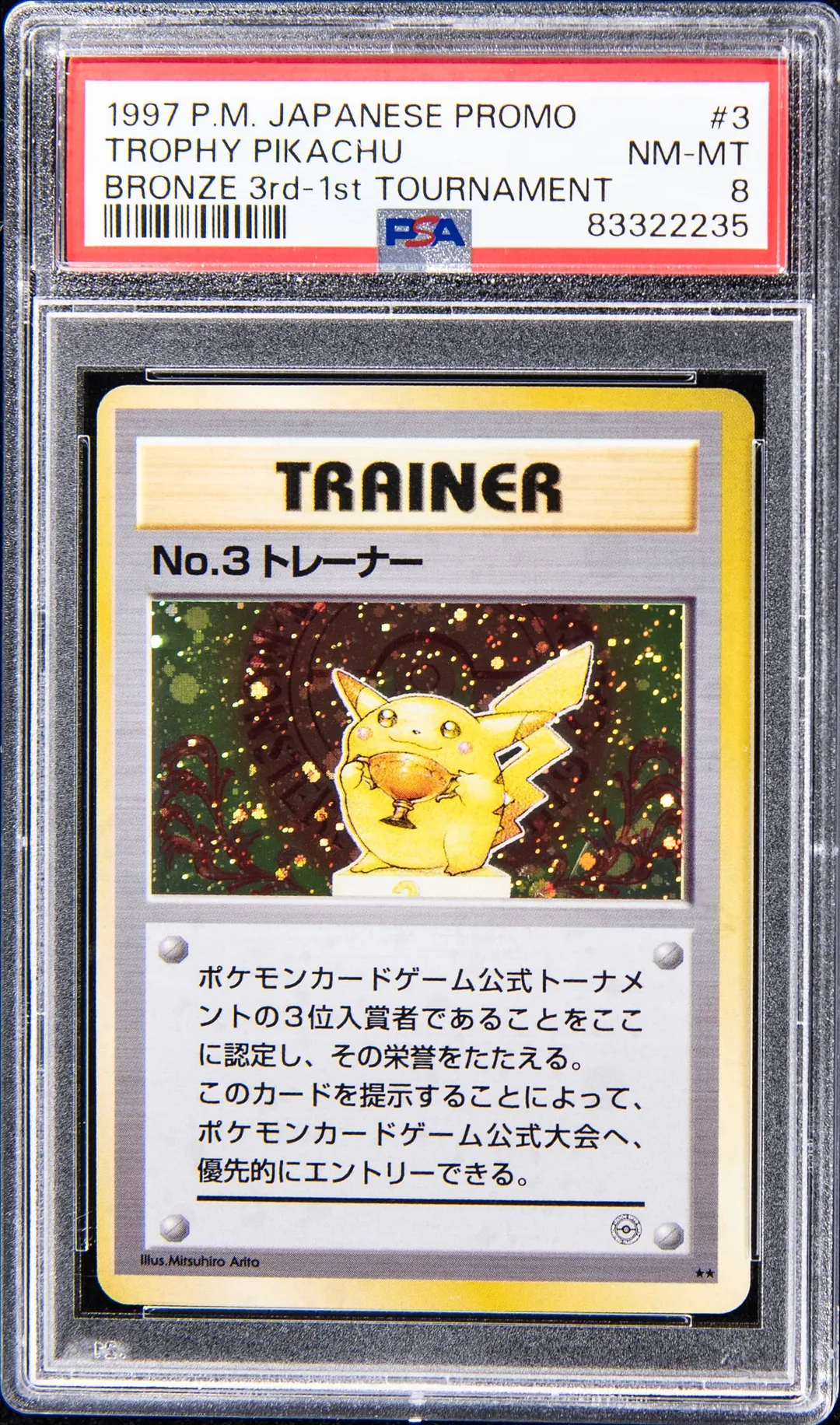
1997 Trophy Pikachu Bronze PSA 8 Sells for $378K
Goldin sold a 1997 Japanese 1st Tournament Trophy Pikachu Bronze PSA 8 for $378,200. See why this ultra-rare promo matters to Pokémon collectors.
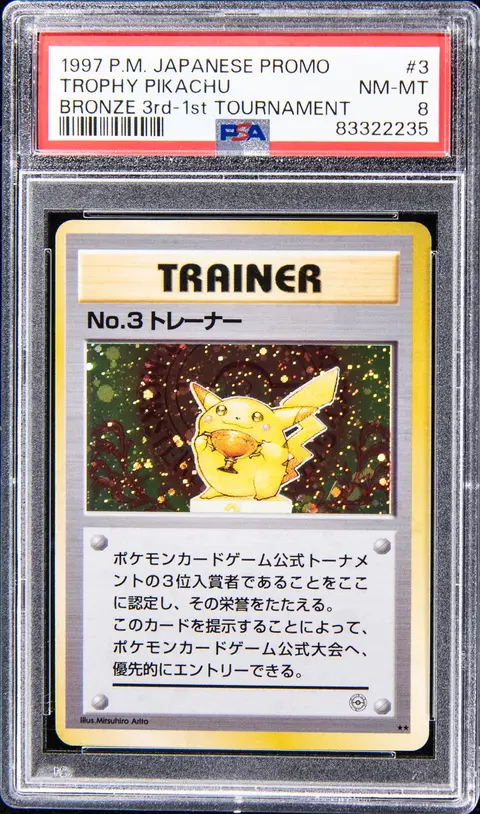
Sold Card
1997 Pokemon Japanese Promo 1st Tournament #3 Trophy Pikachu, Bronze 3rd Place - PSA NM-MT 8
Sale Price
Platform
Goldin1997 Pokemon Japanese Promo 1st Tournament #3 Trophy Pikachu, Bronze 3rd Place - PSA 8 Sells for $378,200
On December 7, 2025, Goldin closed a major result for one of the most elusive cards in the Pokémon hobby: a 1997 Pokémon Japanese Promo 1st Tournament #3 Trophy Pikachu, Bronze 3rd Place, graded PSA NM-MT 8, selling for $378,200.
For a card that almost never surfaces publicly, this sale offers a useful reference point for collectors trying to understand the hierarchy of early Japanese trophy cards and how condition affects value.
Card overview: what exactly sold?
- Character: Pikachu (Trophy Pikachu)
- Year: 1997
- Origin: Japanese Pokémon Card Laboratory / official tournament prize
- Card: 1st Tournament #3 Trophy Pikachu, Bronze (3rd Place)
- Variant: 3rd Place bronze stamp, tournament trophy promo
- Grading: PSA (Professional Sports Authenticator)
- Grade: NM-MT 8 (Near Mint–Mint)
- Type: Ultra-rare tournament prize, not a standard set card or pack pull
This is not a typical set card like Base Set Charizard or a modern chase card. Trophy Pikachu promos from the late 1990s were awarded to top finishers in early Japanese tournaments, making them some of the earliest and rarest Pokémon prize cards.
The bronze 3rd place version from the 1997 1st Tournament is part of a very small family of cards (generally gold/silver/bronze for 1st, 2nd, and 3rd place), each with its own appeal to high-end collectors.
Why this card matters to collectors
1. Early competitive Pokémon history
The 1997 Trophy Pikachu cards are directly tied to the beginnings of organized Pokémon play in Japan. They were awarded to top finishers, not sold in packs, which gives them a built-in narrative of competition and achievement.
For collectors, that makes them:
- Early evidence of Pokémon as a competitive trading card game, not just a kids’ product.
- A tangible piece of the franchise’s first organized tournaments.
2. Genuine rarity vs. printed scarcity
Many modern cards are “rare” on paper because they are stamped with low serial numbers or limited print runs. Trophy Pikachu is different:
- It was only given to a very small number of players at a specific event.
- Many copies likely stayed in private collections or were lost over time.
- Surviving copies that make it into third‑party grading and then to public auction are extremely limited.
This type of rarity is often called organic scarcity – the card is scarce because of how it was originally distributed, not just because it says “/50” or “/100” on the card.
3. Key early Pikachu issue
Pikachu is the face of the Pokémon brand, and early promo appearances carry extra weight. Among those, trophy cards are a small, top tier. For serious Pikachu and trophy card collectors, this is a true centerpiece item.
Within that ecosystem, the 1997 Trophy Pikachu line is often viewed as:
- A grail-level family of cards for Pikachu collectors.
- A reference point for how the market values early Japanese tournament prizes.
Market context and recent sales
In hobby conversations, collectors often talk about “comps”, short for comparable sales. Comps are previous public sales of the same card or a very similar card, used to understand a current price.
For a card this rare, there are very few true comps. Instead of frequent eBay sales, Trophy Pikachu cards tend to appear occasionally at major auction houses like Goldin, Heritage, and PWCC.
Exact card comps
Public sales data for this exact configuration—1997 Japanese 1st Tournament #3 Trophy Pikachu, Bronze, PSA 8—is sparse. When a card appears only every few years, the market doesn’t have a tight, continuous price history.
What we can reasonably say based on available information:
- Higher-grade examples (when they surface) are often placed or privately discussed at very high price levels.
- Lower grades, or different year/placement versions of Trophy Pikachu, have also sold for strong five- and six‑figure prices depending on grade and venue.
- The $378,200 realized at Goldin on 12/07/25 sits comfortably in the range expected for early, top‑tier Pokémon trophy cards in strong condition.
Because there are so few sales, each one effectively resets or refines expectations for the card.
Grade and population matters
A card’s pop report (population report) is the grading company’s count of how many copies exist at each grade.
For cards like Trophy Pikachu:
- The PSA pop is extremely low across all grades.
- Even a PSA 8 is considered a strong grade given the age, scarcity, and the way these cards were originally handled (often by children or competitive players, not long‑term archivists).
For ultra‑rare promos, the difference between PSA 7, 8, 9, and 10 is magnified because there might be only a handful total at each tier. A PSA 8 often acts as a “market reference” grade – high enough to be strongly collectible, but common enough (relatively speaking) that it can appear more than once in a decade.
How this $378,200 result fits in
With limited direct comps, it’s more accurate to describe this sale as in line with recent high‑end trophy card behavior than to call it definitively high or low.
Key takeaways:
- The price confirms continued demand for pre‑2000 Japanese trophy cards at the top of the market.
- Conditioned on its rarity and grade, $378,200 represents a serious commitment from the winning bidder, but not an out‑of‑pattern outlier for this echelon of Pokémon material.
- Each new sale at major houses helps anchor expectations for private transactions that often never become public.
Era and broader hobby context
This Trophy Pikachu is from what many collectors call the early vintage Pokémon era:
- Pre‑2000 Japanese promos and trophy cards
- Low print or limited distribution
- Tied to the launch and early organization of the game
Compared with the “junk wax” sports era (late 1980s–early 1990s) where overproduction led to extreme supply, early Japanese Pokémon promos were printed and distributed very conservatively.
Recent broader trends that form the backdrop:
- High‑end Pokémon has generally stabilized compared to the peak of the 2020–2021 boom, with fewer wild price swings and more informed bidding.
- Serious collectors have increasingly focused on true scarcity and historical relevance, which favors cards like Trophy Pikachu over mass‑produced modern chase cards.
There has not been a specific single news event around Trophy Pikachu itself in late 2025, but ongoing interest in early Japanese promos, plus occasional record‑setting results in related cards, continues to keep attention on this segment.
What this sale means for different types of collectors
1. New or returning collectors
You do not need a six‑figure budget to learn from this result. A few useful lessons:
- Tournament and prize cards are their own lane in Pokémon, with a different scarcity profile than standard set cards.
- Early Japanese promos often fly under the radar until you start actively researching them; many collectors begin with more accessible promos before even thinking about trophy cards.
- When research is thin, focus on what you can confirm: how often a card appears for sale, whether it’s a pack pull or prize card, and how many are graded by PSA, BGS, or CGC.
2. Active hobbyists
For collectors already deep into Pokémon:
- This sale reinforces the premium on provenance and history – cards awarded to winners and finalists continue to command strong attention.
- PSA 8 seems to function as a solid reference level here: still elite, but slightly more accessible than the handful of 9s or potential 10s.
- If you collect modern promos or local trophy cards, this result shows how the market values the earliest and most foundational examples at the top of that pyramid.
3. Small sellers and hobby businesses
For sellers who won’t handle this kind of card directly, the sale still matters as part of the broader pricing environment:
- High‑end trophy activity often correlates with continued confidence in the upper tier of the market.
- Interest in early Japanese promos can trickle down into demand for more attainable 1990s promos, CoroCoro issues, and early WotC era rarities.
Again, none of this is a prediction or advice – it’s simply context you can keep in mind while pricing, buying, or selling adjacent cards.
Final thoughts
The $378,200 sale of the 1997 Pokémon Japanese Promo 1st Tournament #3 Trophy Pikachu, Bronze 3rd Place, PSA 8 at Goldin on December 7, 2025, is another data point confirming where early Japanese trophy cards sit in the Pokémon hierarchy.
For most collectors, this card lives on the aspirational end of the spectrum. But it also serves as a reference for what the market values most: genuine scarcity, early history, and a direct connection to the competitive roots of the game.
figoca will continue tracking major trophy and promo sales like this one so collectors at every budget level can better understand how these high‑end benchmarks shape the broader Pokémon market.