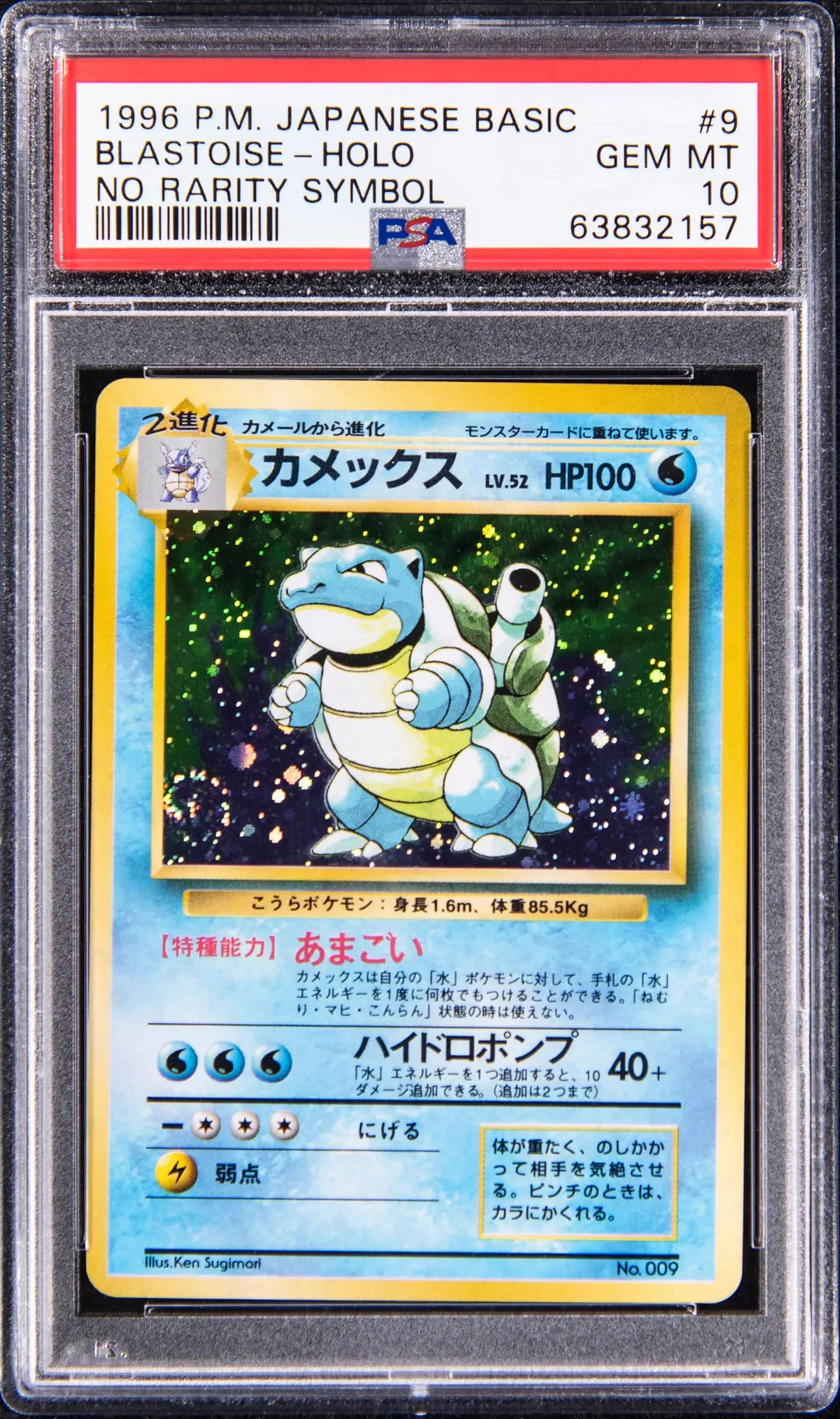
1996 No Rarity Blastoise PSA 10 Sells for $231K
Deep dive into the $231,800 Goldin sale of a 1996 Japanese Base Set no rarity Blastoise PSA 10 (pop 6) and what it means for vintage Pokémon collectors.
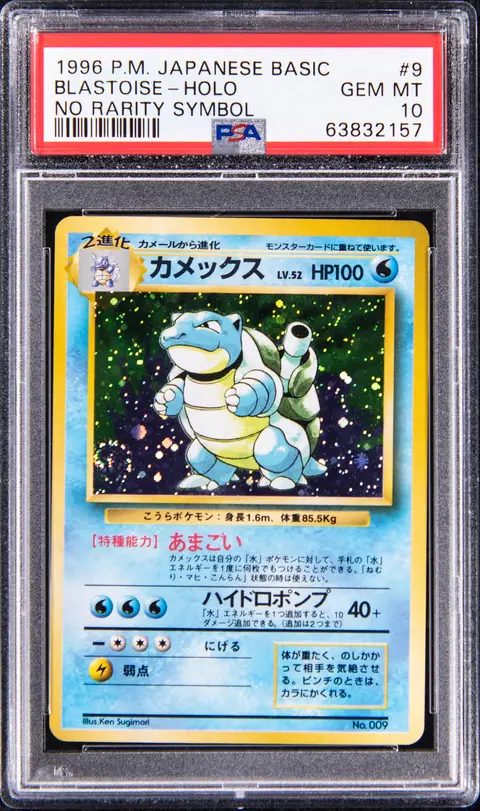
Sold Card
1996 Pokemon Japanese Base Set Holo #9 Blastoise, No Rarity Symbol - PSA GEM MT 10 - Pop 6
Sale Price
Platform
Goldin1996 Pokémon Japanese Base Set Holo #9 Blastoise, No Rarity Symbol – PSA GEM MT 10 – Pop 6
On December 7, 2025, Goldin sold a 1996 Pokémon Japanese Base Set Holo #9 Blastoise with no rarity symbol, graded PSA GEM MT 10, for $231,800. For a key early Pokémon card, that result stands out and is worth unpacking carefully.
Below, we’ll walk through why this card matters, how rare a PSA 10 really is, and how this sale fits into the broader market for high‑end vintage Pokémon.
The card at a glance
Card details
- Character: Blastoise
- Year: 1996
- Set: Pokémon Japanese Base Set (original Japanese release)
- Card number: #9 (Holo)
- Variant: No Rarity Symbol (early print, no rarity mark in the bottom‑right corner of the card face)
- Language: Japanese
- Era: Vintage (mid‑1990s)
Grading details
- Grading company: PSA (Professional Sports Authenticator)
- Grade: GEM MT 10 (PSA’s highest standard grade for pack‑pulled cards)
- Population (“pop”): 6 in PSA 10 as of the time of this sale
There are no autographs, patches, or serial numbering here. The key “premium” features are:
- Early Japanese printing
- The no rarity symbol variant
- The PSA 10 population of just 6 copies
In the Pokémon world, that combination of early release, variant status, and top grade places this Blastoise firmly in the blue‑chip category for character collectors and vintage set specialists.
What is the “no rarity symbol” Blastoise?
Most Pokémon cards show a small rarity symbol (circle, diamond, or star) in the bottom‑right corner on the front of the card. A small batch of the earliest Japanese Base Set print run was printed without that symbol – these are called “no rarity” cards.
Key points about no rarity Base Set cards:
- They are widely considered the first print run of Pokémon TCG cards in Japan.
- They were only available for a short window before the standard rarity symbol version took over.
- They were printed and distributed before anyone foresaw the long‑term collectability of the game.
Within that early print run, Blastoise is one of the three main starters’ final evolutions (alongside Charizard and Venusaur). While Charizard often draws the most attention, Blastoise has a strong collector base, especially among fans who grew up with the original games and anime.
For many collectors, a no rarity Blastoise in PSA 10 is a way to own a piece of Pokémon’s literal first wave, in the best possible condition that PSA will recognize.
Understanding the PSA 10 population and scarcity
When collectors talk about “pop report”, they mean the grading company’s public count of how many copies of a specific card have received each grade. For this card:
- PSA 10 population: 6
Even without exact figures for every grade, a few things are clear from the broader hobby context:
- Vintage Japanese holo cards are condition sensitive. The combination of early printing, holofoil surface, and older storage habits makes high‑grade copies unusually hard to find.
- No rarity cards are even tougher. They were not printed in the same volume as the standard Japanese Base Set, and many survived in played condition.
- PSA 10 is a genuine outlier. With only 6 known PSA 10 copies, each new sale essentially helps set the reference point for the market.
For a vintage card like this, scarcity is less about “short print” in a modern sense and more about how few pristine survivors exist today.
Market context: how does $231,800 fit in?
This Goldin sale closed at $231,800 on December 7, 2025.
Because no rarity PSA 10 Blastoise examples are so thinly traded, truly direct comparables (“comps”) – recent sales of the exact same card in the same grade – are limited. In that situation, collectors usually look at:
- Past sales of this exact card/grade (when available)
- Sales of lower grades of the same card (PSA 9, PSA 8)
- Sales of comparable key no rarity holos (like Charizard or Venusaur) across similar grades
- High‑end early Pokémon sales more broadly (English 1st Edition Base holos, trophy cards, etc.)
Across those categories, a few patterns generally emerge in the hobby:
- Sharp price tiers by grade. For no rarity cards, the jump from PSA 9 to PSA 10 can be substantial, reflecting both the pop gap and the psychological pull of owning a “top of pop” card.
- Premium for character importance. Among starters’ final evolutions, Charizard tends to lead, followed by Blastoise and Venusaur. Blastoise is still widely viewed as a core chase card.
- Steady interest in early Japanese printings. Over the past several years, collectors have given increasing attention to Japanese originals, especially earliest‑print examples like no rarity.
Within that context, $231,800 sits comfortably in the high‑end vintage Pokémon bracket. It aligns with what we typically see when:
- The card is a key character from an historically important set.
- The grade is the top available, with a single‑digit population.
- The card is offered through a major auction house (in this case, Goldin) that reaches deep high‑end collector pools.
Because true PSA 10 sales are so scarce, each auction tends to act less like a routine comp and more like a new reference point for future negotiations and private deals.
Why collectors care about this card
Several layers of significance come together in this specific Blastoise:
Historically important set
1996 Japanese Base Set is the beginning of the Pokémon TCG. For many collectors, it’s the foundation of the entire hobby.No rarity as an early print variant
No rarity cards are often treated as a distinct, more scarce version of the set. They appeal to:- Early Pokémon historians
- Master set builders
- High‑end variant collectors
Blastoise as a core character
Blastoise sits near the top tier of first‑gen Pokémon popularity, especially for fans who picked Squirtle as their starter. It doesn’t always match Charizard’s numbers, but it has a committed collector base.Vintage era dynamics
Vintage cards (roughly mid‑1990s through early 2000s) behave differently from modern ultra‑printed sets:- Supply is finite and mostly known.
- High‑grade examples are often locked away in collections.
- Each fresh high‑grade card that surfaces can reset expectations for what the market is willing to pay.
Top grade as a status asset
For some collectors, owning a PSA 10 is partly about condition, and partly about having something that very few others can own. With a population of 6, this card qualifies.
How this sale fits into broader Pokémon trends
A few broader hobby themes provide context for this result:
Maturing interest in Japanese originals:
As more collectors dig into the history of the game, Japanese releases and early print variants have seen sustained attention.Data‑driven collecting:
Pop reports, auction archives, and graded registry competition have made it easier to see just how few top‑tier copies exist for cards like this. Scarcity is no longer a vague sense; it’s measurable.Selective strength at the high end:
Even when modern or mid‑tier cards soften, historically important, truly scarce pieces often remain more resilient. That doesn’t mean prices are guaranteed, but it explains why certain cards continue to draw strong bids.
In that landscape, a PSA 10 no rarity Blastoise aligns with what many collectors now prioritize: early, important, verifiably scarce, and in clearly elite condition.
Takeaways for collectors and small sellers
A few practical lessons from this Goldin sale on December 7, 2025:
Understand the variant.
For vintage Pokémon, details like “no rarity” vs standard print, 1st Edition vs unlimited, and language (Japanese vs English) can dramatically shift value.Population matters.
A pop 6 PSA 10 is a different conversation from a card with hundreds of 10s in the census. Always look up the pop report when evaluating rarity.Grade gaps can be steep.
The price difference between PSA 9 and PSA 10 on a card like this is not just incremental; it can be a major jump. Condition details (centering, print quality, scratches) really matter for high‑end targets.Use comps thoughtfully.
For ultra‑scarce cards, there may be very few recent public sales. In those cases, it can make sense to look:- Across grades (e.g., 9 vs 10)
- Across similar cards (e.g., other no rarity holos)
- Across eras (comparing to other top‑tier vintage keys)
Document provenance where possible.
For high‑end pieces, knowing past auction houses and dates (here: Goldin, December 7, 2025) adds a layer of context and sometimes buyer confidence.
Final thoughts
The sale of a 1996 Pokémon Japanese Base Set Holo #9 Blastoise, No Rarity Symbol – PSA GEM MT 10 (Pop 6) for $231,800 at Goldin on December 7, 2025 highlights how focused the market has become on historically significant, truly scarce vintage Pokémon.
For newer collectors, this card is a reminder that not all Base Set holos are created equal – early print variants, language, and grade can combine to create a much rarer piece than the artwork alone might suggest.
For long‑time hobbyists, this sale serves as another data point in the evolving story of no rarity cards and their place in the hierarchy of Pokémon’s most important early issues. As more information and sales data accumulate, cards like this Blastoise will likely remain central reference points in conversations about high‑end vintage Pokémon.