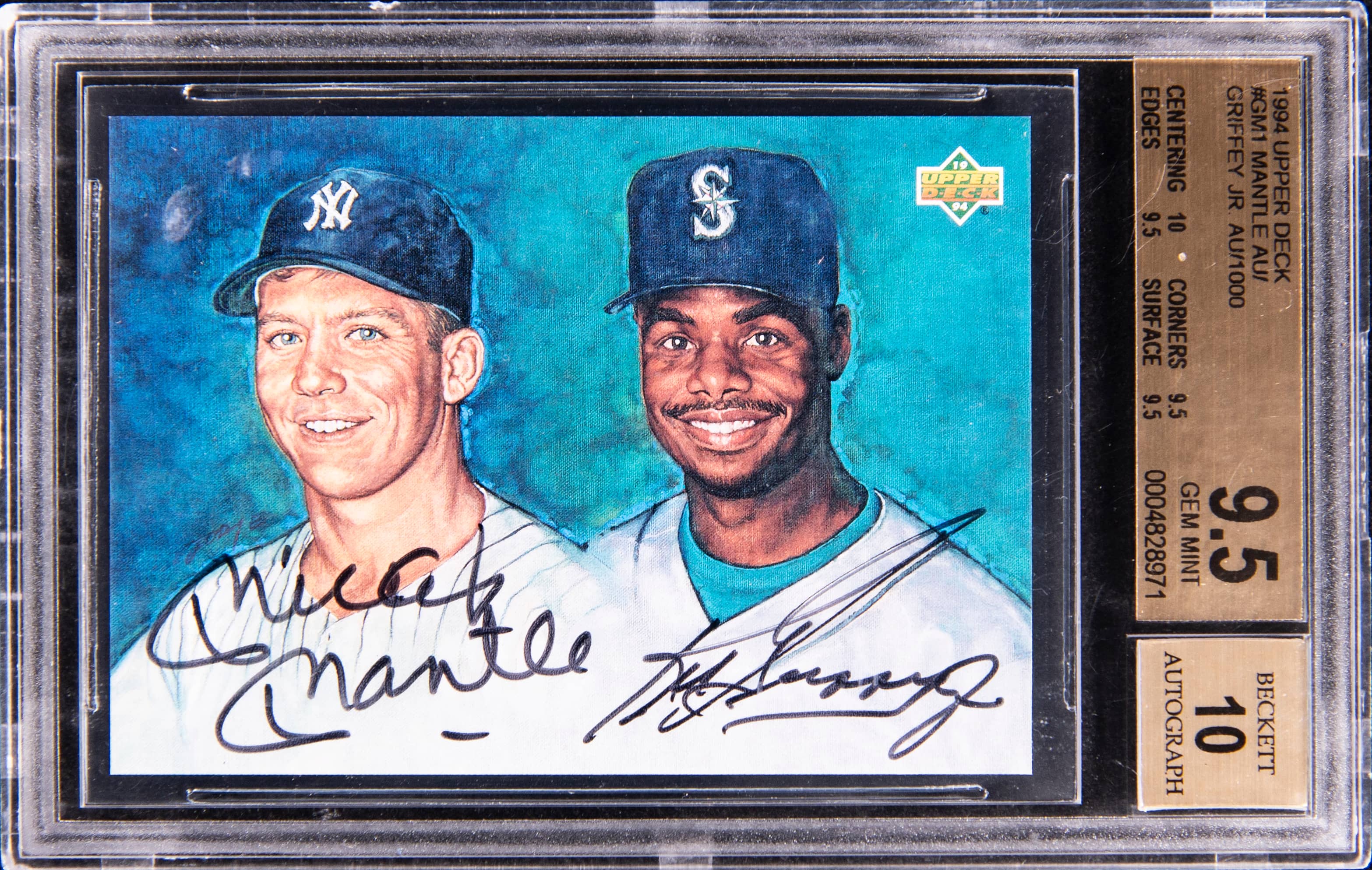
1994 UD Mantle/Griffey Dual Auto BGS 9.5 Sells High
Goldin sold a 1994 Upper Deck Mantle/Griffey dual auto BGS 9.5/10 (True Gem+, Pop 6) for $97,600 on Jan 4, 2026. Here’s the card’s context and market.
Sold Card
1994 Upper Deck Autograph #GM1 Mickey Mantle/Ken Griffey Jr. Dual-Signed Card - BGS GEM MINT 9.5, Beckett 10 - True Gem+ - Pop 6
Sale Price
Platform
Goldin1994 Upper Deck Autograph #GM1 Mickey Mantle/Ken Griffey Jr. Dual-Signed Card – BGS 9.5 / 10 Sells for $97,600
On January 4, 2026, Goldin closed a significant sale for a hobby favorite: a 1994 Upper Deck Autograph #GM1 Mickey Mantle/Ken Griffey Jr. dual-signed card, graded BGS GEM MINT 9.5 with a Beckett 10 autograph grade. The card realized $97,600, positioning it as a notable modern-market benchmark for one of the hobby’s most recognizable 1990s autographs.
Below, we’ll break down what this card is, why it matters to collectors, how this sale fits into recent price history, and what the population data suggests about scarcity at the top end.
Card overview: 1994 Upper Deck Autograph #GM1 Mantle/Griffey
This card combines two of the most collected names in baseball:
- Players: Mickey Mantle (New York Yankees legend) and Ken Griffey Jr. (Seattle Mariners superstar at the time)
- Year & set: 1994 Upper Deck, Autograph insert
- Card number: #GM1
- Type: Dual on-card autograph (both Mantle and Griffey signed directly on the card surface, not on a sticker)
- Rookie status: Not a rookie card for either player, but a key dual-auto issue from the 1990s
- Grading:
- Company: Beckett Grading Services (BGS)
- Card grade: GEM MINT 9.5
- Autograph grade: Beckett 10
- Subgrades: Designated as a True Gem+, meaning all four BGS subgrades are 9.5 or better with at least one 10 (center, corners, edges, surface). True Gem+ copies sit at the very top of the BGS 9.5 tier.
- Population: Pop 6 in this True Gem+ configuration, highlighting how few copies reach this exact level.
The 1994 Upper Deck Mantle/Griffey dual auto is one of the defining 1990s chase cards, especially for collectors who lived through the mid-’90s pack-opening era. It predates today’s mass-produced serial-numbered auto-checklists and sits closer to the transitional period between vintage and the modern autograph-heavy hobby.
Why collectors care about this card
Several factors give this card enduring appeal beyond basic star power:
Cross-generational star pairing
Mantle and Griffey Jr. represent two different eras of Yankees and Mariners lore, but more broadly, two waves of hobby enthusiasm:- Mantle as a cornerstone of vintage collecting and a central figure in 1950s and 1960s Topps.
- Griffey Jr. as the face of the late-1980s and 1990s “junk wax” boom, especially with his 1989 Upper Deck rookie.
Having both signatures on the same card makes this a kind of “bridge piece” between vintage and modern collecting.
Early-era pack-inserted authenticated autos
By 1994, certified pack-inserted autographs were still relatively new compared with today’s products. This card is part of the early wave of officially authenticated on-card signatures from a major manufacturer, not a later buyback or aftermarket signing.On-card dual autograph
In modern products, dual and triple autos are common. In the mid-1990s they were far less so, especially with a pairing this strong. Both signatures are on-card and visually balanced, which matters to collectors looking for eye appeal alongside grade.Historical hobby narrative
The Mantle/Griffey #GM1 is often discussed among 1990s collectors in the same breath as other iconic inserts and autographs of the era. It’s not a rookie, but it functions as a “key issue” for both players in the context of premium, pack-inserted autos.
Grading, True Gem+ status, and population
A pop report (population report) is the grading company’s census of how many copies of a card they’ve graded at each grade. High grades are often much scarcer than raw copies.
For this card:
- BGS has only a limited number of GEM MINT 9.5s overall.
- Within that, only six copies currently qualify as True Gem+ (all four subgrades 9.5 or better with at least one 10).
Collectors generally place a premium on:
- True Gem+ vs. standard 9.5: Because it gives extra certainty that the card is at the high end of GEM MINT.
- 10 autograph grade: Clean, bold signatures with no visible issues can significantly influence demand, especially on dual-signed cards where both signatures must present well.
In short, this is not just a GEM MINT example; it is one of the very best GEM MINT examples in the BGS census.
Market context and recent sales
In hobby conversations, “comps” (comparables) are recent sales of the same card or very similar cards, used to understand current market levels.
For the 1994 Upper Deck Mantle/Griffey #GM1, there are a few key tiers that collectors often look at:
Unslabbed or lower-grade copies
- Raw (ungraded) or mid-grade copies typically sell at a substantial discount to top-graded BGS examples, especially if the autos show fading or streaking.
BGS 8.5–9 / PSA 8–9 range
- These often trade for meaningfully less than GEM MINT examples, with a noticeable gap once you move to high eye appeal and stronger grades.
BGS 9.5 / PSA 10 top-end copies
- Prior public auction results for BGS 9.5 and PSA 10 versions of this card have been considerably higher than mid-grade copies, especially where the autograph grade is 10 and centering is strong.
For this specific True Gem+ BGS 9.5 / 10 auto, recent public sales in the same configuration are limited because:
- Very few copies exist in this exact grade combination.
- Owners of high-end 1990s Mantle/Griffey autos tend to hold them longer term.
Based on available data:
- High-end graded examples of this card have sold in the past at strong multiples over lower grades, reflecting the scarcity at the top of the pop.
- A realized price of $97,600 in January 2026 at Goldin falls in line with the broader trend that the very best graded copies of celebrated 1990s inserts and autos can command significant premiums over the general run of the card.
While the hobby has seen ups and downs over the last few years, the top of the market for historically important, low-pop, premium-grade issues—especially involving Mantle—has held up better than more speculative modern cards. This sale fits into that pattern rather than standing out as an obvious outlier in either direction.
Era context: from junk wax to premium inserts
The 1990s are often labeled the “junk wax era” because of the massive production runs for base cards. However, certain inserts and autographs from that time were printed in far smaller quantities and have emerged as true chase cards.
The 1994 Upper Deck Mantle/Griffey #GM1 sits firmly in this second category:
- It is not a base card; it is an autographed insert with naturally limited supply.
- The combination of Mantle, Griffey, and an early Upper Deck auto release gives it a historical importance that differs from mass-produced base issues.
This context helps explain why high-end graded copies can perform strongly even when many 1990s base cards remain inexpensive.
Recent hobby and player-related influences
A few broader factors provide background for this sale:
- Mickey Mantle’s market remains a pillar of vintage and blue-chip collecting. Key Mantle cards, especially 1950s Topps issues and premium autographs, consistently draw strong interest.
- Ken Griffey Jr. has a durable collector base, powered by nostalgia from those who grew up watching him in the 1990s and chasing his early Upper Deck cards.
- The hobby has also seen renewed focus on cross-era pairings and historically important dual autographs, which this card exemplifies.
There were no specific short-term headlines necessary to justify interest in this card; its appeal is mostly driven by its long-standing status in the hobby.
What this sale suggests for collectors
For collectors and small sellers, this $97,600 result at Goldin on January 4, 2026, offers several takeaways:
Grade and eye appeal matter disproportionately at the top end
The difference between a nice copy and a True Gem+ / 10 auto copy can be dramatic in dollar terms. This is common for key 1990s inserts and autos.Not all 1990s cards are created equal
While many 1990s base cards are overproduced, carefully curated premium issues—especially early certified autographs—can show very different long-term behavior.Low population + iconic pairing supports demand
With only six True Gem+ copies in the BGS census and a dual on-card autograph of Mantle and Griffey Jr., this card fits squarely into the category of “high-end, low-supply, historically important” pieces.Use comps as context, not prediction
Recent sales (including this one) are data points, not guarantees. They help frame expectations but should not be read as promises for future performance.
How this card fits into a 1990s-focused collection
For collectors building a focused 1990s portfolio, this card checks several boxes:
- Represents one of the decade’s most recognized autographed inserts.
- Features a cross-era pairing that resonates with both vintage and modern collectors.
- Offers a clear grading story with BGS and a tight population at the top grade level.
Whether you collect Mantle, Griffey, Yankees, Mariners, or 1990s Upper Deck inserts more broadly, the 1994 Upper Deck Autograph #GM1 stands out as a centerpiece-level card.
Conclusion
The January 4, 2026 Goldin sale of the 1994 Upper Deck Autograph #GM1 Mickey Mantle/Ken Griffey Jr. dual-signed card—graded BGS GEM MINT 9.5 with a Beckett 10 autograph and designated True Gem+ (Pop 6)—at $97,600 reinforces the card’s status as a cornerstone 1990s autograph.
It underscores how:
- Early certified autographs from major manufacturers continue to command strong attention.
- Top-pop, premium-grade examples can separate themselves sharply from the rest of the field.
For collectors, this sale is less about short-term speculation and more about recognizing where this card sits in the long-term story of 1990s baseball cards and the evolution of autographed inserts.