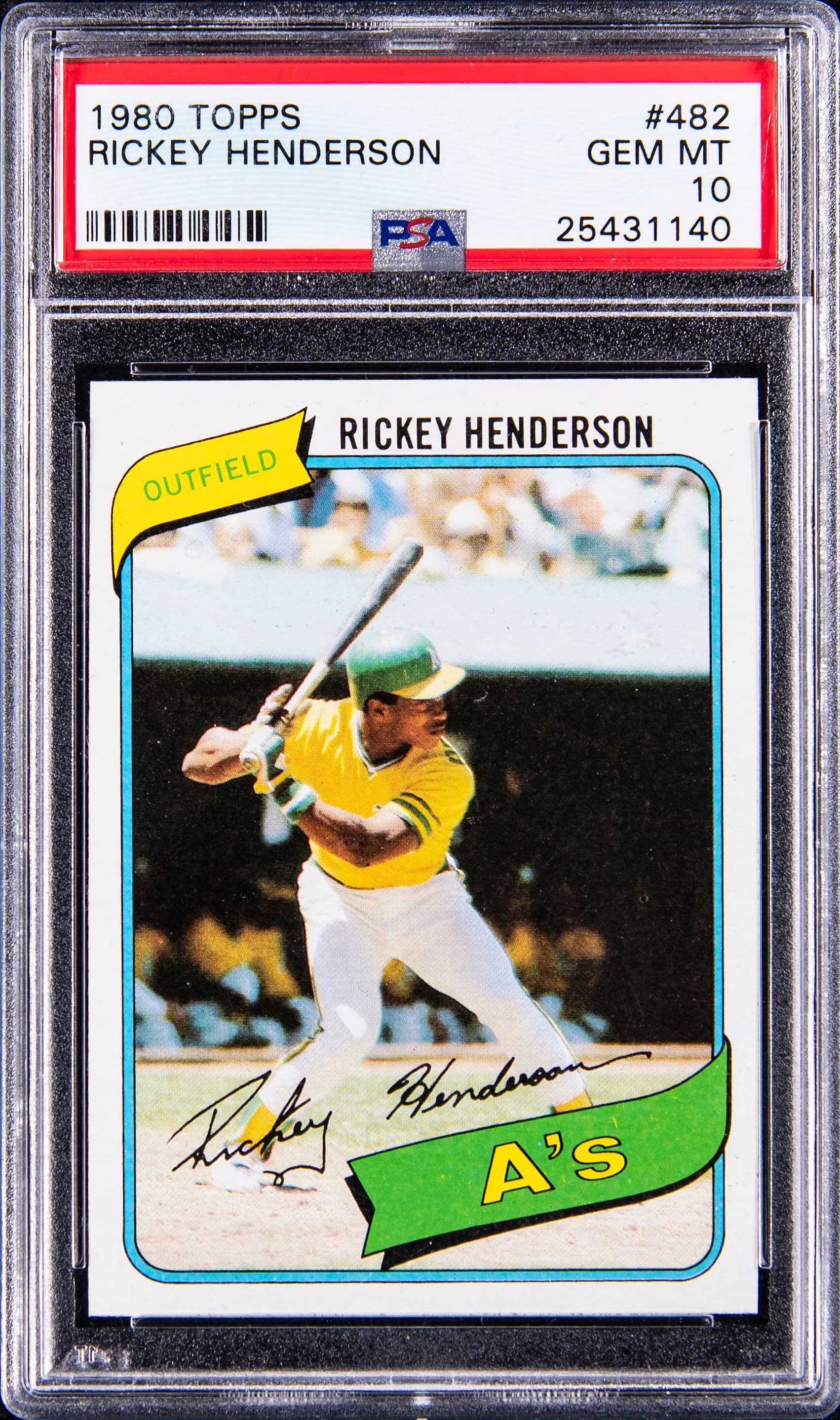
1980 Topps Rickey Henderson PSA 10 Sells for $183K
A 1980 Topps #482 Rickey Henderson Rookie Card PSA 10 sold for $183,000 at Goldin on Jan 4, 2026. Here’s what it means for vintage baseball collectors.
Sold Card
1980 Topps #482 Rickey Henderson Rookie Card - PSA GEM MT 10
Sale Price
Platform
Goldin1980 Topps #482 Rickey Henderson Rookie Card – PSA GEM MT 10 Sells for $183,000 at Goldin
On January 4, 2026, Goldin closed a notable vintage baseball sale: a 1980 Topps #482 Rickey Henderson Rookie Card graded PSA GEM MT 10 realized $183,000.
For collectors who follow vintage and early-1980s cardboard, this is a key data point for one of the defining rookie cards of the modern game.
The Card at a Glance
- Player: Rickey Henderson
- Team: Oakland A’s
- Year / Set: 1980 Topps Baseball
- Card Number: #482
- Card Type: Base rookie card (flagship Topps RC)
- Grading Company: PSA (Professional Sports Authenticator)
- Grade: GEM MT 10 (Gem Mint)
- Special Attributes: Standard base issue – no autograph, patch, or serial numbering. The value is driven by condition scarcity and Hall of Fame significance.
This card is widely viewed as Rickey Henderson’s premier rookie card. There are other early issues (like minor league and oddball releases), but within mainstream, pack-pulled cards, 1980 Topps #482 is the hobby’s flagship Henderson rookie.
Why This Rookie Matters
Rickey Henderson’s career resume is straightforward but powerful:
- All-time MLB leader in stolen bases and runs scored
- 10-time All-Star, 1990 AL MVP, two-time World Series champion
- First-ballot Hall of Famer, inducted in 2009
For collectors, that translates into a Hall of Fame cornerstone rookie from a classic Topps design. 1980 Topps bridges the gap between the 1970s and what many call the “early junk wax” era. Production was strong for the time, but the combination of centering issues, printing quality, and how kids actually handled cards in 1980 makes true Gem Mint copies unusually tough.
Population and Condition Scarcity
When collectors talk about a “pop report” (population report), they mean the published count of how many copies a grading company has assigned to each grade. For the 1980 Topps Rickey Henderson:
- PSA has graded many thousands of copies overall.
- PSA 8 and PSA 9 are relatively common.
- PSA 10 is genuinely scarce relative to total submissions. The pop is low enough that each auction attracts wide attention.
The main obstacles to PSA 10 on this card are:
- Centering: 1980 Topps is known for off-center cuts, especially side-to-side.
- Print defects: Focus, print dots, and occasional surface issues.
- Edges and corners: Even light handling from the early 1980s can push a card down into PSA 7–9 territory.
That is why this sale isn’t just “another Henderson rookie”; it’s a top-pop example (among the best-graded in existence) in a fully matured Hall of Fame market.
Recent Sales and Market Context
A “comp” (comparable sale) is simply a recent sale of the same card, or a very close variant, used for price context.
For the 1980 Topps Rickey Henderson #482 in PSA 10:
- Over the past few years, this card has consistently ranked among the most watched vintage/early-80s rookies.
- Earlier high-end results for PSA 10 copies have reached well into six figures, with the most aggressive peaks seen during the 2020–2021 hobby surge.
- As the broader market cooled from those peak levels, prices retraced from their absolute highs but have generally stabilized in a range that still reflects strong demand for true blue-chip Hall of Fame rookies.
The $183,000 result at Goldin on January 4, 2026 sits in that established high-end, six-figure band. It reflects:
- Ongoing demand for ultra-elite examples of historically important rookies.
- The fact that supply in PSA 10 remains extremely limited compared to overall interest in Henderson’s legacy and the 1980 Topps set.
While exact numbers move over time and by auction, broad patterns have been:
- PSA 7–8: Accessible for many collectors, often traded as entry-level Henderson rookies.
- PSA 9: A strong mid- to high-grade option with deeper liquidity (more frequent sales, more buyers and sellers).
- PSA 10: Thinly traded, auction-driven, and highly sensitive to bidder depth in any given sale.
This tiered structure is typical for key Hall of Fame rookies from the late 1970s and early 1980s, where condition truly separates everyday copies from investment-level pieces.
How This Sale Fits the Bigger Picture
Several factors help explain why this specific card in PSA 10 commands such attention:
Era and Set:
1980 Topps is considered “vintage-adjacent” or early modern. Production was higher than in the 1960s, but not at the extreme levels of the late-1980s junk wax years. That creates an interesting mix: plenty of raw copies, but relatively few in pristine condition.Player Legacy:
Rickey Henderson isn’t a speculative player. His Hall of Fame case is long settled, and his statistical records (especially stolen bases) are unlikely to be seriously challenged soon. This makes his flagship rookie a long-standing target for set builders and Hall of Fame collectors.Grade Scarcity:
Because Gem Mint examples are so scarce, each PSA 10 sale is something of a mini-event in the vintage community. Even modest shifts in bidder participation can create visible differences in final prices.Hobby Maturity:
Much of the speculative heat has cooled from the 2020–2021 boom. Today’s six-figure Henderson buyers at auction houses like Goldin are typically very informed: they track pop reports, past comps, and broader macro trends in the vintage segment.
Within that context, $183,000 is a meaningful but not shocking number. It suggests steady confidence in the long-term relevance of cornerstone Hall of Fame rookies at the very top of the grading scale.
What Collectors Can Take Away
Whether you are new to figoca, returning to the hobby, or already active in vintage baseball, this sale highlights a few useful lessons:
- Condition curves matter. The difference between PSA 9 and PSA 10 on iconic rookies can be enormous because the supply of 10s is so limited.
- Set reputation counts. 1980 Topps is a recognized, widely collected flagship set. Cards from such sets tend to have deeper demand than niche or one-off releases.
- Auction venues shape visibility. High-end houses like Goldin concentrate serious bidders, which helps establish reference points for future negotiations and private deals.
It’s also a reminder that collectors at all levels can participate in a card’s story. While most people will never chase a PSA 10 Henderson, lower grades, raw examples, and parallel collecting goals (team sets, decade sets, Hall of Fame runs) keep this card relevant well beyond the high-end market.
Final Thoughts
The $183,000 sale of a 1980 Topps #482 Rickey Henderson Rookie Card in PSA GEM MT 10 at Goldin on January 4, 2026 reinforces the card’s status as a cornerstone of post-1970s baseball collecting.
For figoca users tracking market data, it’s a clean, high-visibility comp: a top-pop Hall of Fame rookie, in a blue-chip grade, sold through a major auction house in a more measured market cycle. It won’t predict the next sale on its own, but it adds another important point on the long-term price chart of one of the hobby’s essential rookie cards.